


Finding the Right Solar 1000 Watts for Sale: Your Guide to Smart Energy Independence
So, you're searching for "solar 1000 watts for sale." It's a smart move. Whether you're a homeowner looking to trim that electricity bill, a camper seeking off-grid freedom, or a business owner aiming for energy resilience, a kilowatt of solar power is a fantastic starting point. But here's the thing: buying solar panels is more than just a transaction. It's about investing in a system that reliably converts sunlight into usable power for years to come. In this guide, we'll demystify what "1000 watts" really means for your energy needs, explore the key components beyond the panels, and show you how to build a solution that truly works.
Table of Contents
Understanding the Power of 1 Kilowatt (kW)
Let's break it down. A 1000-watt (or 1 kilowatt) solar panel system refers to its peak power output under ideal laboratory conditions—full, direct sunlight at a specific angle. In reality, your daily energy harvest depends heavily on your location, weather, and system setup.
To give you a tangible idea, here's what 1kW of solar power can typically generate in different regions:
| Region | Average Daily Energy Production (kWh) | What It Can Power (Approx.) |
|---|---|---|
| Southern California, USA | 4.5 - 5.5 kWh | Run a modern refrigerator for a full day. |
| Northern Germany | 2.8 - 3.5 kWh | Power LED lighting and a TV for an entire evening, with some to spare. |
| Mediterranean Coast | 4.0 - 5.0 kWh | Keep a high-efficiency heat pump water heater running for a few hours. |
As you can see, the keyword is average. You'll produce more on a sunny summer day and less during a cloudy winter afternoon. This variability is precisely why pairing those solar panels with a battery storage system is the game-changer for consistent, usable power.
Beyond the Panels: The Essential System Components
When you see "solar 1000 watts for sale," it's crucial to know what you're actually getting. A functional solar power system is an ecosystem, not a single product.
- The Solar Panels (Modules): These are the face of the system. For 1000W, you might buy two 500W high-efficiency panels or four 250W panels. Panel efficiency determines how much roof space you'll need.
- The Inverter: This is the brain. Solar panels produce direct current (DC), but your home and grid use alternating current (AC). The inverter converts DC to AC. For a system with storage, you'll need a hybrid inverter or a separate battery inverter.
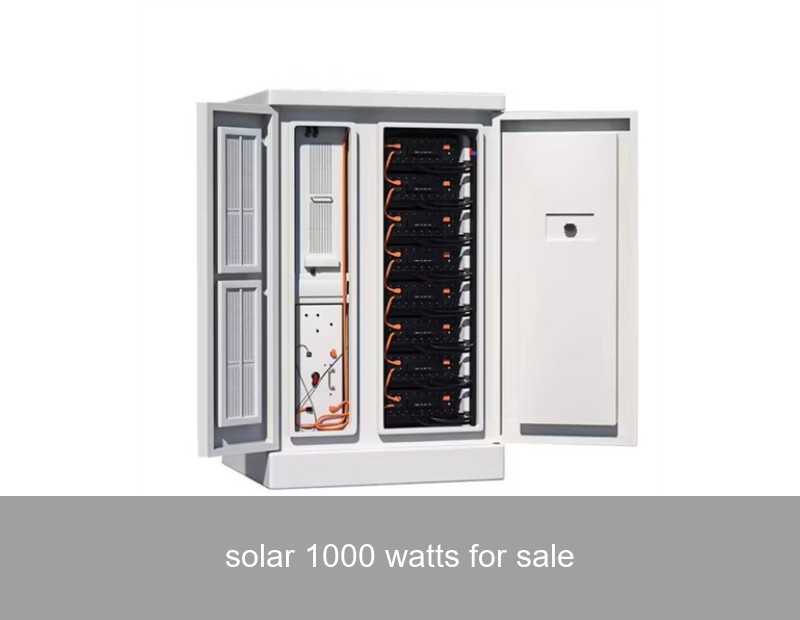
- The Battery Storage System (BESS): This is the heart of energy independence. It stores excess solar energy produced during the day for use at night or during outages. This is where companies like Highjoule truly excel, providing intelligent battery systems that manage energy flow efficiently.
- Mounting & Balance of System (BOS): Racks, cables, connectors, and safety equipment—the unsung heroes that keep everything secure and operational.

Image Source: Unsplash (Photographer: American Public Power Association)
A Real-World Case: The Berlin Bakery's Resilience Story
Let's move from theory to practice. Consider a small artisanal bakery in Berlin, Germany. Their challenge? Rising energy costs and the critical need for uninterrupted refrigeration. A power outage would mean spoiled inventory and lost revenue.
The Solution: They installed a 6kW solar array (larger than 1kW, but the principle scales) paired with a Highjoule H-Stack 10 commercial battery storage system. This modular lithium-ion phosphate (LiFePO4) battery system was chosen for its safety, longevity, and seamless integration with their existing solar inverters.
The Data-Driven Outcome: Within the first year:
- Grid Independence: The bakery achieved 75% self-consumption of its solar energy, up from just 30% without storage.
- Cost Savings: They reduced their grid electricity purchases by over 60%, a significant figure given Europe's volatile energy markets (IEA, 2023).
- Resilience: During two planned grid maintenance outages, the battery system kept the refrigerators, lighting, and point-of-sale systems running seamlessly, preventing an estimated €2,000 in potential losses.
This case illustrates that the real value isn't just in the panels for sale; it's in the intelligent storage that makes solar power reliable and economically powerful.
Choosing the Right "1000 Watts" for Your Lifestyle
Your ideal setup depends on your goal:
- The Off-Grid Adventurer: For an RV or cabin, a 1000W portable solar kit with a built-in charge controller and a separate high-capacity power station (a portable battery) might be perfect. Look for durability and ease of setup.
- The Home Energy Optimizer: For a house, a 1kW grid-tied system is a modest start. However, to maximize its value, pairing it with even a small battery like the Highjoule H-Cell 5 allows you to store excess daytime energy for evening use, dramatically increasing your self-consumption.
- The Business Contingency Planner: For a small office or critical load backup, reliability is key. A system with high-quality monocrystalline panels and a scalable battery backup system ensures essential operations continue during an outage.
The Highjoule Approach: Integrated Systems, Not Just Parts
At Highjoule, we understand that searching for "solar 1000 watts for sale" is the beginning of a journey toward energy security. Since 2005, we've evolved from a component provider to a global solutions architect for commercial, industrial, residential, and microgrid applications.
We don't just sell batteries; we provide intelligent energy platforms. Our H-Series battery storage systems, like the H-Stack for commercial use and the H-Cell for residential, are designed with a built-in Energy Management System (EMS). This smart software doesn't just store energy; it learns your consumption patterns, integrates with local weather forecasts, and decides the most economical time to charge or discharge—maximizing your return on investment and supporting grid stability.
When you choose Highjoule, you're getting a harmonized system where the inverter communicates flawlessly with the battery bank and the solar arrays, all managed through a user-friendly app. This level of integration is what transforms a simple solar purchase into a long-term, intelligent energy asset.

Image Source: Unsplash (Photographer: Andreas Gücklhorn)
Future-Proofing Your Investment
The solar technology you buy today should serve you for 25+ years. When evaluating options, consider these future-proofing factors:
- Scalability: Can you easily add more panels or battery capacity later? Highjoule's modular battery design allows you to start with what you need and expand as your needs grow.
- Software Updates: Does the system's intelligence improve over time? Our EMS receives regular updates that can unlock new features and optimize algorithms.
- Grid Services: In some markets, you can earn revenue by allowing your battery to provide services to the local grid (NREL, 2023). A smart system like Highjoule's can be configured to participate in these programs.
- Safety Standards: Always ensure equipment meets stringent regional safety standards (like UL 9540 in the US or IEC 62619 in Europe). Highjoule's LiFePO4 chemistry is inherently stable and meets these global benchmarks.
So, as you continue your search for the perfect solar solution, we leave you with this question: Are you looking for just a set of panels, or are you ready to invest in a complete, intelligent energy ecosystem that will power your independence and resilience for decades to come?
 Inquiry
 Online Chat