


Powering the Future: How Renewable Energy is Transforming the Power Grid
You've likely seen the headlines: "Solar and Wind Break Records," or "Coal Plants Closing." The energy landscape is shifting beneath our feet, driven by the urgent need for sustainability and energy independence. But here's the question on the minds of grid operators, businesses, and homeowners alike: How do we integrate these variable power sources like solar and wind into a stable and reliable power grid? The answer lies not just in generating clean energy, but in intelligently storing and managing it. The modern power grid, once a one-way street, is becoming a dynamic, two-way network powered by renewable energy and advanced energy storage systems (ESS).
Table of Contents
- The Challenge: Intermittency Meets Inertia
- The Data: Grid Stability in a Renewable World
- The Solution: Energy Storage as the Grid's Brain & Battery
- Case Study: California's Duck Curve and the Storage Solution
- Highjoule's Role: Building Intelligent Grid Resilience
- The Future Grid: Decentralized and Democratized
The Challenge: Intermittency Meets Inertia
Traditional power grids were built around predictable, "dispatchable" sources like coal, gas, and nuclear. These plants provide not just energy, but also crucial grid inertia—the kinetic energy in their spinning turbines that helps maintain grid frequency during sudden changes in supply or demand. Now, imagine replacing these giant spinning masses with solar panels that go to sleep at night and wind turbines that rely on the breeze. This intermittency creates a fundamental mismatch: renewable energy generation doesn't always align with when we need electricity most.
This isn't a theoretical problem. Grid operators now face the daily puzzle of balancing rapid ramps in demand with a generation mix that can be as changeable as the weather. Without a solution, we risk grid instability, voltage fluctuations, and even blackouts—paradoxically, at a time when we have more clean energy than ever before.
The Data: Grid Stability in a Renewable World
The numbers tell a compelling story. According to the International Energy Agency (IEA), renewables are set to contribute 80% of new power capacity globally through 2030. In the European Union, wind and solar recently overtook gas as the leading source of electricity. However, a study by the National Renewable Energy Laboratory (NREL) highlights that achieving high penetration of renewables (above 50-60%) requires significant investment in flexibility resources, with energy storage being a primary enabler.
| Renewable Share | Key Challenge | Required Solution |
|---|---|---|
| Below 30% | Minor balancing, curtailment | Traditional grid management |
| 30% - 60% | Rapid ramping, frequency volatility | Utility-scale storage, demand response |
| Above 60% | Seasonal storage, synthetic inertia | Advanced long-duration storage, AI-driven grid orchestration |
This data underscores a critical transition: the power grid's backbone is evolving from fuel-based generation to technology-based management.
The Solution: Energy Storage as the Grid's Brain & Battery
So, how do we solve the intermittency riddle? Enter the energy storage system (ESS). Think of it as the shock absorber and buffer for the modern power grid. It doesn't just store excess renewable energy; it provides the essential grid services that fossil fuel plants once dominated.
- Frequency Regulation: Responding in milliseconds to tiny fluctuations in grid frequency, maintaining the crucial 50Hz/60Hz standard.
- Peak Shaving: Discharging stored energy during periods of high demand (like hot summer evenings), preventing the need to fire up expensive and polluting "peaker" plants.
- Renewable Firming: Smoothing out the sudden drops or spikes in output from a solar farm when a cloud passes or the wind gusts.
- Voltage Support: Injecting or absorbing reactive power to keep voltage levels within safe limits, protecting equipment and ensuring power quality.
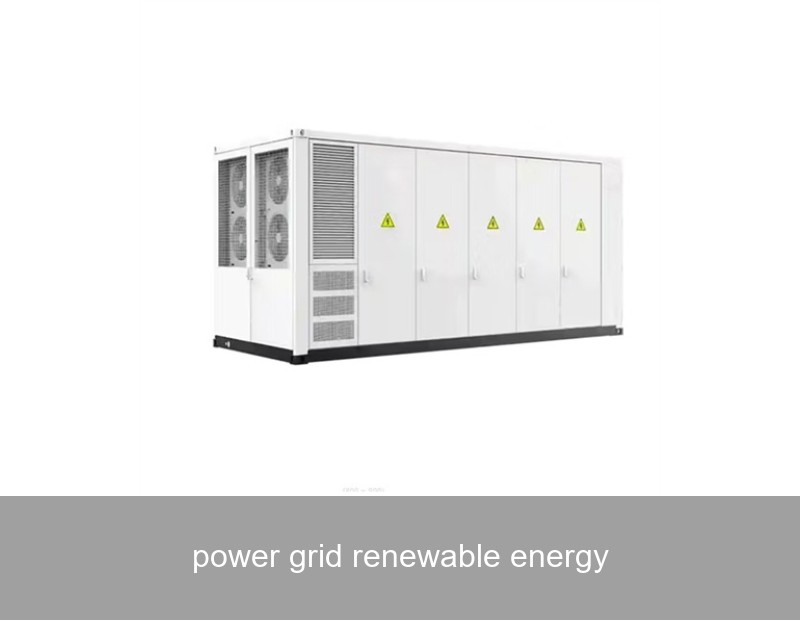
In essence, a modern ESS like those developed by Highjoule acts as both a high-performance battery and an intelligent grid asset. Our GridMax Utility-Scale ESS platform is engineered specifically for this dual role. It combines high-density, long-life lithium-iron-phosphate (LFP) battery modules with a sophisticated energy management system (EMS) that can be programmed to provide multiple value streams simultaneously—from frequency response to energy arbitrage.

Image Source: Unsplash (Representative image of a grid-scale battery storage installation)
Case Study: California's Duck Curve and the Storage Solution
No discussion of renewables and the grid is complete without mentioning California's famous "Duck Curve." This graph, charted by the California Independent System Operator (CAISO), shows the deepening mid-day dip in net load (thanks to abundant solar) and the steep evening ramp as the sun sets and demand rises. This creates a massive challenge for grid reliability.
California's response has been a massive, mandated build-out of energy storage. One notable success is the Moss Landing Energy Storage Facility in Monterey County. With a capacity of over 750 MW / 3,000 MWh (as of phases 1 & 2), it's one of the world's largest battery installations. During a heatwave in September 2022, batteries across the CAISO grid, including Moss Landing, discharged a record 2.4 GW of power to the grid, crucially stabilizing supply and preventing rolling blackouts. This real-world data proves that storage is no longer a pilot project; it's a critical, grid-scale reliability tool.
Highjoule's Role: Building Intelligent Grid Resilience
At Highjoule, we've been at the forefront of this transition since 2005. We understand that integrating renewable energy into the power grid requires more than just hardware; it requires intelligence and adaptability. Our solutions are designed to serve every node of the evolving energy network.
- For Utilities & Grid Operators: Our GridMax systems offer modular, scalable storage for frequency regulation, black start capability, and transmission deferral. They come with grid-forming inverter technology, which can actually help create a stable grid "island" if needed, mimicking the inertia of traditional generators.
- For Commercial & Industrial (C&I) Sites: Our PowerStack C&I series allows factories, data centers, and office buildings to manage demand charges, provide backup power, and participate in demand response programs. By integrating with on-site solar, it maximizes self-consumption and ROI.
- For Residential Communities & Microgrids: The HomeHub residential system and MicroGrid Controller enable neighborhoods or remote facilities to operate independently from the main grid, powered by their own solar and storage. This builds incredible resilience against extreme weather and outages.
Our proprietary Adaptive Energy Operating System (AEOS) is the brains behind all our products. It uses predictive algorithms and real-time data to make decisions that optimize for cost, carbon footprint, and reliability—automatically.

Image Source: Unsplash (Representative image of a residential energy storage installation)
The Future Grid: Decentralized and Democratized
The ultimate destination is a decentralized, democratized grid. Imagine millions of assets—home batteries, EV chargers, commercial storage systems—all connected and coordinated to support the main grid. This "virtual power plant" (VPP) concept turns consumers into "prosumers," who both consume and produce grid stability.
This future is being built today. In Germany and Australia, VPPs aggregating home batteries are already providing frequency services to national grids. In the US, states like Texas (ERCOT) are rapidly adopting storage to manage their unique grid dynamics. The power grid, fueled by renewable energy, is becoming more resilient, not less, through intelligent technology.
As we witness this historic transformation, the question shifts from "Can we do it?" to "How can we best prepare our homes, businesses, and communities to be active, beneficial participants in this new energy ecosystem?"
 Inquiry
 Online Chat