


Unlocking Grid Stability: The Essential Role of the 5 MW On-Grid Energy Storage Cabinet
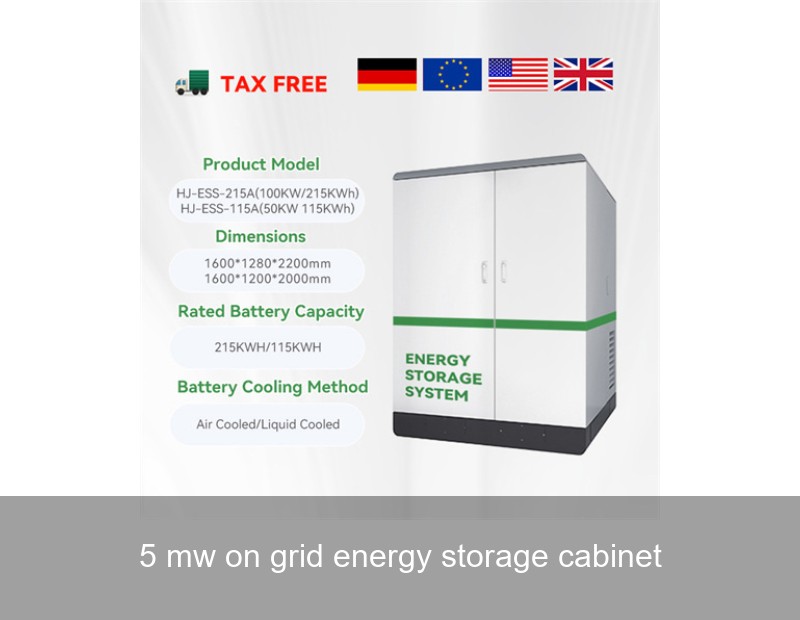
Imagine you're the manager of a large manufacturing plant or a solar farm. The sun is shining, your turbines are spinning, but the local electricity grid is experiencing a sudden dip in frequency—a common issue as we integrate more variable renewables. How do you respond in milliseconds to support the grid and avoid costly penalties? Or perhaps, you're looking to shave peak demand charges that make up a significant portion of your energy bill. The answer increasingly lies in a powerful, self-contained solution: the 5 MW on-grid energy storage cabinet. This isn't just a battery in a box; it's a sophisticated grid asset, a silent guardian of stability, and a potent financial tool, all rolled into one modular unit.
The Grid Stability Imperative: More Renewables, More Need for Storage
The energy landscape is undergoing a seismic shift. Across Europe and the United States, ambitious decarbonization goals are driving record installations of solar and wind power. According to the International Energy Agency (IEA), global renewable capacity additions jumped by almost 50% in 2023, with solar PV accounting for three-quarters of this growth. But here's the catch: the sun doesn't always shine, and the wind doesn't always blow. This inherent variability creates challenges for grid operators who must maintain a perfect balance between supply and demand, second by second.
This is where large-scale, on-grid energy storage steps in as the critical enabler. Think of the grid as a vast, constantly swaying seesaw. Generation is on one side, consumption on the other. Storage acts as the agile participant who can instantly jump to either side to balance it. A 5 MW on-grid energy storage cabinet is a pre-engineered, containerized solution designed to provide this balancing act at a substantial scale. "5 MW" represents its power rating—how much electricity it can inject or absorb at any given moment, equivalent to powering thousands of homes simultaneously. Its energy capacity (typically measured in MWh) determines how long it can sustain that power output.

Image Source: Unsplash - Solar farms are a key driver for grid-scale storage needs.
The Core Functions: More Than Just Backup Power
Unlike off-grid systems, an on-grid cabinet is synchronized with the public utility network. Its value is delivered through multiple, often simultaneous, applications:
- Frequency Regulation: Automatically charging or discharging to help maintain the grid's standard frequency (e.g., 50 Hz in Europe, 60 Hz in the US), a service often compensated by grid operators.
- Peak Shaving: Discharging stored energy during periods of high electricity prices or demand, dramatically reducing capacity charges for commercial and industrial users.
- Renewable Firming: Smoothing out the minute-to-minute fluctuations from a solar or wind farm, making their output more predictable and valuable.
- Voltage Support: Providing reactive power to stabilize voltage levels on local distribution lines.
Inside the Powerhouse: Key Components of a 5 MW Cabinet
So, what's inside this technological powerhouse? A modern 5 MW on-grid energy storage cabinet is a marvel of integration. It's far more than just batteries.
| Component | Function | Highjoule's Approach |
|---|---|---|
| Battery Racks | The core energy storage medium, typically using Lithium Iron Phosphate (LFP) chemistry for safety and long cycle life. | Highjoule uses automotive-grade, UL-certified LFP cells with proprietary cell balancing and monitoring for maximum longevity and safety. |
| Power Conversion System (PCS) | The "brain" of power flow. It converts DC battery power to AC grid power and controls the rate and direction of flow. | Our integrated, bi-directional PCS boasts >98.5% efficiency and ultra-fast response times (<100ms) for grid services. |
| Thermal Management | Critical for safety and performance. Maintains optimal battery temperature in all climates. | We employ a liquid cooling system that is 30% more efficient than standard air cooling, ensuring consistent performance from -30°C to 50°C. |
| Energy Management System (EMS) | The strategic commander. It decides when to charge or discharge based on market signals, grid needs, or owner preferences. | Highjoule's AI-driven EMS, GridSynergy AI, can stack multiple revenue streams, optimizing for both grid services and private economic use. |
| Safety & Enclosure | Includes fire suppression, gas venting, physical security, and a robust, weatherproof NEMA 3R-rated enclosure. | Our cabinets feature multi-layer protection: passive safety of LFP chemistry, active gas detection, and an aerosol-based fire suppression system as standard. |
Real-World Case Study: A German Industrial Park's Success Story
Let's move from theory to practice. In 2022, a major industrial park in North Rhine-Westphalia, Germany, faced a dual challenge: high grid fees that impacted competitiveness and a desire to increase the self-consumption of their onsite rooftop solar. Their solution was the installation of a 5 MW / 10 MWh on-grid energy storage cabinet from Highjoule.
The system was configured for primary frequency response (FCR) for the German grid, a service auctioned by the transmission system operator. Simultaneously, it was programmed to perform peak shaving for the park's own operations.
- Financial Results (First 12 Months):
- Revenue from FCR market: ~€280,000
- Savings from reduced peak demand charges: ~€120,000
- Increased solar self-consumption value: ~€40,000
- Total Annual Financial Benefit: ~€440,000
- Technical Performance: The system achieved a 99.8% availability rate, responding to hundreds of grid frequency events daily without fail. The liquid cooling system maintained optimal cell temperature variance below 3°C, even during a record-hot summer.
This case perfectly illustrates the power of revenue stacking. The cabinet wasn't just a cost center; it became a profitable grid citizen and a strategic asset for the industrial park.

Image Source: Unsplash - Professional maintenance ensures the longevity of critical energy assets.
The Highjoule Advantage: Engineering for Reliability and Intelligence
At Highjoule, with nearly two decades of experience since 2005, we understand that a 5 MW on-grid energy storage cabinet is a long-term investment. Our design philosophy centers on three pillars: Safety, Longevity, and Intelligence.
Our Sentinel Cabinet Series is the culmination of this philosophy. It's not just a collection of parts; it's a fully integrated, factory-tested system. We go beyond the standard by:
- Proactive Health Analytics: Our cloud-connected platform predicts cell degradation and potential issues months in advance, shifting maintenance from reactive to planned.
- Grid-Forming Inverter Readiness: Future-proofed to support advanced "grid-forming" capabilities, allowing it to help restart a grid after a blackout—a feature becoming crucial as inverter-based resources dominate.
- Modular Scalability: Need to start with 2.5 MW and expand later? Our modular design allows for cost-effective power scaling within the same footprint.
We provide a full turnkey service—from initial site feasibility and interconnection studies to installation, commissioning, and ongoing performance monitoring—ensuring our clients realize the full value of their storage asset.
Beyond Tech: Financial and Operational Considerations
Deploying a system of this scale is a significant decision. Key considerations include:
- Interconnection Process: Engaging early with your local Distribution Network Operator (DNO) or utility is critical. They will study the grid impact and approve the connection. Highjoule's engineering team supports this entire process.
- Revenue Models: Markets vary. In the US, look at FERC Order 841 opportunities and ISOs like CAISO or ERCOT. In Europe, focus on FCR, aFRR, and capacity markets. The right EMS is key to tapping these.
- Total Cost of Ownership (TCO): Look beyond the upfront capex. Consider cycle life, degradation rates, efficiency losses, and O&M costs. A cheaper system with a shorter lifespan often has a higher TCO.
The Future Outlook for Grid-Scale Storage
The trajectory is clear. As grids worldwide move towards net-zero, the role of large-scale storage will only grow. We're moving from single-application systems to multi-service, AI-optimized assets that act as virtual power plants. The 5 MW on-grid energy storage cabinet is the workhorse of this transition—a standardized, deployable unit that brings resilience, flexibility, and profitability to the grid's edge.
Is your business or community ready to explore how a strategic storage asset can transform your energy costs, contribute to grid stability, and future-proof your operations against an evolving energy landscape?
 Inquiry
 Online Chat