


Understanding One Solar Panel Capacity: Your Key to Smarter Energy Planning
Have you ever looked at a sleek, glassy solar panel on a rooftop and wondered, "How much power can that one panel actually produce?" It's a fundamental question, whether you're a homeowner considering a new installation or a facility manager planning a large-scale commercial array. The capacity of one solar panel is the essential building block of any solar energy system. It dictates the size, output, and ultimately, the return on your investment. But this figure isn't just a static number on a spec sheet. In this article, we'll demystify solar panel capacity, explore what influences its real-world performance, and show you how understanding this single unit is crucial for designing resilient, cost-effective energy systems that include cutting-edge storage solutions like those from Highjoule.
Table of Contents
- What Exactly is "One Solar Panel Capacity"?
- Beyond the Lab: Why STC Ratings Are Only Half the Story
- From Capacity to Kilowatt-Hours: Calculating Real Energy Output
- The Storage Imperative: Why Your Panel's Capacity Demands a Battery
- Case Study: Maximizing a Commercial Rooftop in Germany
- Future-Proofing Your System: Capacity, Degradation, and Smart Design
What Exactly is "One Solar Panel Capacity"?
In simple terms, the capacity of a solar panel refers to its maximum potential electricity output under ideal laboratory conditions. This is measured in watts (W), with most modern residential and commercial panels ranging from 400W to 550W. You'll often see this labeled as the "nameplate rating" or the "STC (Standard Test Conditions) power rating."
Think of it like the horsepower rating of a car engine. It tells you the peak potential, but your actual mileage will vary based on driving style, terrain, and weather. Similarly, a 450W panel won't constantly output 450 watts. Its real-world production is a dance between its inherent capacity and several external factors.
The Key Components Determining Capacity
- Cell Technology & Efficiency: Monocrystalline silicon cells, which are common in premium panels, offer higher efficiency (often 21%+) than polycrystalline, meaning they convert more sunlight per square meter into electricity.
- Number & Size of Cells: The standard 60-cell (120 half-cut) or 72-cell formats directly influence voltage, current, and the overall wattage.
- Manufacturing Quality: Advanced anti-reflective coatings, durable backsheets, and robust framing all contribute to maintaining high performance over decades.
Beyond the Lab: Why STC Ratings Are Only Half the Story
Here’s the critical insight every energy planner needs: the STC rating is a crucial benchmark, but it's not a promise of daily production. The actual energy yield of your one solar panel is governed by its operating environment.
| Factor | Impact on Panel Output | Typical Influence |
|---|---|---|
| Sunlight Intensity & Angle | Directly proportional to power generation. | Seasonal and daily variation can cause output to fluctuate by 60-80%. |
| Temperature | Panels lose efficiency as they heat up (temperature coefficient). | A hot sunny day can reduce peak output by 10-15% compared to STC. |
| Shading & Soiling | Even partial shading on one cell can drastically reduce a panel's output. | Dirt or bird droppings can easily cause 5%+ losses if not cleaned. |
This variability is the central challenge of solar power. Your 10kW array might be hitting its theoretical peak for only a few hours on a cool, brilliantly sunny day. For the rest of the time, it's producing less. This is where the conversation must evolve from just panels to a complete energy ecosystem.

Image Source: Unsplash - A high-capacity solar panel in detail.
The Storage Imperative: Why Your Panel's Capacity Demands a Battery
If solar generation is inherently intermittent, how do we create reliable, 24/7 clean power? The answer lies in pairing your solar array's capacity with an intelligent battery storage system. This combination transforms your system from a fair-weather generator into a resilient power asset.
Consider this: a panel's peak production at midday often exceeds immediate on-site consumption. Without storage, this surplus is exported to the grid, often at low rates. Conversely, in the evening when the sun sets and demand peaks, you're forced to buy expensive grid power. An advanced Battery Energy Storage System (BESS) breaks this cycle.
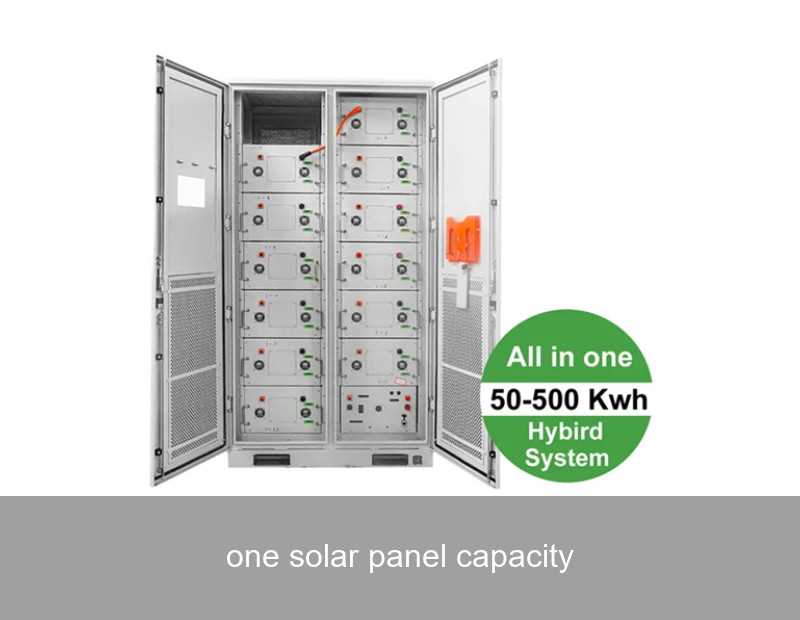
At Highjoule, we design our HPS Series Commercial & Industrial storage solutions and HRS Home Energy Systems specifically to align with the generation profile of solar arrays. Our systems don't just store energy; they intelligently manage it. Using AI-driven software, they learn your consumption patterns, forecast solar yield based on weather data, and decide the optimal times to charge, store, and dispatch energy. This maximizes self-consumption of your solar generation—sometimes from 30% to over 80%—protects against outages, and provides valuable grid services.
Case Study: Maximizing a Commercial Rooftop in Bavaria, Germany
Let's ground this discussion with a real-world example from one of our European deployments.
Phenomenon: A mid-sized automotive parts manufacturer near Munich had a 200 kW rooftop solar array. Their facility manager was frustrated. Despite the substantial capacity, their grid electricity bills remained high, and they were not achieving their sustainability targets because a large portion of their solar generation was going to waste during weekends and low-production periods.
Data & Analysis: A Highjoule energy audit revealed a critical mismatch. The array's peak output (~1500 kWh on a perfect summer day) vastly exceeded the plant's base load during non-production hours. Over 40% of their annual solar yield was being exported. Meanwhile, they were paying peak demand charges during morning startup.
Solution & Outcome: Highjoule engineered and installed a containerized HPS-500 battery system with 500 kWh of storage capacity and a 250 kW inverter. The system was seamlessly integrated with their existing solar inverters. The results, monitored over 12 months, were compelling:
- Self-Consumption of Solar: Increased from 58% to 92%.
- Peak Demand Charges: Reduced by an average of 28% by using stored solar energy to "shave" the morning and evening grid draw.
- Energy Cost Savings: Achieved a net reduction of €31,000 in the first year, factoring in the avoided grid purchases and reduced demand charges.
This case illustrates that the true value of one solar panel's capacity is unlocked not in isolation, but when its output is captured, time-shifted, and strategically deployed by a sophisticated storage system.
Future-Proofing Your System: Capacity, Degradation, and Smart Design
When planning a system, it's also vital to think long-term. Solar panels naturally degrade, losing about 0.5% to 1% of their capacity per year. A panel with a 25-year warranty is typically guaranteed to produce at least 85-90% of its original capacity by the end of that period. This gradual decline must be factored into the sizing of both your solar array and your complementary storage.
This is where Highjoule's approach to system design excels. We don't just sell hardware; we provide end-to-end smart energy solutions. Our design process models not only your initial solar production but projects it over 20+ years, accounting for degradation. We then size our modular battery systems to ensure they continue to deliver optimal financial and resilience benefits throughout the entire lifecycle of your solar investment. Furthermore, our systems are software-upgradable, allowing you to adapt to new tariffs, add more storage, or integrate with emerging technologies like vehicle-to-grid (V2G).

Image Source: Unsplash - A containerized battery energy storage system.
Your Next Step in Energy Independence
So, the next time you see that spec for one solar panel capacity, remember it's the starting point of a much more important conversation. It's the seed from which a truly intelligent and independent energy system grows. The key question is no longer just "How many panels do I need?" but rather "How will I capture, manage, and utilize every kilowatt-hour my panels produce, day and night, for decades to come?"
What is the single biggest challenge you face in making your current or planned solar generation more reliable and valuable for your home or business?
 Inquiry
 Online Chat