


From Megawatts to Gigawatts: Understanding the World's Largest Battery Storage Projects
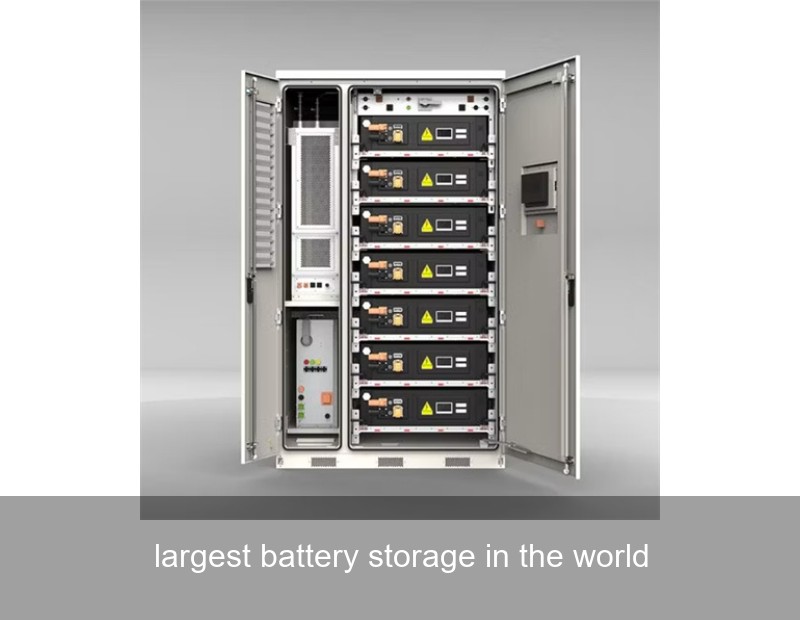
Have you ever wondered what happens when the sun isn't shining and the wind isn't blowing? As our global energy grid pivots towards renewable sources, this question becomes critical. The answer increasingly lies in massive, grid-scale batteries. These aren't the ones in your remote control; we're talking about engineering marvels—the largest battery storage in the world facilities—that are redefining reliability and sustainability. Let's explore how these gigantic projects work, why they matter for our energy future, and what this technological leap means for businesses and communities.
Table of Contents
- The Race to Gigawatt Scale
- More Than Just Size: The Core Functions
- Anatomy of a Giant: Key Components
- Case Study: Keeping the Lights on in California
- The Global Landscape: US and Europe Leading the Charge
- Highjoule's Role in Scalable, Intelligent Storage
- Future Trends: What's Beyond the Current Giants?
The Race to Gigawatt Scale
The scale of battery energy storage systems (BESS) has exploded in recent years. We've moved from projects measured in kilowatts (kW) to megawatts (MW), and now, decisively, into the realm of gigawatts (GW). A single GW is enough to power roughly 750,000 homes simultaneously. This isn't just an incremental change; it's a paradigm shift enabled by plummeting lithium-ion battery costs, which have fallen by over 90% in the last decade, and significant advancements in power conversion and system integration.
These largest battery storage in the world projects act as the "shock absorbers" for the modern grid. They store excess renewable energy when production is high and demand is low, then discharge it during peak hours or when renewable generation dips. This simple concept of "time-shifting" energy is complex in execution at this scale, requiring unprecedented engineering precision and intelligent software control.
More Than Just Size: The Core Functions
While capacity (measured in MWh or GWh) grabs headlines, the true value of these giants lies in their multi-faceted services:
- Grid Frequency Regulation: They respond in milliseconds to tiny fluctuations in grid frequency, a service far faster than traditional fossil-fuel plants.
- Renewable Integration: They smooth out the intermittent "duck curve" of solar power, ensuring a steady, dispatchable power supply after sunset.
- Deferring Grid Upgrades: By providing local power during peak times, they can delay or avoid the need for expensive new transmission lines or power plants.
- Enhancing Resilience: In regions prone to extreme weather or wildfires, they provide critical backup power to keep essential services running.
Anatomy of a Giant: Key Components
Building the largest battery storage in the world is more than just connecting millions of cells. It's a sophisticated ecosystem:
| Component | Function | Scale Consideration |
|---|---|---|
| Battery Cells & Modules | The fundamental energy storage unit, typically lithium-ion. | Millions of cells require impeccable quality control and thermal management. |
| Power Conversion System (PCS) | Converts DC battery power to AC grid power and vice versa. | Must handle hundreds of MW with extreme efficiency and reliability. |
| Energy Management System (EMS) | The "brain" that controls charging/discharging based on market signals and grid needs. | Optimizes for multiple revenue streams and ensures safe operation. |
| Thermal Management | Keeps batteries within optimal temperature range. | Critical for safety, performance, and longevity at multi-MW scale. |
Case Study: Keeping the Lights on in California - The Moss Landing Legacy
No discussion of the largest battery storage in the world is complete without the Moss Landing Energy Storage Facility in California, USA. A landmark project, it exemplifies the direct response to grid challenges. Following public safety power shutoffs to prevent wildfires, California aggressively pursued storage to bolster grid resilience.
Moss Landing's Phase III, operated by Vistra Corp, boasts a staggering 750 MW / 3,000 MWh capacity. To put that in perspective, its full discharge could power approximately 225,000 Californian homes for four hours during an evening peak. In its first year of significant operation, the facility played a pivotal role in mitigating energy shortages during a major heatwave, injecting vital power into the grid when demand shattered records. This real-world performance validated the role of gigawatt-scale storage as a reliable grid asset, not just an experiment. You can read more about its impact in this California Energy Commission report.

Image: The Moss Landing site, repurposing existing power plant infrastructure for a new energy era. (Source: Wikimedia Commons, CC BY-SA)
The Global Landscape: US and Europe Leading the Charge
The United States, driven by federal policy support and state-level mandates, is the current leader in deploying grid-scale storage. Europe is rapidly catching up, with the UK, Germany, and Italy hosting significant projects. The European Union's ambitious REPowerEU plan explicitly identifies energy storage as a key pillar for energy security and independence. For instance, the UK's National Grid ESO frequently utilizes large-scale batteries for dynamic frequency response services.
The technology is also evolving. While lithium-ion dominates, technologies like flow batteries (for longer-duration storage) and compressed air energy storage (CAES) are being deployed for specific use cases. The future grid will likely feature a mix of storage durations and technologies.
Highjoule's Role in Scalable, Intelligent Storage
At Highjoule, we view these monumental projects as both inspiration and validation for the distributed storage revolution. Since 2005, we've been engineering advanced battery storage systems that bring the same principles of intelligence, reliability, and sustainability to commercial, industrial, and microgrid applications. While we may not build a single 3 GWh monolith, our expertise lies in creating scalable, modular systems that aggregate to form a virtual, resilient network.
Our HI-CORE Industrial BESS is a prime example. It incorporates the same core technology DNA found in the world's largest sites—high-efficiency, bi-directional PCS, advanced liquid-cooling thermal management for safety and longevity, and a proprietary AI-driven EMS. This system allows a factory, data center, or renewable energy park to operate like its own mini-grid: maximizing solar self-consumption, providing backup power, and even participating in grid service programs where available. For larger community or utility-scale needs, our solutions are designed to scale seamlessly from containerized units to multi-MW storage farms.

Image: Precision engineering and monitoring are key for reliable large-scale storage. (Source: Unsplash)
Future Trends: What's Beyond the Current Giants?
The record for the largest battery storage in the world will undoubtedly be broken again. The frontier is now "long-duration energy storage" (LDES) – systems that can discharge for 10, 24, or even 100 hours. This is crucial for managing seasonal variations and multi-day weather events. Furthermore, the integration of green hydrogen production with storage systems presents a fascinating pathway for storing truly massive amounts of renewable energy.
The conversation is also shifting from pure capacity to holistic value. How can these assets most effectively reduce carbon emissions, lower consumer costs, and strengthen community resilience? The answer lies in smarter software and market structures that allow storage to provide multiple stacked services simultaneously.
Your Energy Future
The journey of the largest battery storage in the world is more than a technical competition; it's a roadmap for our sustainable energy future. It proves that with the right technology, we can harness the power of nature reliably and efficiently. Whether at the gigawatt scale for the national grid or the megawatt scale for your business, the principles are the same.
Is your organization ready to explore how intelligent, scalable storage can reduce your energy costs, secure your power supply, and contribute to a more stable grid? What role could your facility play in the new energy landscape?
 Inquiry
 Online Chat