


GPECO Solutions: How Much Do Advanced Energy Storage Systems Really Cost?
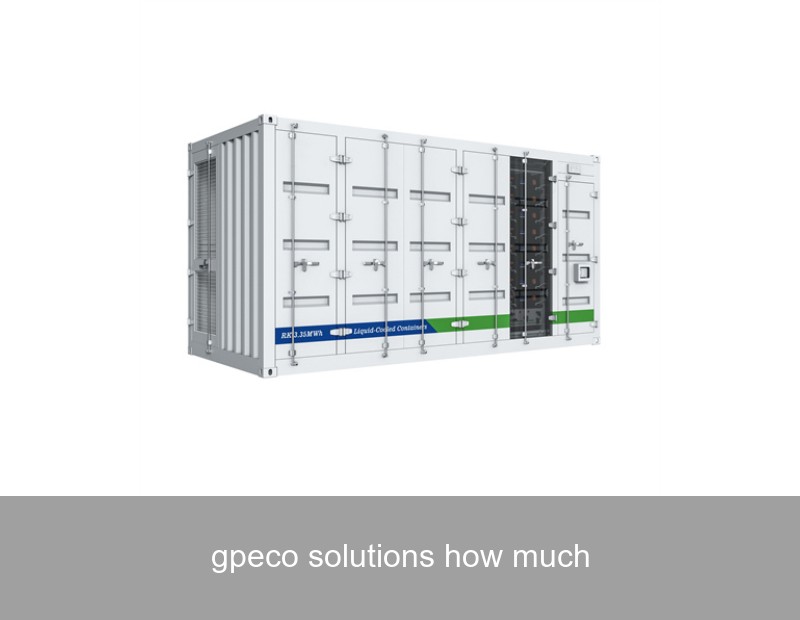
If you're a business owner, facility manager, or homeowner looking to take control of your energy bills and sustainability goals, you've likely come across terms like "GPECO solutions" or "energy storage." And the immediate, pressing question is almost always: "How much?" It's a great question, but the answer isn't a single number. The cost of a sophisticated energy storage system is an investment equation, balancing upfront price with long-term savings, resilience, and environmental impact. Let's demystify the pricing of advanced energy storage and explore what truly defines its value.
Table of Contents
- The Phenomenon: Energy Volatility is the New Normal
- Breaking Down the "How Much": Key Cost Components
- The Data: How the Investment Pays Back
- A Real-World Case: Manufacturing in Germany
- The Highjoule Approach: Smart, Integrated Solutions
- Making Your Decision: Key Questions to Ask

Modern industrial energy solutions combine generation and storage for maximum ROI.
The Phenomenon: Energy Volatility is the New Normal
Across Europe and the U.S., organizations are facing a perfect storm in energy markets. Wholesale electricity prices are increasingly unpredictable, driven by geopolitical factors, grid constraints, and the rapid integration of intermittent renewables. For commercial and industrial (C&I) entities, this translates directly to volatile utility bills and operational risk. Simultaneously, the push for decarbonization is stronger than ever, with corporate sustainability targets and regulatory frameworks adding both pressure and opportunity. In this landscape, simply asking "how much does a battery cost?" is like asking "how much does a business insurance policy cost?"—the critical question is about the value it protects and creates.
Breaking Down the "How Much": Key Cost Components
A complete, grid-connected energy storage solution involves more than just battery cells. Understanding the components helps clarify the investment:
- Battery Modules & Racks: The core energy storage media (e.g., Lithium Iron Phosphate - LFP). Costs are often measured in $/kWh of storage capacity.
- Power Conversion System (PCS): The inverter/charger that manages AC/DC conversion. This is sized by power (kW) and determines how quickly you can charge or discharge.
- Battery Management System (BMS) & Energy Management Software (EMS): The intelligence of the system. A sophisticated EMS, like Highjoule's Helios Energy Platform, is crucial for optimizing financial returns by automating decisions based on tariffs, weather, and load patterns.
- Thermal Management & Enclosure: Safety and longevity systems, which can be air or liquid-cooled.
- Engineering, Procurement, & Construction (EPC): Site-specific design, permitting, electrical work, and integration.
- Ongoing Software & Service: Many providers offer performance monitoring and maintenance packages.
| Factor | Impact on System Cost | Impact on Long-Term Value |
|---|---|---|
| System Size (kWh / kW) | Larger systems have lower $/kWh but higher total cost. | Greater savings potential through scaled arbitrage and demand charge management. |
| Technology & Chemistry | LFP batteries may have a higher upfront cost than some alternatives. | Superior cycle life, safety, and longevity, leading to lower lifetime cost. |
| Integration Complexity | Coupling with existing solar, generators, or microgrids adds cost. | Unlocks synergistic benefits, resilience, and maximizes self-consumption. |
| Local Incentives & Grants | Can reduce net capital expenditure by 20-50% in many regions. | Dramatically improves ROI and payback period. |
The Data: How the Investment Pays Back
So, how do you move from cost to ROI? Advanced storage systems generate tangible financial streams. In the U.S., for instance, the Inflation Reduction Act (IRA) offers direct investment tax credits (ITC) for standalone storage, fundamentally improving economics. In Europe, programs like Germany's KfW development bank offer favorable loans. The recurring revenue or savings typically come from:
- Demand Charge Reduction: For many C&I customers, 30-50% of their electricity bill can be "demand charges" based on peak power draw. A battery can shave these peaks, delivering immediate, recurring savings.
- Energy Arbitrage: Buying grid electricity when it's cheap (often at night), storing it, and using it when prices are high.
- Grid Services & Incentives: In some markets, systems can earn revenue by providing frequency regulation or capacity services to the grid.
- Resilience Value: While harder to quantify, avoiding downtime during outages can be worth millions for critical operations.
A Real-World Case: Manufacturing in Germany
Let's look at concrete data. A mid-sized automotive parts manufacturer in Bavaria, Germany, was facing annual electricity costs exceeding €450,000, with steep demand charges and a commitment to reach 80% renewable consumption. They partnered with Highjoule to implement a turnkey solution: a 500 kWh / 250 kW LFP battery storage system integrated with their existing rooftop solar PV.
- Demand Charge Reduction: 22% decrease in peak grid draw, saving approximately €38,000 annually.
- Increased Solar Self-Consumption: Rose from 35% to over 70%, diverting excess solar energy to the battery instead of exporting it at low rates.
- Payback Period: With the combination of energy savings and a German federal grant (BAFA), the calculated simple payback period was under 6 years. The system's expected lifespan is 15+ years.
"The question wasn't just the initial price tag," the plant manager noted. "It was about finding a partner who could guarantee the system's performance and intelligence. The Helios Energy Platform autonomously optimizes for the complex German electricity market, something a simpler battery couldn't do."

Intelligent energy management software is key to unlocking maximum value from storage assets.
The Highjoule Approach: Smart, Integrated Solutions
Since 2005, Highjoule has evolved from a battery innovator to a global provider of intelligent, integrated energy ecosystems. We understand that "how much" is intrinsically linked to "how smart." Our Atlas Series commercial & industrial battery storage systems are built with UL1973-certified LFP cells, designed for safety and a 10,000+ cycle life. But the true differentiator is our Helios Energy Platform, a cloud-based EMS that uses AI and real-time market data to make your storage asset work as hard as possible financially.
For residential and small business clients, our Nexus Home Battery offers a scalable, aesthetically designed solution that seamlessly pairs with solar, providing backup power and bill savings. Across all segments, we offer comprehensive services from initial energy analysis and feasibility studies to long-term performance guarantees and maintenance, ensuring your investment is protected and optimized for the long haul.
Making Your Decision: Key Questions to Ask
Instead of focusing solely on sticker price, we encourage you to frame your inquiry around total value. Here are critical questions for any provider:
- Can you provide a detailed, site-specific financial model showing payback period and lifetime ROI?
- How does your energy management software adapt to changing utility rates and market conditions?
- What is the total cost of ownership over 10-15 years, including expected degradation and service?
- Can you integrate with my existing or planned solar PV, generator, or building management system?
- What performance guarantees and long-term service agreements do you offer?
For authoritative, independent information on storage technologies and benefits, resources like the National Renewable Energy Laboratory (NREL) or the International Renewable Energy Agency (IRENA) are excellent references.

Residential storage solutions are becoming a standard for energy independence.
So, what's the next step for your organization? Could a detailed analysis of your last 12 months of utility bills reveal a surprising opportunity for savings and sustainability that changes how you view the "cost" of energy storage?
 Inquiry
 Online Chat