


Greenbank BESS: How Much Does a Battery Energy Storage System Really Cost?
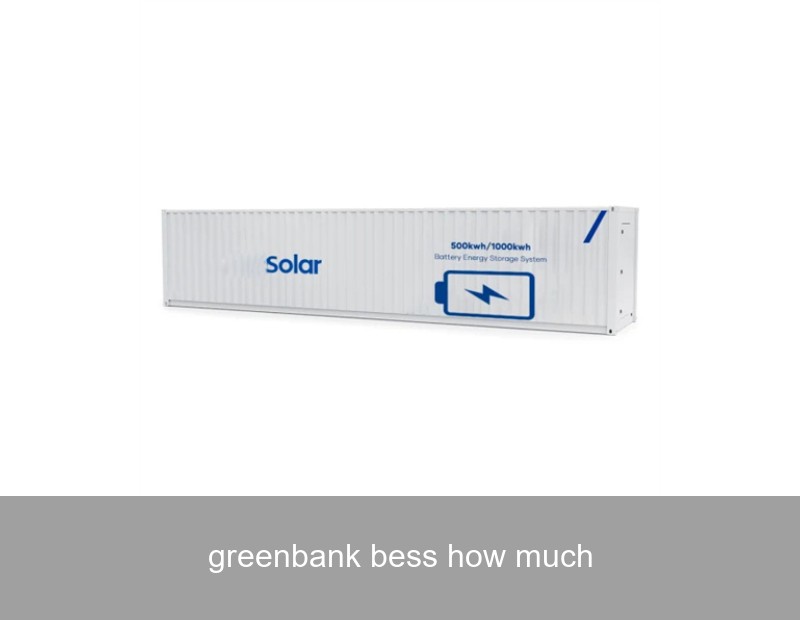
You've heard the buzz. Maybe your neighbor installed a solar-plus-battery system, or your local council announced a new "Greenbank" initiative to boost renewable energy. Suddenly, everyone is talking about Battery Energy Storage Systems (BESS). But when you start considering one for your business, community, or home, the first question that hits you is a practical one: "Greenbank BESS, how much?" The answer, like the technology itself, is dynamic. It's not just about the price tag of the hardware; it's about understanding the value of energy resilience, savings, and sustainability. Let's demystify the real cost of a BESS and what you're truly investing in.
Table of Contents
The Price Puzzle: More Than Just a Number
Asking "how much" for a BESS is like asking "how much for a house?" It depends on size, location, features, and desired outcomes. A system for a large industrial facility is vastly different from one for a residential home. However, the core components that influence cost are universal: battery capacity (kWh), which is your energy "tank," and power rating (kW), which is how fast you can fill or empty that tank. Industry benchmarks show a wide range. According to the U.S. Department of Energy's 2023 assessment, the installed cost for a 4-hour duration grid-scale BESS can range significantly based on project scale and configuration.

Image: A modern battery storage installation requires careful planning and integration. Source: Unsplash
The "Soft Costs" That Surprise Many
Beyond the battery racks and inverters, the total installed cost includes what we call "soft costs": engineering design, permitting, grid connection fees, installation labor, and ongoing maintenance. For a commercial project, these can account for 20-40% of the total. This is where choosing an experienced partner like Highjoule becomes critical. Our integrated approach from design to commissioning manages these variables efficiently, preventing budget overruns and ensuring a system that delivers on its financial promise.
Key Cost Factors: Breaking Down the BESS Investment
To get a clearer picture, let's examine the primary levers that determine your final investment.
| Cost Component | Description | Influence on "How Much?" |
|---|---|---|
| Battery Technology & Chemistry | Lithium-ion phosphate (LFP) is now the dominant, safer choice for stationary storage versus older NMC blends. | LFP offers longer lifespan and lower fire risk, impacting long-term value, though upfront cell costs can be comparable. |
| System Size & Scalability | The total energy (kWh) and power (kW) you need, and the ability to add more later. | Larger systems have a lower cost per kWh due to economies of scale. Modular design, like Highjoule's, allows cost-effective future expansion. |
| Grid Interconnection & Complexity | The cost and process to connect your system to the local utility grid. | Can be a major variable. Upgraded transformers or switchgear add cost. Experienced providers navigate this best. |
| Intelligence & Software | The brain of the system that decides when to charge, discharge, or hold. | Advanced Energy Management Systems (EMS) like Highjoule's OptiCharge AI maximize revenue and savings, offering a faster ROI. |
The Value Return: Calculating Savings and Security
Focusing solely on upfront cost misses the point. A BESS is a revenue-generating asset or a cost-avoidance tool. Here’s how it pays back:
- Energy Arbitrage: Buy and store electricity when it's cheap (e.g., midday solar surplus), use it or sell it back when prices are high (evening peak).
- Demand Charge Reduction: For commercial users, utilities charge based on your highest 15-minute power draw each month. A BESS can "peak shave," dramatically cutting this fee.
- Backup Power & Resilience: What's the cost of a 4-hour production halt for your factory? Or a spoiled inventory for a supermarket? For many, this is the primary value driver.
- Grid Services & Incentives: In many European and U.S. markets, you can earn money by providing frequency regulation or capacity services to the grid. Government incentives, like the ITC in the U.S., can offset 30-70% of the project cost.
The real question evolves from "Greenbank BESS, how much?" to "What is my return on investment (ROI) and payback period?" For well-designed systems, payback periods of 5-8 years are common, with the system then providing essentially free savings for the remainder of its 15+ year lifespan.
A Real-World Case: The Greenbank Community Microgrid
Let's ground this in reality. Consider a project in a region like California or Southern Spain, with high solar penetration and volatile energy prices. A mid-sized winery (a 500 kW load) faces crippling demand charges and wants to ensure uninterrupted refrigeration. They install a 750 kWh / 375 kW Highjoule Industrial BESS paired with an existing solar array.
- Problem: Monthly demand charges often exceeded $15,000. Grid outages threatened wine production batches.
- Solution: Highjoule's system was configured for peak shaving and backup power. Our EMS automatically dispatches the battery during the utility's peak windows.
- Result: Demand charges were reduced by over 60%, saving ~$9,000 per month. In the first year, the system also generated $18,000 in revenue from a local grid services program. With available incentives, the projected ROI was under 4 years. The winery now markets its "100% renewable-powered" vintages, adding brand value.

Image: Renewable energy integration in the agricultural sector is a growing application. Source: Unsplash
The Highjoule Solution: Smart, Scalable, and Sustainable
At Highjoule, we believe the right answer to "how much" is one that delivers maximum long-term value, not the lowest sticker price. Since 2005, we've engineered our systems with this philosophy.
Our Product Ecosystem
We offer a scalable range of intelligent storage solutions:
- Highjoule H-Cube Commercial & Industrial Series: All-in-one, containerized solutions from 100 kWh to multi-MWh. They feature our proprietary LFP battery packs and built-in OptiCharge AI for automated, profit-optimizing operation.
- Highjoule Home Energy Vault: A sleek, safe residential system designed for seamless integration with rooftop solar, providing energy independence and backup.
- Highjoule Microgrid Controller: The central intelligence for projects combining solar, wind, storage, and generators, ensuring stability and optimal economics.
Beyond the Hardware: The Highjoule Service Advantage
Our "how much" quote includes the peace of mind from our global service network. We provide comprehensive Performance Guarantees, remote monitoring, and predictive maintenance to ensure your system performs at its peak for decades. We handle the complex grid interconnection process and help you identify and secure every available incentive, effectively reducing your net cost.
Your Next Step: From Cost Question to Clarity
So, "Greenbank BESS, how much?" The definitive answer starts with a conversation about your specific needs. What are your energy bills really like? What are your resilience fears? What sustainability goals does your organization have?
We invite you to use Highjoule's ROI Estimator Tool on our website for a preliminary snapshot. But more importantly, what single question about energy storage has been holding you back from exploring this further for your own property or business?
 Inquiry
 Online Chat