


German Wind Turbine Companies: Powering the Energy Transition with Innovation and Integration
If you're following the energy landscape in Europe and beyond, you've likely noticed a powerful force driving the shift towards renewables: German wind turbine companies. From the North Sea's gusty shores to inland rolling hills, these engineering leaders are not just building taller turbines; they are architecting the future of a stable, decarbonized grid. But as their contribution grows, a critical question emerges: how do we ensure this vast, intermittent power is available precisely when needed? The answer lies not just in generation, but in intelligent integration through advanced energy storage.
Table of Contents
- The Phenomenon: Germany's Wind Power Leadership
- The Data: Scale, Ambition, and the Intermittency Challenge
- The Case Study: A Community's Journey from Curtailment to Control
- The Insight: Storage as the Critical Enabler
- Highjoule's Role: Intelligent Storage for a Resilient Grid
- The Future: What's Next for Wind and Storage Synergy?
The Phenomenon: Germany's Wind Power Leadership
Germany's Energiewende (energy transition) is a global benchmark, and its wind industry is the workhorse. Companies like Enercon, with its gearless turbine design, Nordex Acciona, and Siemens Gamesa (with strong German roots and manufacturing) have become household names in renewable energy circles. Their innovation isn't limited to size—though turbines are impressively large—but extends to efficiency, grid compatibility, and digital management systems. These firms have turned wind power into a cornerstone of Germany's electricity mix, fundamentally altering how the grid operates.

This success, however, brings a new set of technical realities. On a blustery day in northern Germany, wind farms can generate more electricity than the local grid can immediately absorb. Conversely, during calm periods, that massive generating capacity drops. This variability is the central challenge for grid operators and, indeed, for the German wind turbine companies themselves, as the value and reliability of their power are paramount.
The Data: Scale, Ambition, and the Intermittency Challenge
Let's look at the numbers to understand the scale. In 2023, wind power was Germany's largest electricity source, contributing over 30% to the public net power generation. The country boasts over 28,000 onshore and 1,500 offshore wind turbines. The ambition continues to soar, with government targets aiming for 115 GW of onshore and 30 GW of offshore wind capacity by 2030. This growth is essential for climate goals but intensifies the grid's balancing act.
The financial and operational impact of intermittency is significant. "Curtailment"—the forced shutdown of turbines to prevent grid overload—is a growing issue. In 2022, an estimated Energy-Charts by Fraunhofer ISE). This represents not just lost clean energy but also lost revenue for wind farm operators and a economic inefficiency. The solution requires moving beyond the grid as a one-way street and transforming it into an interactive, buffered network.
The Case Study: A Community's Journey from Curtailment to Control
Consider the real-world example of a mid-sized commercial park in Lower Saxony, co-located with several modern turbines from a leading German wind turbine company. The park's operations and a nearby small water treatment plant were primarily powered by wind. Yet, the facility manager faced two problems:
- Price Volatility: During low-wind periods, they had to buy expensive power from the grid.
- Curtailment Wastage: During high-wind periods, they could not consume all the locally generated power, seeing it "spilled."
Their goal was to increase self-consumption of wind power from ~40% to over 80% and shield themselves from peak grid prices. The project integrated a Highjoule H4 Commercial Battery Storage System directly with the wind inverters and the park's energy management system. The results, monitored over one year, were compelling:
| Metric | Before Installation | After Installation |
|---|---|---|
| Wind Self-Consumption | 42% | 84% |
| Grid Energy Purchased During Peak Hours | 35% of total load | 12% of total load |
| Annual Energy Cost Savings | Baseline | €68,000 |
| Curtailment Events Utilized | 0% | 100% (stored for later use) |
This case illustrates the transformative potential of pairing generation with storage. The battery system acted as a shock absorber, capturing excess wind energy that would have been lost and delivering it during calm periods or peak price times.
The Insight: Storage as the Critical Enabler
The narrative is shifting. The value of a wind turbine is no longer measured solely by its nameplate capacity (e.g., 5 MW) but by its dispatchable capacity—how reliably its power can be delivered on demand. This is where Battery Energy Storage Systems (BESS) become the indispensable partner for German wind turbine companies and project developers.
Advanced storage does more than just "save" power. It provides critical grid services that allow for higher penetration of renewables:
- Frequency Regulation: Instantaneously injecting or absorbing power to keep the grid's frequency stable—a service increasingly required by TSOs like TenneT or 50Hertz.
- Capacity Firming: Smoothing the output of a wind farm, making it behave more like a predictable conventional power plant for grid operators.
- Voltage Support: Maintaining proper voltage levels on local distribution networks, which can be stressed by variable renewable generation.

By integrating storage, wind projects can enhance their economic model through multiple revenue streams (energy arbitrage, grid services) while becoming a more reliable and welcome neighbor on the grid. This synergy is crucial for meeting the ambitious expansion targets without compromising grid stability.
Highjoule's Role: Intelligent Storage for a Resilient Grid
At Highjoule, we've been at the forefront of this integration since 2005. We understand that a storage system for a wind application isn't an off-the-shelf product; it's a tailored solution. Our expertise lies in designing systems that speak the same language as the sophisticated controllers from German wind turbine companies.
For wind farm operators and industrial consumers leveraging wind power, Highjoule offers:
- The H4 Utility-Scale BESS: A containerized, plug-and-play solution for large wind farms, featuring advanced lifecycle management and grid-forming inverter technology for maximum grid support.
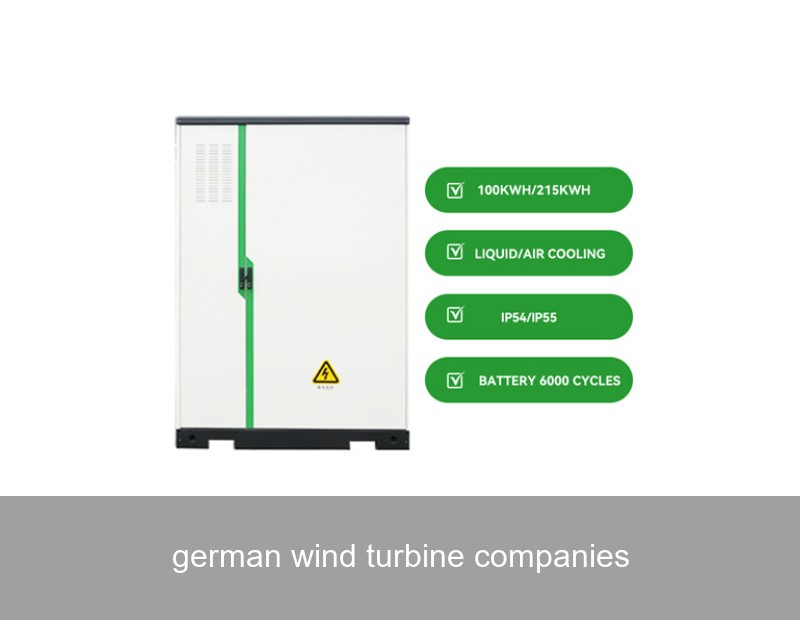
- The H4 Commercial System: Ideal for behind-the-meter applications at commercial or industrial sites with co-located wind generation, optimizing self-consumption and providing backup power.
- AI-Powered Energy Management Software (JouleOS): The true brain of the operation. JouleOS doesn't just react; it forecasts wind production (using weather data) and energy prices to optimize charge/discharge cycles, maximizing financial return and system longevity.
Our systems are designed with the European and North American markets in mind, complying with stringent safety (UL, IEC) and grid connection standards. We partner with project developers to ensure the storage solution is a seamless, value-adding component of the overall wind energy asset.
The Future: What's Next for Wind and Storage Synergy?
The path forward is one of deeper convergence. We are already seeing trends like "storage-ready" wind farm designs and hybrid project bidding in auctions. The next frontier may involve integrated DC coupling between turbines and storage, reducing conversion losses. Furthermore, as IRENA highlights, innovation in green hydrogen could see excess wind power driving electrolyzers, with storage managing the interim steps.
The leadership of German wind turbine companies in technological advancement is unquestioned. Their continued success, however, will be powerfully amplified by their strategic embrace of energy storage as a core component of their offerings and project designs. This partnership is what will truly unlock a resilient, affordable, and 100% renewable energy system.

As you consider the future of your energy assets—whether you're a wind developer, an industrial energy consumer, or a community planner—ask yourself: Is our renewable strategy complete without a plan to capture and control every kilowatt-hour generated? How can we design our systems today to be not just generators, but pillars of grid stability tomorrow?
 Inquiry
 Online Chat