


The Energy Storage Developer: Powering a Sustainable Future with Smart Solutions
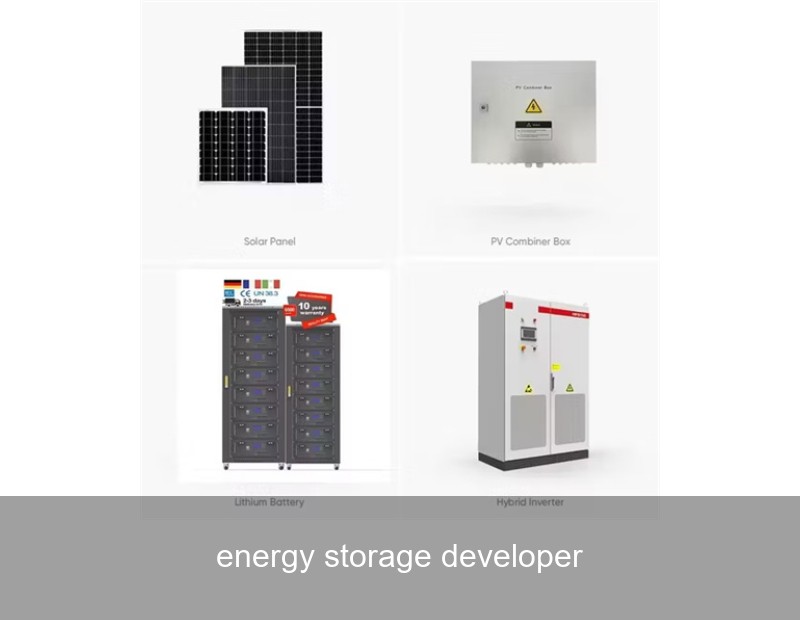
Have you ever wondered what happens when the sun goes down on a solar farm, or the wind stops turning the turbines? The answer lies in the hands of a critical new player in the clean energy transition: the energy storage developer. These are the architects and builders of our modern grid resilience, integrating large-scale battery systems to capture, hold, and dispatch renewable energy precisely when and where it's needed. For businesses, communities, and entire nations aiming for energy independence and sustainability, partnering with a skilled energy storage developer is no longer optional; it's a strategic imperative.
Table of Contents
- The Phenomenon: Intermittency Meets Rising Demand
- The Data: Why Storage is the Linchpin
- Case Study: A European Industrial Park's Transformation
- What Does a Modern Energy Storage Developer Actually Do?
- The Highjoule Approach: Intelligence from the Ground Up
The Phenomenon: Intermittency Meets Rising Demand
Let's face it: renewable energy sources are fantastic, but they're not always predictable. This intermittency creates a fundamental challenge for grid operators. At the same time, electricity demand is soaring—driven by electric vehicles, data centers, and industrial electrification. This mismatch between variable supply and peaky demand leads to grid instability, price volatility, and even the paradoxical curtailment (wasting) of clean energy when production exceeds immediate need. The grid, in its traditional form, is struggling to keep up.

This is the core problem an energy storage developer is tasked with solving. They don't just supply batteries; they deliver a complete turnkey solution that acts as a shock absorber and a power bank for the grid, enabling a reliable flow of clean electricity 24/7.
The Data: Why Storage is the Linchpin
The numbers speak volumes about the urgency and scale of the opportunity. According to the U.S. Energy Information Administration (EIA), battery storage capacity in the United States is expected to nearly double in 2024 alone. In Europe, the European Association for Storage of Energy (EASE) estimates that the EU will need at least 200 GW of energy storage by 2030 to meet its decarbonization goals. The economic driver is equally compelling. Advanced storage systems can perform "energy arbitrage"—buying and storing electricity when prices are low (e.g., midday solar surplus) and selling it when prices are high (evening peak). For a commercial or industrial user, this directly translates to massive savings on demand charges and protection against price spikes.
Case Study: A European Industrial Park's Transformation
Consider the real-world challenge faced by a large manufacturing park in Northern Germany. The park's operations were energy-intensive, and its peak demand charges from the grid were crippling. They had invested in rooftop solar, but a significant portion of this self-generated energy was going unused during weekend shutdowns, simply because there was no way to store it.
Enter a seasoned energy storage developer. The solution deployed was a 4 MWh / 2 MW containerized battery energy storage system (BESS), integrated with the existing solar PV and the park's main electrical infrastructure. The developer handled everything: system design, grid connection permits, installation, and commissioning of a sophisticated energy management system (EMS).
The results, after one year of operation, were transformative:
- Peak Shaving: Reduced grid demand during peak periods by over 85%, slashing capacity charges.
- Solar Self-Consumption: Increased the on-site usage of solar generation from 65% to over 95%.
- Revenue Generation: The system participates in the German primary control reserve market, generating additional income for the park by providing grid stabilization services.
- ROI: The project achieved a simple payback period of under 5 years, a figure that becomes even more attractive as energy prices fluctuate.
This case underscores that a developer's role transcends installation. It's about creating a multi-revenue stream asset that optimizes every kilowatt-hour.
What Does a Modern Energy Storage Developer Actually Do?
Think of them as the master integrator. Their expertise spans multiple disciplines:
| Phase | Key Activities | Outcome |
|---|---|---|
| Feasibility & Design | Site assessment, load profile analysis, financial modeling, technology selection, system sizing. | A bankable project blueprint with clear ROI projections. |
| Development & Permitting | Securing grid interconnection agreements, navigating local codes and regulations, environmental permits. | All necessary approvals to proceed with construction. |
| Engineering & Procurement | Detailed electrical engineering, sourcing of high-quality components (battery racks, PCS, EMS), balance of plant. | A reliable, safe, and optimized equipment package. |
| Construction & Commissioning | Civil works, installation, rigorous testing, integration with generation/load, personnel training. | A fully operational, grid-synced storage asset. |
| O&M & Optimization | Remote monitoring, performance tracking, preventative maintenance, software updates for market participation. | Maximized asset lifespan, uptime, and revenue over 15+ years. |
The Highjoule Approach: Intelligence from the Ground Up
At Highjoule, with nearly two decades of experience since 2005, we have evolved from a component supplier to a full-scope energy storage developer and technology partner. We understand that the hardware is only as good as the intelligence that controls it. Our solutions for commercial, industrial, and microgrid applications are built around this core principle.
Our flagship product, the H-Series Modular BESS, is designed for developer-led projects. Its containerized, plug-and-play architecture significantly reduces on-site complexity and installation time. But the true differentiator is our Neuron Energy Management Platform. This AI-driven software doesn't just react; it predicts. By analyzing weather forecasts, historical load data, and real-time electricity market prices (like those from ENTSO-E in Europe), it autonomously makes millisecond decisions to optimize the system's operation for economic return or carbon reduction—whichever goal our client prioritizes.

For a developer, this means de-risking projects. Highjoule provides not just the physical system but also ongoing performance guarantees and support, ensuring the asset delivers on its financial and operational promises year after year. Our services encompass the entire lifecycle, from initial consultancy to long-term operations and maintenance, making us a single point of accountability.
Key Features for Developers:
- Scalability: Start with a 500 kWh unit and scale to multi-megawatt installations seamlessly.
- Grid Services Ready: Pre-certified for participation in frequency regulation and capacity markets in key regions.
- Safety by Design: Multi-layered protection system (cell, rack, container, grid level) with UL9540 certification.
- Open Protocol Integration: Our EMS easily integrates with existing SCADA, solar inverters, and building management systems.
The Future: What's Next for Grid-Scale Storage?
The technology is advancing at a breathtaking pace. We're moving beyond lithium-ion to explore alternatives like flow batteries for longer-duration storage (8+ hours). The concept of "virtual power plants" (VPPs)—where a developer aggregates hundreds of distributed storage systems to act as a single, dispatchable power plant—is becoming a commercial reality. Furthermore, the integration of second-life EV batteries into stationary storage systems presents a fascinating circular economy model that developers are beginning to pilot.
The role of the energy storage developer will only grow more central. They will be the key to unlocking the full potential of renewable energy, transforming grids into intelligent, decentralized, and resilient networks.
As you look at your organization's energy strategy, what is the single biggest barrier—cost certainty, grid dependency, or sustainability targets—that a well-designed storage project could help you overcome today?
 Inquiry
 Online Chat