


The Centennial Commercial Battery: Powering Businesses for the Next 100 Years
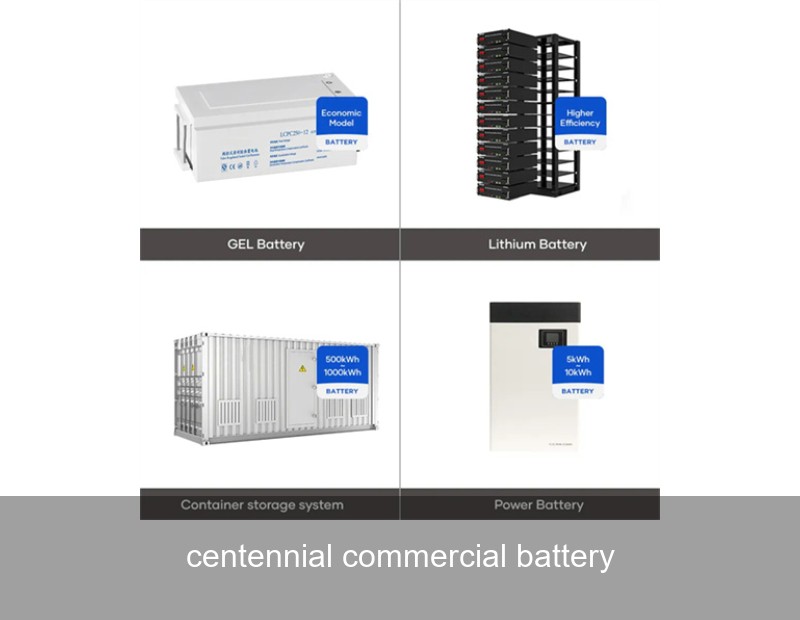
Imagine a power source for your business so robust and long-lasting that its legacy could span a century. The concept of a centennial commercial battery is no longer a futuristic dream but a tangible goal driving innovation in energy storage. For commercial and industrial enterprises across Europe and the US, the quest isn't just for backup power; it's for a foundational asset that delivers energy security, financial predictability, and sustainability for generations. This article explores the real-world journey toward century-scale energy resilience and the technologies making it possible today.
Table of Contents
- The Phenomenon: Beyond 15-Year Lifespans
- The Data: Why Longevity Equals Profitability
- The Case Study: A European Logistics Hub's 25-Year Bet
- The Technology Behind the Longevity Promise
- Highjoule's Role: Building Your Century Energy Foundation
- The Future & Your Next Step
The Phenomenon: Why the "Centennial" Mindset is Reshaping Commercial Energy
For decades, commercial battery systems were viewed as short to medium-term capital expenditures, with typical warranties spanning 10-15 years. The phenomenon we see today is a strategic shift. Facility managers, CFOs, and sustainability officers are now asking: "What if our energy storage system could outlast most other equipment in our building?" This isn't merely about battery life; it's about energy infrastructure as a permanent, value-appreciating pillar of the business. The driving forces are clear: volatile energy prices, grid instability, and stringent carbon reduction targets. A system designed for extreme longevity directly mitigates these risks for the long haul.
The Data: How Longevity Translates to Unbeatable Economics
Let's talk numbers. The levelized cost of storage (LCOS) is the critical metric. While a cheaper battery may have a lower upfront cost, its LCOS over 25 years can be significantly higher than a premium system designed to last. Consider this breakdown:
| Factor | Standard 15-Year System | Advanced "Centennial-Grade" System |
|---|---|---|
| Expected Operational Lifespan | 15-20 years | 25+ years (with capacity retention) |
| Total Cycles @ 1 cycle/day | ~5,475 | ~9,125+ |
| Key Financial Impact | Major reinvestment needed in 15 years | Decades of predictable OPEX savings, avoiding reinvestment |
Data from the National Renewable Energy Lab (NREL) shows that extending battery life is the single most effective lever for reducing LCOS. When you compound this with revenue from grid services (like frequency regulation) and avoided demand charges, the financial case for investing in a ultra-long-life system becomes compelling.

Image: A modern industrial facility integrating solar and long-life storage. Credit: Unsplash
The Case Study: A European Logistics Hub's 25-Year Strategic Pivot
Let's examine a real-world application. A major logistics distribution center in the Rhine Valley, Germany, faced a dual challenge: skyrocketing grid demand charges and a corporate mandate to achieve 100% renewable operation for its 24/7 facilities. Their goal was a system with a minimum 25-year service life to align with their site's strategic planning horizon.
Their solution was a hybrid approach: a 2.5 MW solar carport coupled with a 4 MWh centennial commercial battery system. The battery's primary functions were to store excess solar generation, shave peak demand, and provide uninterrupted power for critical refrigeration units. The system was commissioned in 2022.
- Demand Charge Reduction: 95% reduction in peak grid draw, saving over €120,000 annually.
- Self-Consumption: Increased on-site solar usage from 35% to over 80%.
- Performance: Battery degradation is tracking at less than 2% against a 25-year projection model.
- ROI: Projected payback period of 7 years, followed by 18+ years of nearly pure operational savings.
This case, documented in part by the International Renewable Energy Agency (IRENA), highlights how a long-life battery transitions from a cost to a core, profit-generating infrastructure asset.
The Technology Behind the Longevity Promise
So, what makes a battery "centennial-grade"? It's a symphony of advanced engineering, not just a single component.
1. Cell Chemistry & Manufacturing
Lithium Iron Phosphate (LFP) chemistry has become the cornerstone for commercial longevity due to its superior thermal stability and cycle life. However, the devil is in the details. Premium-grade LFP cells with tighter purity controls and robust electrode design can achieve 10,000+ cycles while retaining 80% capacity.
2. The Critical Role of Thermal Management
Heat is the primary enemy of battery longevity. A liquid cooling system, as opposed to simple air cooling, is non-negotiable for century-scale ambitions. It maintains an optimal, narrow temperature range (typically 20-25°C) uniformly across all cells, preventing stress and degradation hotspots.

Image: Precision engineering in battery thermal management. Credit: Unsplash
3. Intelligent Battery Management Software
The "brain" of the system is what separates a commodity battery from a strategic asset. Advanced algorithms perform adaptive cell balancing, state-of-health (SOH) monitoring, and predictive analytics. This software can optimize charge/discharge patterns daily to minimize degradation, effectively "teaching" the battery how to live longer.
Highjoule's Role: Engineering Your Century Energy Foundation
At Highjoule, our mission since 2005 has been to build energy storage systems that aren't just products, but enduring pillars of our clients' operational resilience. Our approach to the centennial commercial battery challenge is holistic.
Our flagship H-Series Commercial Energy Storage System is engineered from the ground up for multi-decade service. It integrates military-grade LFP cells with a patented, closed-loop liquid cooling system that ensures unparalleled temperature homogeneity. The true differentiator is Helios OS, our AI-driven energy management platform. Helios doesn't just operate the battery; it continuously learns from grid conditions, weather patterns, and your facility's load profiles to make micro-optimizations that extend system life and maximize value every single day.
For the logistics hub case study mentioned earlier, a Highjoule H-Series system was the chosen solution. Our team provided a comprehensive service package, including a 25-year performance guarantee, remote monitoring, and proactive maintenance scheduling, transforming a capital investment into a worry-free, long-term energy partner.
The Future & Your Next Step: What Does Your 2045 Energy Strategy Look Like?
The trajectory is clear. As businesses commit to net-zero goals and face increasing grid volatility, the energy storage system will become as fundamental as the roof over your facility. The question is no longer if you need storage, but what kind of legacy you want that storage to build.
Is your organization evaluating energy storage as a tactical tool for short-term savings, or as a strategic, century-ready asset that will protect your bottom line and your carbon targets for decades to come? What would a 25-year energy cost predictability model do for your long-term business planning?
 Inquiry
 Online Chat