


How Much Does the Sungrow SBR 3.2 Battery Cost? A Complete Value Analysis
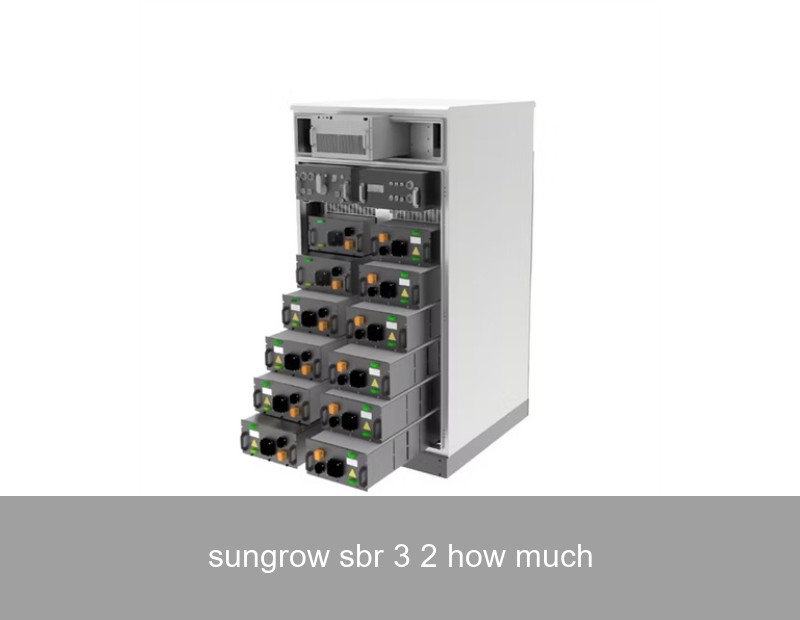
If you're researching home battery storage, the question "Sungrow SBR 3.2 how much?" is likely top of mind. While the upfront price tag is a crucial starting point, the true cost of a battery system involves a more complex equation of performance, longevity, and the total value it brings to your energy independence. In this guide, we'll break down not just the potential investment range, but also the factors that influence it and how advanced solutions from providers like Highjoule can offer a compelling alternative for maximizing your renewable energy investment.
Table of Contents
Key Factors Influencing the Sungrow SBR 3.2 Price
Asking "how much" for a battery like the Sungrow SBR 3.2 is similar to asking the price of a car—it depends on the configuration and what's included. The SBR 3.2 is a lithium iron phosphate (LFP) battery module with a usable capacity of 3.2 kWh. Rarely installed alone, the final system cost is determined by several components.
- System Scale: Most homes require multiple modules. A typical setup might involve 2-3 modules (6.4 kWh to 9.6 kWh of storage), paired with a compatible hybrid inverter.
- Inverter & Hardware: You need a Sungrow SH series hybrid inverter or similar. This critical component manages energy flow between solar panels, battery, and grid.
- Installation Complexity: Labor costs vary significantly by region (e.g., USA vs. Germany), your home's electrical setup, and whether it's a new install or retrofit.
- Market Dynamics: Supply chain factors, local installer markups, and available government incentives or tax credits greatly affect the final price.
A ballpark figure for a complete, installed Sungrow SBR-based system in markets like Germany or California often ranges from $10,000 to $18,000 before incentives, depending heavily on the size and scope. But let's look beyond the initial quote.
Beyond the Sticker Price: Understanding the Total Cost of Ownership
Focusing solely on purchase price can be misleading. A smarter approach evaluates Total Cost of Ownership (TCO) over the system's lifespan, which is typically 10+ years.
| Cost Component | Consideration | Impact on TCO |
|---|---|---|
| Efficiency | Round-trip efficiency (AC-AC) determines how much stored energy you actually use. | A system with 94% vs. 90% efficiency returns more value per cycle, lowering effective cost per kWh. |
| Cycle Life & Warranty | How many charge/discharge cycles is the battery rated for before significant degradation? | A longer, more comprehensive warranty (e.g., 10 years, 6000 cycles) protects your investment. |
| Software & Intelligence | Can the system adapt to time-of-use rates and weather forecasts to optimize savings? | Advanced energy management can unlock 20-30% more value from the same hardware. |
Think of it this way: a cheaper, less efficient battery might "leak" more of your hard-earned solar energy as heat loss over time, meaning you buy more from the grid. The most economical choice is often the one that delivers the highest usable energy over its lifetime.
Real-World Performance: A Case Study from Southern Europe
Let's ground this in reality. A 2023 analysis of a residential installation in Valencia, Spain, provides concrete data. A household with a 8 kWp solar array paired a 9.6 kWh Sungrow SBR battery system (three modules).
The goal was to maximize self-consumption amid rising grid prices. Over one year, the system achieved an 82% self-sufficiency rate, up from 35% with solar alone. The battery's round-trip efficiency was recorded at approximately 91%. However, the homeowner noted that during peak summer generation, the fixed logic of the system sometimes led to unnecessary cycling, slightly impacting potential savings. This case highlights a crucial point: hardware capacity is vital, but the intelligence controlling it is equally important for squeezing out every bit of value.

Image source: Unsplash (Representative image of a modern solar home)
The Highjoule Advantage: Intelligent Storage for Modern Homes
This is where companies like Highjoule, with nearly two decades of deep expertise in grid-edge intelligence, redefine the value proposition. While module costs are competitive across the industry, Highjoule's focus is on building integrated systems where advanced software is the cornerstone.
Our Residential Energy Hub platform goes beyond basic storage. It features:
- Adaptive Learning Algorithms: The system studies your consumption patterns and local weather forecasts to optimize charge/discharge cycles, not just based on time, but on predicted solar yield and grid carbon intensity.
- Seamless Integration: Designed to work harmoniously with leading solar inverter brands and existing home energy management systems, providing flexibility.
- Grid Services Readiness: In some markets, our systems can be configured to participate in virtual power plant (VPP) programs, potentially generating revenue for homeowners by supporting grid stability.
Imagine a battery that doesn't just store energy, but actively thinks about the most economical and sustainable way to use it. That's the core of Highjoule's solution. By optimizing every kilowatt-hour, the effective "cost per useful cycle" of the storage system decreases, improving your return on investment regardless of fluctuating energy tariffs. For commercial and industrial clients, our C&I PowerStack solutions offer similar intelligence at scale, with robust performance guarantees.
Modularity and Future-Proofing
A key concern for buyers is obsolescence. Highjoule's architecture is inherently modular. You can start with a capacity that fits your current budget and energy needs, and seamlessly add more storage later as your family grows or you add an electric vehicle. This scalability protects your initial investment from becoming stranded.

Image source: Unsplash (Representative image of a sleek home battery unit)
Making the Right Investment for Your Energy Future
So, when you search "Sungrow SBR 3.2 how much?", remember you're really asking about the cost of energy resilience. The price of hardware is one line item. The long-term value is determined by the intelligence of the system it's part of.
Before you decide, ask your installer these critical questions:
- What is the projected AC round-trip efficiency of the complete installed system?
- How does the software optimize for time-of-use rates and self-consumption?
- Is the system capable of receiving software updates to adapt to new tariffs or grid programs?
- What is the true scope of the warranty—does it cover capacity retention over time?
We encourage you to look at resources like the International Energy Agency's reports on storage to understand the broader technological landscape. The right battery system is an investment that pays dividends in bill savings, peace of mind during outages, and a reduced carbon footprint for years to come.
Is your primary goal simply to store excess solar, or to build an intelligent, adaptive home energy system that actively manages your household's power flow for maximum efficiency and savings?
 Inquiry
 Online Chat