


Understanding Solar Panel Price in Sri Lanka: A Guide to Smart Energy Investment
When considering a shift to solar energy in a country like Sri Lanka, the first question for many homeowners and businesses is often about cost. "What determines the solar panel price in Sri Lanka?" While the upfront figure is important, the true value lies in understanding the complete picture: system quality, long-term performance, and the intelligence behind the storage solution. This article will break down the factors influencing solar investment in Sri Lanka and how pairing panels with advanced battery storage, like solutions from global providers such as Highjoule, unlocks the full economic and energy security potential.
Table of Contents
- Key Factors Influencing Solar Panel Prices in Sri Lanka
- Beyond the Panels: The Critical Role of Energy Storage
- The Highjoule Advantage: Intelligent Storage for Sri Lankan Resilience
- Case Study: A Sri Lankan Tea Estate's Journey to Energy Independence
- The Future of Solar & Storage in Sri Lanka's Energy Landscape

Image: A solar installation in a tropical climate like Sri Lanka requires robust components. Source: Unsplash
Key Factors Influencing Solar Panel Prices in Sri Lanka
The quoted price for a solar photovoltaic (PV) system in Sri Lanka is not a single number. It's a composite of several variables. Understanding these helps you make an informed comparison and investment.
- Panel Technology & Efficiency: Monocrystalline panels, with higher efficiency rates (often 20%+), typically command a premium over polycrystalline modules. For limited roof space, higher efficiency means more power generation per square meter, often justifying the higher initial solar panel price in Sri Lanka.
- System Size (kWp): Measured in kilowatt-peak (kWp), this is the core capacity. A typical residential system may range from 3kWp to 10kWp, while commercial installations can be hundreds of kWp. Larger systems have a higher total cost but a lower cost per watt.
- Component Quality: The inverter, which converts DC solar power to AC for your home, is the system's brain. Brands and technologies (string vs. microinverters) vary in price and capability. Mounting structures, cabling, and protection devices also contribute.
- Installation Complexity: Roof type, angle, accessibility, and any required structural reinforcements can affect labor costs.
- Import Duties & Currency Fluctuation: As most high-end components are imported, government tariffs and exchange rates directly impact the final price.
According to market data, a standard-quality 5kWp residential solar system in Sri Lanka could range from LKR 1.2 million to LKR 2 million+ (approx. $4,000 - $6,600+), heavily dependent on the factors above. But here's the pivotal insight: the panels themselves often account for only about 30-40% of the total system cost. The real value—and challenge—lies in effectively using the energy you generate.
Beyond the Panels: The Critical Role of Energy Storage
This is where the conversation evolves. Solar panels generate power primarily during the day. But what about at night, or during the frequent grid instability that can affect regions? Without storage, excess solar energy is often fed back to the grid at a low rate, or worse, wasted. A battery energy storage system (BESS) captures that surplus for use on demand, transforming a solar installation from a cost-reduction tool into a pillar of energy resilience.
For a nation like Sri Lanka, aiming to boost renewable energy capacity, storage is not a luxury; it's a necessity for grid stability and maximizing renewable utilization. It shifts the economics from simple payback period to total lifetime value and energy security.
The Highjoule Advantage: Intelligent Storage for Sri Lankan Resilience
This is where Highjoule's expertise becomes highly relevant. As a global leader in advanced energy storage systems since 2005, Highjoule doesn't just sell batteries; we provide integrated, intelligent power solutions. For a Sri Lankan homeowner or business navigating the solar panel price in Sri Lanka, pairing with a Highjoule system means investing in the "brain" of your energy ecosystem.
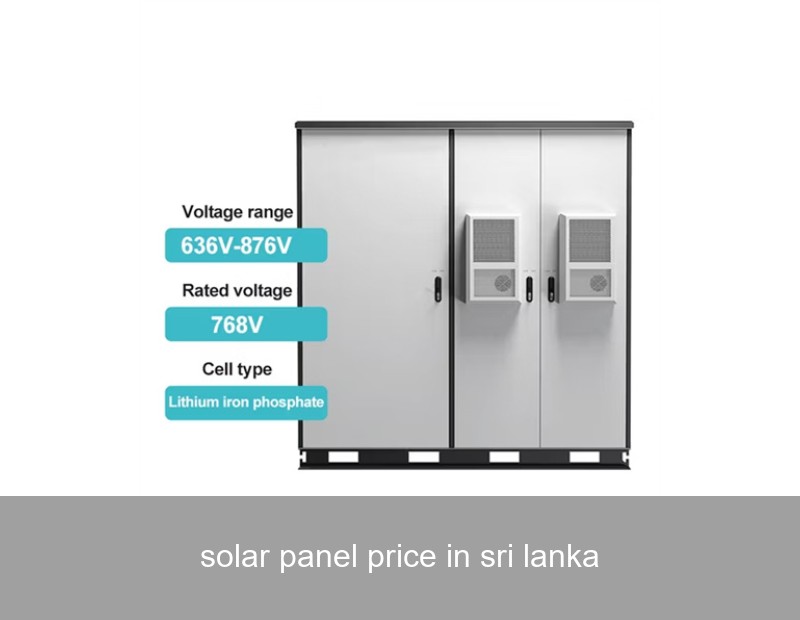
Our solutions, such as the Highjoule H-Series Commercial & Industrial (C&I) systems and Residential Energy Hub, are designed for high-cycle life and performance in diverse climates. They feature:
- Advanced Battery Management Systems (BMS): Ensuring safety, longevity, and optimal performance of lithium iron phosphate (LFP) battery cells, known for their thermal stability and long life—a crucial factor in warmer climates.
- Intelligent Energy Management Software (EMS): This is the core intelligence. The software learns your energy consumption patterns, automatically decides when to store solar energy, when to use it, and when to draw from the grid, maximizing self-consumption and savings.
- Scalability and Modularity: Systems can be scaled to meet growing energy needs, protecting your initial investment.
- Grid Services and Backup Power: For businesses, this provides uninterrupted power during outages, protecting operations and revenue.
Integrating a Highjoule storage system with your solar array might increase the initial investment, but it dramatically increases the utility and return of every dollar spent on the panels themselves. You're not just buying equipment; you're investing in a predictable, controllable, and resilient energy future.

Image: An advanced battery storage system unit, similar to Highjoule's solutions, installed in a clean environment. Source: Unsplash
Case Study: A Sri Lankan Tea Estate's Journey to Energy Independence
Let's look at a real-world application. A medium-sized tea processing estate in the Nuwara Eliya region faced two critical issues: extremely high grid electricity costs during peak drying and processing hours, and unreliable grid supply that risked spoiling batches of tea.
| Challenge | Solution | Result |
|---|---|---|
| High daytime energy costs (>LKR 45/kWh). Unplanned grid outages. | A 450 kWp rooftop solar PV system coupled with a 500 kWh Highjoule C&I battery storage system with intelligent EMS. | The estate now runs primarily on solar during the day, using the battery to shave peak loads. The EMS ensures the battery is optimally charged from solar and provides seamless backup during grid failures. The system now provides over 85% of the facility's power needs. |
The Data: The project's total cost was significant, but the financial analysis revealed a simple payback period of under 5 years due to massive grid cost avoidance. More importantly, it eliminated the risk of production loss from outages, a value that's hard to quantify but vital for business continuity. This case, documented in part by the Asian Development Bank's Sri Lanka energy project reports, highlights a trend: for businesses, the calculus is moving from commodity solar panel price in Sri Lanka to total cost of ownership and risk mitigation through integrated solar-plus-storage.
The Future of Solar & Storage in Sri Lanka's Energy Landscape
The trajectory is clear. As battery technology costs continue to decline globally and software intelligence improves, the value proposition of storage will only strengthen. Government policies, such as net metering or feed-in-tariffs, will evolve, making self-consumption through storage even more attractive.
For the international observer or potential investor, the Sri Lankan market presents a compelling microcosm of the global energy transition: a sunny island nation with a clear need for distributed, resilient, and clean power. The initial question of solar panel price in Sri Lanka is merely the entry point to a deeper discussion about energy strategy.

Image: The global transition to resilient energy systems. Source: Unsplash
So, as you evaluate your own or your client's energy needs in Sri Lanka or similar markets, consider this: Are you looking for the lowest cost per watt of solar panel today, or are you investing in the lowest cost of clean, reliable energy for the next 20 years? How might an intelligent storage system transform the economic and operational profile of your solar investment?
 Inquiry
 Online Chat