


Solarify Energy: How Much Can You Really Save and Generate?
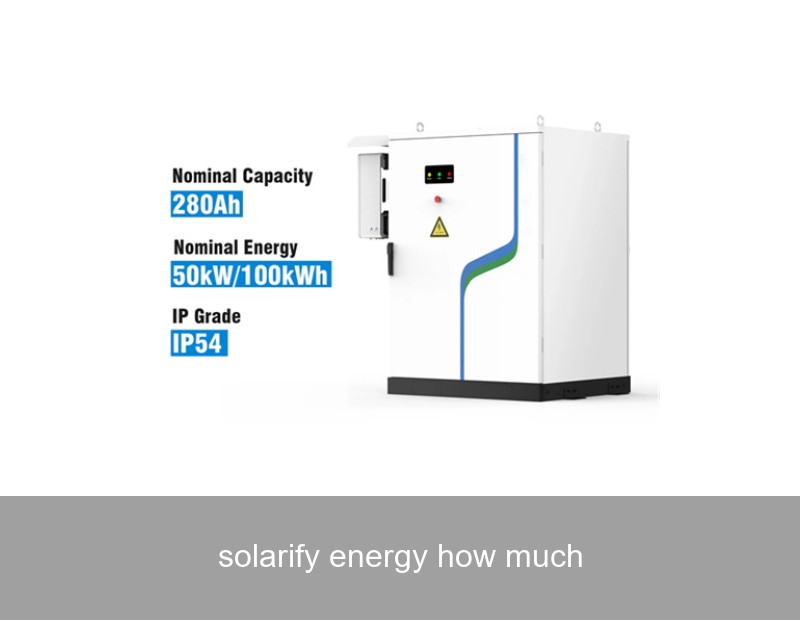
You've likely heard the buzz: "Go solar, save money, be energy independent." But when you dig deeper, the central question becomes, "Solarify energy: how much?" How much does it cost? How much will I save? How much power can I actually generate? It's not just about slapping panels on a roof; it's about a calculated investment in a sustainable future. As energy prices remain volatile and climate concerns grow, understanding the real numbers behind solar energy is crucial for homeowners and businesses across Europe and the US.
Table of Contents
- The Phenomenon: From Curiosity to Necessity
- Breaking Down the Costs: The Initial Investment
- The Savings Potential: More Than Just a Lower Bill
- Generation Capacity: Sizing Your System Right
- The Game Changer: How Much Does Storage Amplify Savings?
- A Real-World Case Study: A German Manufacturing SME
- Highjoule's Role: Precision in Your Energy Equation
- Your Next Step: Answering "How Much" for You
The Phenomenon: From Curiosity to Necessity
Gone are the days when solar was a niche choice. Today, it's a mainstream financial and environmental strategy. The phenomenon is driven by two powerful forces: skyrocketing grid electricity costs and rapidly falling prices for solar technology. According to the International Renewable Energy Agency (IRENA), the global weighted average cost of electricity from utility-scale solar photovoltaics fell by a staggering 89% between 2010 and 2022. This convergence makes asking "how much" more relevant than ever.
But here's the twist. The simple "payback period" calculation is evolving. It's no longer just about offsetting grid consumption. The real value now lies in maximizing self-consumption and building resilience, which is where intelligent energy storage comes into play.
Breaking Down the Costs: The Initial Investment
So, let's tackle the first part of "solarify energy: how much does it cost?" For a typical residential system in the US or Europe, costs are usually calculated per watt ($/W) or as a total turnkey price.
- System Components: The price includes solar panels, inverters, mounting hardware, wiring, and importantly, the installation labor.
- Key Variables: Your final cost depends on system size (e.g., 6kW vs. 10kW), roof complexity, panel efficiency, and local market factors.
- Incentives are Key: The net cost is dramatically lower after incentives. In the US, the federal Investment Tax Credit (ITC) allows you to deduct 30% of the system cost from your taxes. Many European countries offer attractive feed-in tariffs or tax rebates.
For example, a 10kW system in the US might have a gross cost of $25,000-$30,000. After the 30% ITC, the net investment could be $17,500-$21,000. Always consult with a local expert for a precise quote.
The Savings Potential: More Than Just a Lower Bill
Savings are where the story gets exciting. How much you save depends on:
| Factor | Impact on Savings |
|---|---|
| Your Local Electricity Rate | Higher grid rates mean greater savings from each solar kWh you self-consume. |
| Solar System Production | Determined by your location's sunlight (solar irradiance) and system orientation. |
| Your Consumption Pattern | Do you use most power during the sunny day (good alignment) or at night (requires storage)? |
| Net Metering Policies | Rules for selling excess power back to the grid vary and significantly affect economics. |
In regions with high electricity prices and decent sun, it's common for homeowners to see a reduction of 70-90% on their annual electricity bills. The savings over 25+ years (the typical panel warranty) can amount to tens of thousands of dollars or euros.
Generation Capacity: Sizing Your System Right
"How much energy will it generate?" A qualified installer will perform a detailed analysis using tools like PVWatts. As a rule of thumb, in sunnier parts of Southern Europe or the US Southwest, 1kW of solar can produce about 1,400-1,600 kWh per year. In Northern Europe or the Pacific Northwest, it might be 900-1,200 kWh per year. A 10kW system could therefore generate between 9,000 and 16,000 kWh annually, potentially covering a significant portion of a typical household's needs.
The Game Changer: How Much Does Storage Amplify Savings?
This is the critical modern chapter of the "how much" story. Solar panels generate power only during the day. Without storage, you might still import expensive power at night. Adding a battery storage system like those from Highjoule changes the equation entirely.
- Increase Self-Consumption: Store excess daytime solar for use in the evening, reducing grid imports by up to 80% or more.
- Backup Power: Provide critical power during grid outages—a value that's hard to quantify but immensely important.
- Energy Arbitrage: In some markets, you can store grid power when it's cheap and use it when prices are high.
Highjoule's IntelliBESS residential and commercial battery systems are designed for this exact purpose. Their smart energy management software doesn't just store energy; it optimizes its flow based on your usage patterns, electricity rates, and even weather forecasts, ensuring you extract maximum financial value from every kilowatt-hour your panels produce.

A Real-World Case Study: A German Manufacturing SME
Let's move from theory to hard data. Consider a mid-sized manufacturing company in Bavaria, Germany. Facing electricity costs of over €0.32/kWh, they needed to control expenses and ensure production continuity.
The Project: Installation of a 250 kWp rooftop solar array coupled with a 500 kWh Highjoule Industrial PowerPack battery storage system.
- Solar Generation: ~250,000 kWh
- Self-Consumption Rate (with storage): Increased from 35% to 92%
- Grid Electricity Purchased: Reduced by 78%
- Annual Energy Cost Savings: €68,000
- CO2 Emissions Avoided: ~120 tonnes
Furthermore, the system provides seamless backup for critical loads, preventing costly downtime. The investment payback period was calculated at under 7 years, thanks in part to Germany's support for efficient storage solutions. This case, documented in a IEA report on storage, clearly shows that for businesses, "solarifying" with storage is a powerful financial and operational decision.
Highjoule's Role: Precision in Your Energy Equation
As a global leader in advanced energy storage since 2005, Highjoule doesn't just sell batteries. We provide intelligent systems that make the answer to "solarify energy: how much?" as favorable as possible for you. Our solutions for residential (IntelliBESS Home), commercial, and microgrid applications are built on three pillars:
- Intelligence: Our AI-driven platform, EnergyOS, continuously learns and optimizes, deciding when to store, use, or (where applicable) sell energy.
- Efficiency: With industry-leading round-trip efficiency, more of your precious solar energy is available for use, not lost in conversion.
- Sustainability & Safety: We use long-lifecycle, recyclable chemistries and incorporate multiple layers of safety in our hardware and software design.
For a large-scale commercial or utility project, our Containerized Megawatt Storage Solutions offer grid-scale stability and renewable integration. We help you not just generate solar energy, but master it.

Your Next Step: Answering "How Much" for You
The journey to "solarifying" your energy is unique. The numbers that matter are your current energy bill, your roof's potential, your local climate and policies, and your resilience goals. Generic online calculators can give a ballpark, but a tailored analysis is irreplaceable.
So, we leave you with this: What would a detailed, no-obligation energy audit that models the specific savings and ROI for your property reveal about your path to energy independence? The first step to knowing your exact "how much" is to ask the right experts.
 Inquiry
 Online Chat