


Understanding Solar Panel Manufacturing Costs: A Deep Dive into Past, Present, and Future
If you're considering solar for your home or business, you've likely noticed how much more affordable it's become. This isn't by accident. The dramatic drop in solar panel manufacturing costs over the last two decades is one of the most remarkable success stories in renewable energy. But what's driving this trend? Is it sustainable? And how do these upstream costs impact the final value of your complete energy system? Let's unpack the economics behind the panels on your roof.
Table of Contents
The Great Cost Plunge: From Niche to Mainstream
In the early 2000s, solar photovoltaic (PV) technology was largely seen as a costly, subsidized alternative. Fast forward to today, and it's often the cheapest source of new electricity generation in many parts of the world. The numbers are staggering. According to the International Renewable Energy Agency (IRENA), the global weighted average cost of electricity from utility-scale solar photovoltaics fell by 89% between 2010 and 2022. This is overwhelmingly tied to a reduction in solar panel manufacturing costs.

Image Source: Unsplash - A modern, automated solar panel production line.
This cost curve, often called Swanson's Law (akin to Moore's Law for chips), observed that panel prices dropped about 20% for every doubling of cumulative shipped volume. We've moved from small-scale, labor-intensive production to gigawatt-scale, hyper-automated factories.
Key Drivers Behind Falling Manufacturing Costs
The reduction in solar panel manufacturing costs isn't due to one single miracle. It's a symphony of technological innovation, economies of scale, and competitive supply chains.
- Economies of Scale & Automation: As global demand soared, manufacturers built ever-larger factories (gigafactories). This massive scale, coupled with advanced robotics, drastically reduced the cost per unit of production.
- Polysilicon & Wafer Efficiency: The heart of most panels is silicon. Process improvements have yielded more silicon from raw materials, while sawing techniques have reduced waste. Simultaneously, cell efficiencies have climbed steadily, meaning more power output from the same amount of material.
- Cell Technology Evolution: The shift from standard Al-BSF (Aluminum Back Surface Field) cells to PERC (Passivated Emitter and Rear Cell), and now towards TOPCon and HJT (Heterojunction) technologies, has improved efficiency without proportionally increasing cost.
- Supply Chain Maturation: A fiercely competitive, global supply chain for everything from glass and ethylene-vinyl acetate (EVA) encapsulant to silver paste has driven down component prices.
- Policy & Market Dynamics: Early government subsidies, particularly in Germany and China, fueled initial demand and innovation, kickstarting the scale cycle. Today, global competition keeps pressure on manufacturers to innovate and cut costs.
Beyond the Panel: The Total System Cost Equation
Here's a crucial insight: the panel itself is now only one part of your total solar investment. While solar panel manufacturing costs have fallen dramatically, the "balance of system" (BoS) costs—inverters, mounting, wiring, labor, and notably, energy storage—represent a larger slice of the pie.
This is where the story gets even more interesting for an energy consumer. A low-cost panel producing abundant daytime energy is fantastic, but maximizing its value often requires storing that energy for use when the sun isn't shining. This is the logical next step in the renewable energy journey.
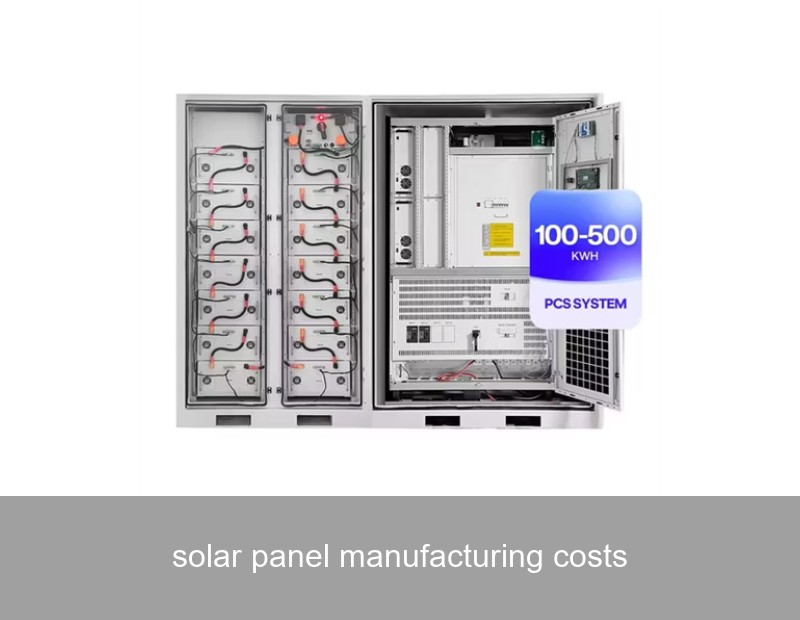
Companies like Highjoule have focused on this very challenge. While panel costs dropped, Highjoule pioneered advanced battery energy storage systems (BESS) that seamlessly integrate with solar arrays. Their H-Joule Commercial and H-Joule Residential series are designed not just to store energy, but to intelligently manage it—optimizing self-consumption, providing backup power, and even enabling participation in grid services. The true economic value of your solar panels is fully unlocked when paired with intelligent storage, ensuring no kilowatt-hour goes to waste.
| Component | Share of Total System Cost (Approx.) | Trend |
|---|---|---|
| Solar Panels (Modules) | 20-25% | Continuing gradual decline |
| Inverter & Power Electronics | 10-15% | Stable with tech evolution |
| Mounting & Hardware | 5-10% | Relatively stable |
| Installation & Labor | 15-25% | Region-dependent, can be rising |
| Battery Energy Storage System | 25-35% | Decreasing rapidly (similar to solar's past) |
| Permits, Grid Connection, etc. | 5-10% | Varies widely by jurisdiction |
Case Study: Cost Trends in the European Market
Let's look at a real-world example. Germany, a solar pioneer, has seen feed-in tariffs plummet alongside module costs. A 2023 report by Fraunhofer ISE noted that the levelized cost of electricity (LCOE) for small rooftop PV systems in Germany fell below 8 Euro cents/kWh. For a midsize industrial company in Bavaria, the calculation shifted from "should we go solar?" to "how can we use *all* this solar power effectively?"
Project: A German automotive parts manufacturer installed a 500 kW rooftop solar array in 2020. While the daytime generation reduced grid consumption, a significant portion was exported to the grid at low rates due to midday overproduction and low on-site weekend demand.
Solution & Data: In 2022, they integrated a Highjoule H-Joule Industrial 500 battery storage system. The 500 kWh storage capacity was programmed to capture excess solar, provide peak shaving (reducing demand charges), and offer backup for critical processes.
Result: The company increased its solar self-consumption rate from 35% to over 80%. Combined with demand charge management, this translated to a 22% reduction in their annual net energy costs and a hedge against energy price volatility. The project payback period, factoring in storage, remained under 7 years—a compelling business case built on the foundation of low solar panel manufacturing costs and enhanced by smart storage.

Image Source: Unsplash - An industrial site with solar panels and an adjacent containerized battery storage unit.
Future Trends and Challenges
So, will solar panel manufacturing costs keep falling? The trend will continue, but likely at a slower, more incremental rate. Efficiency gains (like perovskite-silicon tandem cells) will deliver more power per panel, effectively reducing cost per watt. However, raw material price fluctuations, supply chain geopolitics, and the critical need for sustainable manufacturing and recycling are emerging challenges.
The next frontier is the holistic integration of generation, storage, and smart energy management. This is where providers like Highjoule excel. Their EnergyOS platform uses AI to not only manage a site's solar and storage assets but also to optimize energy flows based on weather forecasts, electricity tariffs, and consumption patterns. The goal is no longer just the cheapest panel, but the lowest total cost of energy ownership.
Maximizing Your Solar Investment
As a consumer or business owner, the lesson is clear. When evaluating solar, look beyond the price tag per panel. Consider:
- Total System Lifetime Value: How will you use the energy? Can storage increase your self-consumption and ROI?
- Technology Synergy: Are the inverter, panels, and storage designed to communicate and operate efficiently as a single system?
- Partner Expertise: Choose a provider who understands the entire ecosystem, from panel economics to grid services.
Highjoule embodies this integrated approach. With nearly two decades of experience, they offer tailored solutions—from residential H-Joule Home setups to massive Microgrid solutions—that ensure the economic advantage born from decades of declining solar panel manufacturing costs is fully captured and amplified at the point of use.
Image Source: Unsplash - A modern home with solar panels, representing the integrated clean energy ecosystem.
Given that the hardware costs are becoming increasingly optimized, what energy management strategy will you implement to squeeze every drop of value from your solar investment?
 Inquiry
 Online Chat