


Solar Panels for Housing Societies: The Complete Guide to Shared Renewable Power
Imagine your entire apartment building or residential community powered by clean, affordable sunlight. This isn't a futuristic dream—it's a rapidly growing reality for housing societies across Europe and the United States. As energy costs soar and environmental consciousness becomes a collective priority, the question is no longer if communities should switch to solar, but how. Installing solar panels for housing society developments represents a powerful shift from individual consumption to shared, sustainable benefit. This guide will walk you through the why, the how, and the tangible rewards of embracing community solar power.
Table of Contents
- The Rising Demand for Community Solar Solutions
- Key Considerations for Housing Society Solar Projects
- Technology Essentials: Beyond the Panels
- Case Study: A German Housing Cooperative's Success Story
- How Highjoule Powers Community Solar Projects
- Navigating Financial Pathways and Incentives
- Taking the First Steps Towards Your Solar Community
The Rising Demand for Community Solar Solutions
The trend is unmistakable. A recent report by the International Renewable Energy Agency (IRENA) highlights that distributed solar power, including community-scale projects, is a cornerstone of the global energy transition. For housing societies, the drivers are multifaceted:
- Economic Resilience: Locking in decades of predictable, low-cost energy protects residents from volatile fossil fuel markets.
- Property Value Enhancement: Sustainable features are increasingly a major factor in property valuation and buyer appeal.
- Collective Environmental Impact: Achieving significant carbon reduction goals that individual units cannot accomplish alone.
- Energy Security: Reducing dependence on the main grid, especially when paired with storage, provides backup during outages.
This isn't just about installing panels; it's about building a smarter, more resilient energy infrastructure for the entire community.
Key Considerations for Housing Society Solar Projects
Successfully implementing a solar solution for a multi-dwelling unit requires careful planning. The key challenges and their solutions often include:
| Challenge | Solution & Consideration |
|---|---|
| Shared Roof Space & Ownership | Conduct a structural survey, establish clear legal agreements on usage rights and benefit distribution among residents. |
| Energy Distribution & Billing | Implement a robust sub-metering system or explore virtual net metering policies available in many U.S. states and European countries. |
| Upfront Capital Investment | Evaluate Power Purchase Agreements (PPAs), community solar subscriptions, green loans, and available government grants. |
| Ongoing Maintenance | Factor in long-term Operation & Maintenance (O&M) contracts to ensure peak system performance for 25+ years. |
Technology Essentials: Beyond the Panels
While high-efficiency photovoltaic (PV) panels are the face of the system, the true intelligence lies in the balance of system components. For a housing society, the system architecture is critical:
- Optimized Inverter Systems: Centralized or string inverters must be sized correctly for the shared load and roof layout. Smart Energy Management Systems (EMS): The brain of the operation. An EMS monitors production, manages consumption patterns across common areas (lighting, elevators, gyms), and can optimize self-consumption.
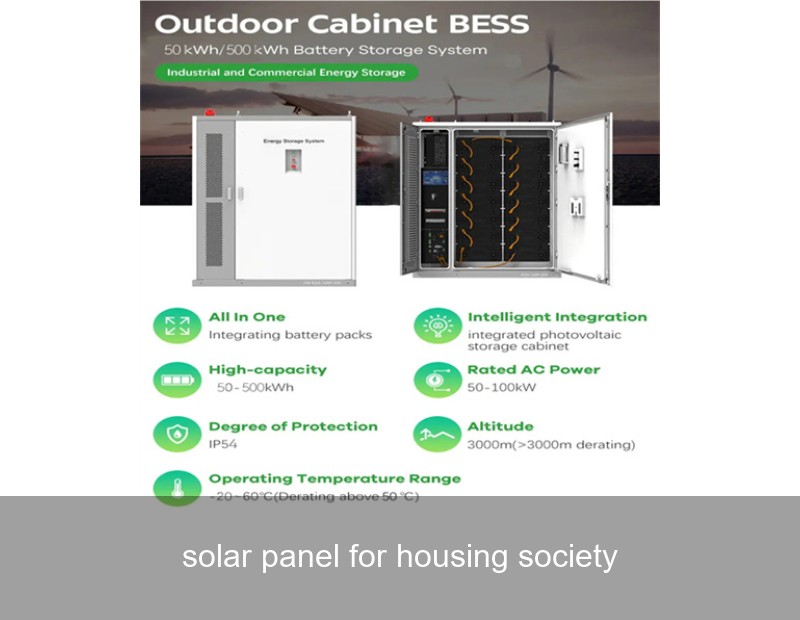
- Battery Energy Storage Systems (BESS): This is the game-changer. Storing surplus solar energy for use in the evening or during peak tariff hours maximizes financial return and boosts energy independence.
Image: A housing society leveraging rooftop solar. Source: Unsplash

Integrating these technologies seamlessly is where specialist providers like Highjoule add immense value. Our HI-Stack Commercial & Industrial (C&I) battery storage systems are engineered for precisely these scenarios, featuring advanced lithium-ion chemistry, scalable modular design, and built-in safety protocols that meet the strictest international standards.
How Highjoule Powers Community Solar Projects
With nearly two decades of experience, Highjoule doesn't just supply equipment; we deliver end-to-end intelligent power solutions. For housing societies, our tailored approach includes:
- Feasibility & Design: Our experts analyze your energy consumption data, roof potential, and local regulations to create an optimized technical and financial model.
- Integrated Product Suite: We offer compatible high-efficiency PV modules, our flagship HI-Stack BESS, and the Highjoule Nexus Energy Management Platform. This platform provides the housing board and residents with real-time visibility into energy production, storage levels, and cost savings via a user-friendly dashboard.
- Professional Installation & Grid Integration: Our certified network of partners ensures safe, compliant, and efficient installation, handling all grid interconnection paperwork.
- Long-term Support: We offer comprehensive O&M packages and remote monitoring to guarantee your community solar asset performs optimally for its entire lifespan.
Case Study: A German Housing Cooperative's Success Story
Let's look at real-world data. A 120-unit housing cooperative in Baden-Württemberg, Germany, partnered with Highjoule and a local installer in 2022 to address rising Energiekosten (energy costs).
The Project:
- Installed a 245 kWp rooftop PV system.
- Integrated a 120 kWh Highjoule HI-Stack battery storage system.
- Connected all common area loads and enabled surplus sharing to a portion of resident units under Germany's EEG (Renewable Energy Act) framework for self-consumption.
Results After 12 Months (2023 Data):
- 85% of common area electricity demand met by solar.
- €18,500 saved on annual electricity bills for the cooperative's budget.
- 42 tonnes of CO2 emissions avoided.
- The battery system provided seamless backup power during two grid maintenance outages, keeping hallways lit and elevators operational.
This case demonstrates the tangible triple-bottom-line return: economic, environmental, and social resilience.
Navigating Financial Pathways and Incentives
The financial model for a housing society solar project can be flexible. In the U.S., the Investment Tax Credit (ITC), now extended under the Inflation Reduction Act, can significantly offset the cost of solar and paired storage. Many states offer additional rebates and have community solar or virtual net metering programs.
In Europe, countries like Spain, Italy, and France have streamlined regulations for collective self-consumption. Germany's support for renewable energy remains robust. Highjoule's project development team stays current on these evolving incentives across our key markets to ensure our clients capture all available value.
Image: A housing committee reviewing project plans. Source: Unsplash

Taking the First Steps Towards Your Solar Community
Initiating this journey requires consensus and clear information. Start by forming a sub-committee within your housing association to research and champion the project. Gather 12-24 months of electricity bills for all common areas. Then, engage with a reputable, experienced provider who can conduct a professional site assessment and present a detailed proposal.
The transition to a solar-powered housing society is a profound decision that pays dividends for decades. It's an investment in community well-being, financial prudence, and planetary health. With the right technology partner, the process is streamlined, transparent, and ultimately, empowering.
 Inquiry
 Online Chat