


Which Solar Panel is Best for Commercial Use? A Guide to Maximizing Your ROI
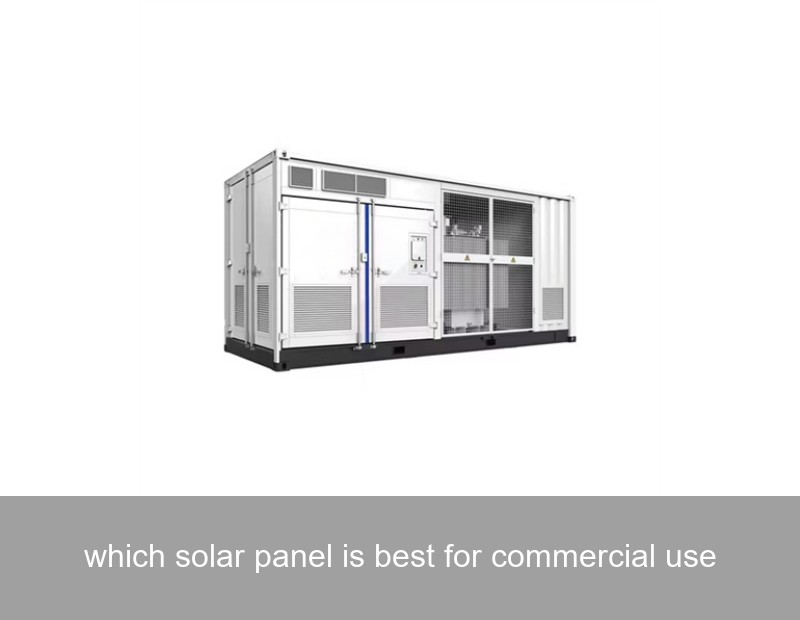
As a business leader in Europe or the US, you're likely considering solar not just as a green statement, but as a critical financial decision. The question "Which solar panel is best for commercial use?" is paramount. The answer, however, goes beyond simply comparing module datasheets. The best commercial solar panel is the one that delivers the highest long-term value and reliability within your specific energy ecosystem. This guide will walk you through the key technologies, financial considerations, and the crucial role of system integration to help you make an informed choice for your business.
Table of Contents
Solar Panel Technologies for Commercial Rooftops
Today's market offers three dominant panel technologies, each with distinct advantages for commercial and industrial (C&I) applications.
Monocrystalline Silicon (Mono-Si): The Efficiency Leader
Recognizable by their uniform dark color and rounded cell edges, monocrystalline panels are crafted from a single crystal structure. This purity grants them the highest efficiency rates on the market, typically between 20-23%. For a commercial roof with limited space, this means you can generate more power per square meter, maximizing your energy yield. They also generally have the longest lifespan and best performance in high-heat conditions, a key consideration for large, sun-exposed rooftops.
Polycrystalline Silicon (Poly-Si): The Cost-Effective Workhorse
With a blue, speckled appearance from multiple silicon fragments, polycrystalline panels have been a traditional choice for budget-conscious projects. Their efficiency is lower, usually in the 15-17% range. While they require more roof space for the same output, their lower initial cost per panel can be attractive for very large installations where space is not a constraint.
Thin-Film (Cadmium Telluride - CdTe): The Lightweight Performer
Thin-film panels, like those using Cadmium Telluride, are applied as a thin layer onto glass or metal. They excel in real-world conditions like high temperatures and partial shading, suffering less performance drop than crystalline silicon. Their lightweight and flexible nature makes them ideal for roofs with lower load-bearing capacity. However, they typically require the most space due to lower efficiency (10-13%).
| Technology | Average Efficiency | Space Requirement | Heat Tolerance | Best For |
|---|---|---|---|---|
| Monocrystalline (Mono-Si) | 20-23% | Low | Excellent | Space-constrained roofs, maximizing long-term ROI |
| Polycrystalline (Poly-Si) | 15-17% | High | Good | Large, low-cost utility-scale installations |
| Thin-Film (CdTe) | 10-13% | Very High | Superior | High-temperature environments, lightweight roofs |
Beyond Efficiency: Key Selection Criteria for Your Business
Choosing the best solar panel involves a multi-faceted analysis. Here’s what your procurement team should evaluate:
- Degradation Rate: This tells you how much output a panel loses each year. Premium monocrystalline panels often come with degradation rates as low as 0.3% per year, guaranteeing 90%+ output after 25 years. A panel that loses 1% annually will produce significantly less energy over its lifetime.
- Temperature Coefficient: Solar panels get less efficient as they get hotter. A lower (more negative) temperature coefficient (e.g., -0.26%/°C vs. -0.40%/°C) means better performance on a scorching summer day, which is critical for commercial rooftop installations.
- Warranty & Manufacturer Bankability: A 25+ year performance warranty is standard for tier-1 manufacturers. But equally important is the financial health of the company backing that warranty. You need assurance they'll be around in 20 years to honor it.
- Local Climate & Roof Characteristics: Does your facility experience frequent high temperatures? Is shading from nearby structures an issue? The "best" panel for a warehouse in Arizona might differ from one in Northern Germany.

Image: A modern commercial solar installation. Source: Unsplash (Representative image)
Real-World Impact: A Case Study from Germany
Let's look at data from a real project. A mid-sized automotive parts manufacturer in Bavaria, Germany, faced rising energy costs and pressure to meet corporate sustainability targets. Their roof was large but had some irregular shading patterns in the afternoon.
The Challenge: Maximize self-consumption of solar energy to reduce grid dependence, despite partial shading.
The Solution & Data: The installer opted for high-efficiency monocrystalline bifacial panels (which capture light from both sides) paired with power optimizers on each panel. These optimizers mitigated the shading losses by allowing each panel to operate independently. The 500 kWp system was completed in 2022.
- Annual Generation: ~525,000 kWh
- Self-Consumption Rate: Increased from an estimated 65% (with standard string inverters) to over 85% thanks to the integrated battery storage system that stored excess midday production for use in the evening.
- Financial Outcome: The business now covers 72% of its daytime energy needs with solar, reducing its annual energy bill by approximately €68,000. The addition of storage was key to unlocking this high self-consumption, proving that panel choice is just one part of the equation.
The Missing Piece: Why System Integration is Everything
Here's a crucial insight many businesses overlook: the best solar panel is only as good as the system it's connected to. A premium panel paired with a low-quality inverter, a poorly designed electrical layout, or no storage solution can drastically underperform.
Think of it like a sports car with cheap tires—you won't achieve its potential. For commercial use, the goal is rarely just to export power to the grid. It's to maximize self-consumption, increase energy resilience, and manage demand charges. This requires intelligent integration of:
- Advanced Inverters: That convert DC to AC power with maximum efficiency and provide critical grid-support functions.
- Smart Energy Management Systems (EMS): Software that acts as the brain, deciding when to use solar power directly, when to charge batteries, and when to draw from the grid based on cost and consumption patterns.
- Battery Energy Storage Systems (BESS): The cornerstone of modern commercial solar. Storage captures surplus solar energy for use at night or during peak tariff periods, turning a solar system from a cost-saver into a strategic asset.
Highjoule's Holistic Approach to Commercial Solar
At Highjoule, with nearly two decades of experience since 2005, we understand that answering "which solar panel is best for commercial use" is the beginning of the conversation, not the end. We provide integrated, intelligent storage-first energy solutions.
Our approach is to first analyze your facility's specific load profile, tariff structure, and resilience needs. We then design a system where solar generation, whether from high-efficiency monocrystalline or robust thin-film panels, is seamlessly coupled with our core technology: the Highjoule Quantum BESS.
Our battery systems, like the Quantum Series for C&I applications, feature:
- Ultra-safe lithium iron phosphate (LFP) chemistry.
- Scalable architecture from 100 kWh to multi-MWh configurations.
- Advanced EMS software that integrates with your solar inverters, enabling real-time optimization for self-consumption, peak shaving, and backup power.
For a large retail store in California, this meant installing a 1.2 MW solar array with a 600 kWh Highjoule BESS. The system not only cuts energy bills but also provides critical backup power for refrigeration and lighting during public safety power shutoffs, protecting inventory and revenue. The panels produce the electrons, but it's the Highjoule storage and intelligence that gives the business control and true energy independence.

Image: A modern Battery Energy Storage System (BESS) unit in an industrial setting. Source: Unsplash (Representative image)
Making the Final Decision: A Practical Checklist
To navigate your selection process, consider these steps:
- Audit & Goals: Conduct a detailed energy audit. Is your primary driver cost savings, sustainability reporting (ESG), resilience, or all three?
- Shortlist Tier-1 Panels: Focus on manufacturers with proven bankability and strong warranties. Compare degradation rates and temperature coefficients specific to your site.
- Demand a Storage-First Design: Ask any potential integrator to model the financial return with and without battery storage. You'll often find the combined system delivers a superior ROI.
- Think Long-Term: Consider the total cost of ownership over 25 years, not just the installation price. A slightly more expensive, higher-performing system with robust storage will likely pay off far more.
Your Energy, Your Decision: What's the First Step?
The landscape of commercial solar is evolving from simple generation to sophisticated energy management. The best solar panel is a critical component, but it's the synergy of generation, storage, and intelligence that unlocks transformative business value.
So, as you ponder which direction to take, we leave you with this question: When you look at your next quarterly energy bill, what aspect—cost volatility, grid dependence, or carbon footprint—motivates you most to take control of your power?
For further independent reading on solar technology benchmarks, you can refer to resources from the National Renewable Energy Laboratory (NREL) or the IEA PVPS Task 13 reports on PV reliability.
 Inquiry
 Online Chat