


The ProLogium Solid State Battery: Is It the Game-Changer for Renewable Energy Storage?
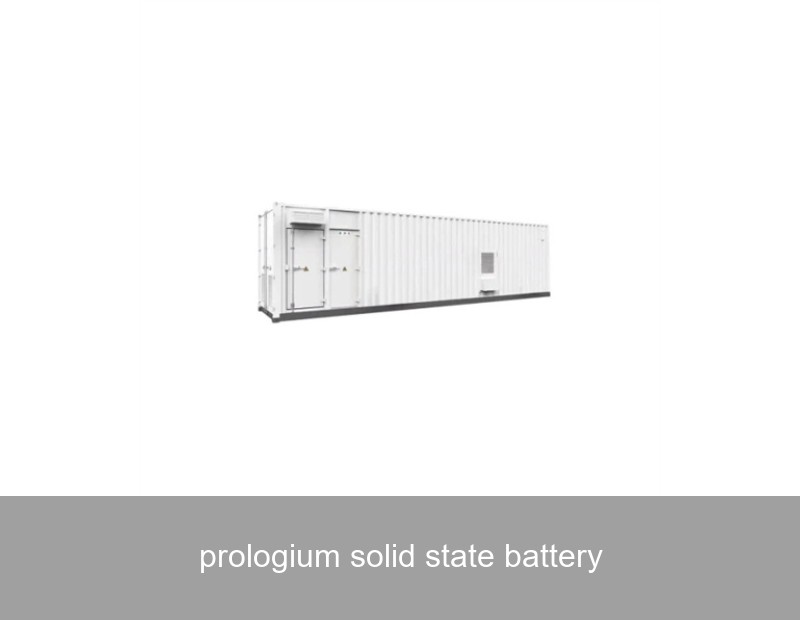
Table of Contents
If you're managing a commercial facility, planning a residential community project, or simply keeping an eye on the clean energy transition, you've likely heard the buzzword: solid-state battery. Among the frontrunners, the name Prologium solid state battery consistently surfaces. But what does this technology actually mean for your energy independence, costs, and sustainability goals? Let's move beyond the hype and explore the tangible impact this innovation could have on how we store and use renewable power.
The Challenge: Storing the Sun and Wind
Renewable energy has a scheduling problem. The sun sets, the wind calms, but our factories, homes, and cities need power 24/7. This mismatch is the single biggest hurdle to a fully decarbonized grid. Traditional lithium-ion batteries, while revolutionary, come with their own set of concerns: thermal runaway risks, degradation over time, and performance limitations in extreme temperatures. This is where the search for a safer, more robust successor intensifies, bringing solid-state technology—and specifically ProLogium's approach—into sharp focus.

Think of it this way: our current energy storage landscape needs an upgrade from a reliable but aging workhorse to a next-generation, all-weather champion.
What is a ProLogium Solid State Battery? Breaking Down the Tech
At its core, a solid-state battery replaces the flammable liquid electrolyte in conventional lithium-ion cells with a solid ceramic or polymer electrolyte. ProLogium, a Taiwanese pioneer founded in 2006, has developed a unique oxide ceramic solid electrolyte. Their technology, known as Prologium solid state battery solutions, is notable for its proprietary stacking process and bipolar design.
Here’s a simple comparison to highlight the key shift:
| Feature | Traditional Li-ion (Liquid Electrolyte) | Prologium Solid-State (Oxide Ceramic) |
|---|---|---|
| Safety | Risk of fire/thermal runaway | Inherently stable; significantly reduced fire risk |
| Energy Density | Good, but plateauing | Potentially 2x higher (theoretical) |
| Operating Temperature | Limited range | Wider range, better performance in cold |
| Lifespan (Cycle Life) | ~3,000 - 5,000 cycles | Targeting >10,000 cycles |
This isn't just an incremental improvement. It's a fundamental redesign that tackles the core weaknesses of current storage systems, promising a future where battery packs are smaller, safer, and last decades longer.
By the Numbers: The Solid-State Advantage
Let's talk data. ProLogium has demonstrated cells with an energy density exceeding 1,000 Wh/L in its labs, a critical step towards making electric vehicles and long-duration storage more practical. Perhaps more compelling for grid operators is the cycle life. While real-world, large-scale data is still being gathered, the target of >10,000 full charge-discharge cycles could translate to a system lifespan of 20-30 years with minimal degradation. For a commercial solar farm, this dramatically alters the total cost of ownership calculus.
You can delve into the broader scientific context of solid-state battery development through resources like the U.S. Department of Energy's Vehicle Technologies Office.
From Lab to Grid: A European Microgrid Case Study
Technology is only as good as its application. Consider a forward-thinking project in Southern Europe, where a consortium is developing an off-grid industrial microgrid. The challenge: power a 24/7 agro-processing plant solely with on-site solar and wind, requiring not just daily load-shifting but also multi-day resilience during periods of low generation.
- Project Goal: 100% renewable, off-grid operation for a 5 MW load.
- Traditional Solution: A massive lithium-ion battery bank (20+ MWh) would be needed, with significant space, safety cooling requirements, and an expected replacement cycle of 10-15 years.
- Innovative Pilot: The consortium is integrating a 2 MWh Prologium solid state battery system as a high-performance core. Its compact size fits into a constrained footprint, its safety profile reduces the need for complex fire suppression, and its projected longevity aligns with the 25-year lifespan of the solar assets.
Early data from the integration phase shows the system maintaining over 95% round-trip efficiency even during peak summer temperatures where traditional systems often derate. This single pilot doesn't prove everything, but it provides a crucial, real-world data point: solid-state is moving from automotive roadmaps into tangible energy infrastructure. For further reading on microgrid advancements, the International Energy Agency's innovation tracking offers valuable insights.
Highjoule's Role in the Next-Generation Storage Ecosystem
As a global provider with nearly two decades of experience since 2005, Highjoule's mission is to integrate the most reliable and efficient storage technologies into solutions that work for our clients today, while actively preparing for the breakthroughs of tomorrow. We view innovations like the Prologium solid state battery not as distant futures, but as the coming evolution of our product lines.
Our current H-Series commercial & industrial battery energy storage systems (BESS) are engineered for intelligence and durability, featuring advanced thermal management and predictive software—the very same integration expertise that will be essential for deploying next-generation solid-state modules when they reach full commercial maturity.

For our residential and microgrid clients, this means the Highjoule Energy Hub platform is designed with forward compatibility in mind. The transition to higher-density, safer chemistries will be a seamless upgrade path, protecting your investment. We are actively engaged in testing and development partnerships to ensure that when solid-state technology is ready for widespread deployment, Highjoule systems will be ready to deliver its full benefits—be it for peak shaving at a manufacturing plant, backup power for a hospital, or optimizing self-consumption for a housing development.
Looking Ahead: Open Questions and Your Next Step
The potential is undeniable, but practical minds have questions. What is the current cost per kWh compared to mature lithium-ion? How will recycling ecosystems develop? The industry is working through these challenges, with scale-up being the primary hurdle. The key for energy decision-makers is not to wait, but to build a storage strategy that is adaptable.
So, here's a question for you: As you evaluate your organization's or community's energy resilience plan for the next decade, how are you factoring in the arrival of storage technologies that could double lifespan and eliminate major safety concerns? Are your infrastructure plans flexible enough to adopt these advancements?
We invite you to explore how Highjoule's intelligent storage solutions can future-proof your energy assets today. The journey to solid-state and beyond is already underway.
 Inquiry
 Online Chat