


Power Storage for Solar Panels: The Key to Unlocking True Energy Independence
You've made the smart decision to install solar panels. You're watching them generate clean energy, reducing your carbon footprint and your electricity bills. But have you ever stood looking at your panels on a brilliantly sunny afternoon, only to realize you're at work and your home isn't using most of that power? Or felt a twinge of anxiety as clouds roll in, wondering if you'll need to draw from the grid tonight? This, right here, is the missing piece of the puzzle. The true potential of your solar investment isn't fully realized until you pair it with power storage for solar panels. Let's explore how this technology transforms solar from a partial solution into a complete energy revolution.
The Solar Dilemma: When the Sun Doesn't Shine
Solar panels are fantastic producers, but they operate on nature's schedule, not yours. The fundamental challenge is intermittency. Generation peaks in the middle of the day, often when demand in homes is lowest. In the evening, when families return home, switch on lights, appliances, and heating, solar production falls to zero. This creates a mismatch.
Without storage, excess solar energy is typically fed back into the grid (through schemes like net metering), and you draw power back when you need it. But this model has limitations:
- Grid Dependency: You're still reliant on the utility grid, especially at night.
- Reduced Value: The credit you get for exported power is often far less than the retail price you pay for imported power.
- Vulnerability: Grid outages mean your solar system usually shuts off too, leaving you in the dark even on a sunny day.
This is where adding a battery energy storage system (BESS) changes the entire equation. It shifts solar energy from the time it's produced to the time it's needed.
What is Power Storage for Solar Panels?
At its core, power storage for solar panels is a system that captures the electricity your panels generate and holds it for later use. The most common and efficient technology for homes and businesses today is the lithium-ion battery system. Think of it as a high-tech, high-capacity energy bank for your property.
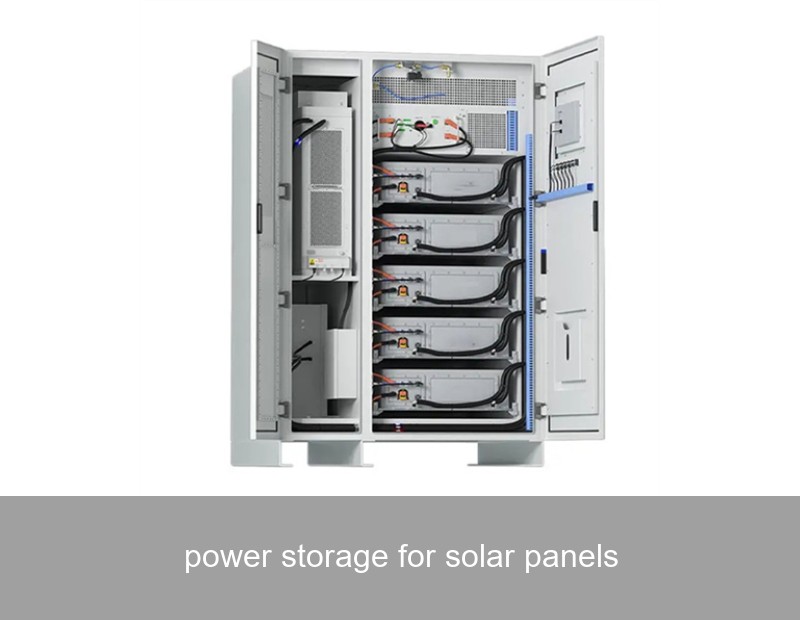
A typical system includes:
- Battery Modules: The physical units that store DC (Direct Current) electricity.
- An Inverter/Charger: Often an integrated unit that performs three critical jobs: converting the DC solar power to AC (Alternating Current) for your home, converting AC to DC to charge the batteries, and managing the flow of energy between all components.
- A Battery Management System (BMS): The brain of the operation, ensuring safety, longevity, and optimal performance by monitoring cell voltage, temperature, and state of charge.
- System Controller: The intelligent software that decides, based on your settings, weather forecasts, and tariff rates, when to store, use, or export energy.

Image Source: Unsplash - A modern home energy storage system, neatly integrated.
The Benefits Unlocked: More Than Just Backup
Integrating storage with solar isn't just about having lights on during a storm. It delivers a multi-layered value proposition:
| Benefit | How It Works | Direct Impact |
|---|---|---|
| Maximized Self-Consumption | Store your daytime surplus to use in the evening. | Dramatically reduce grid imports, slashing your electricity bill. |
| Energy Resilience & Backup | During a grid outage, the system island your home, powering critical loads from the battery. | Peace of mind and continuity for essential appliances, security, and comfort. |
| Time-of-Use (TOU) Optimization | Intelligent software avoids drawing power during expensive peak-rate periods by using stored energy. | Further cost savings in regions with TOU pricing, which is becoming standard in many US states and parts of Europe. |
| Grid Support & Sustainability | By reducing peak demand on the grid, you help stabilize the network and allow for higher renewable penetration. | Contribute to a cleaner, more resilient community energy infrastructure. |
Real-World Impact: A Case Study from California
Let’s move beyond theory. Consider the real-world example of a mid-sized winery in Sonoma County, California. The region faces frequent Public Safety Power Shutoffs (PSPS) to prevent wildfires, threatening not just comfort but critical refrigeration for wine production.
Phenomenon: The winery had a 250 kW solar array but remained vulnerable to multi-day grid outages.
Data & Solution: They installed a 500 kWh battery storage system integrated with their existing solar. The system was sized to maintain all critical operations—refrigeration, lighting, and tasting room facilities—for up to 72 hours without sun or grid.
Case Results: In the first year:
- Grid energy consumption reduced by 92% during peak summer months.
- Successfully rode through three separate PSPS events, saving an estimated $85,000 in potential product spoilage.
- Leveraged California's SGIP (Self-Generation Incentive Program) to offset a significant portion of the system cost.
Insight: For this business, power storage for solar panels transformed from a cost item into a critical business continuity and financial asset. It turned a liability (grid instability) into a competitive advantage. You can read more about the importance of storage for grid resilience from the U.S. Department of Energy.
Choosing the Right System for Your Needs
Not all storage systems are created equal. Key considerations include:
- Capacity (kWh): How much energy can it store? This determines how long it can power your home.
- Power Rating (kW): How much power can it deliver at once? This determines how many appliances you can run simultaneously.
- Depth of Discharge (DoD): The usable percentage of the battery's total capacity. A higher DoD means more usable energy.
- Round-Trip Efficiency: The percentage of energy put into storage that you can later use. High-quality systems exceed 90%.
- Scalability & Integration: Can you easily add more batteries later? Does it seamlessly integrate with new or existing solar?
Highjoule's Intelligent Solutions for a Sustainable Future
At Highjoule, with nearly two decades of experience since 2005, we've moved beyond just providing batteries. We engineer intelligent, integrated energy ecosystems. Our approach to power storage for solar panels is built on three pillars: Intelligence, Resilience, and Sustainability.
For residential clients, our Home Energy Hub is a sleek, all-in-one unit that combines a high-efficiency hybrid inverter with scalable lithium iron phosphate (LiFePO4) battery modules. Its AI-driven software learns your consumption patterns, integrates weather forecasts, and can be configured to automatically optimize for self-consumption, cost savings, or backup readiness. It's the true brain of your home's energy flow.
For commercial and industrial applications, our C&I Energy Storage Series offers modular, containerized solutions. These systems are designed to manage demanding loads, participate in demand charge reduction programs, and provide critical backup power. A great example is our work with a manufacturing plant in Germany, where our system stores excess wind and solar from their onsite microgrid, smoothing out production and cutting their energy costs by over 30%. Learn about global storage trends from the International Energy Agency.

Image Source: Unsplash - Large-scale battery storage supporting a renewable energy site.
The Highjoule Advantage: Built to Last
Our systems use premium LiFePO4 chemistry, renowned for its safety, long cycle life (typically over 6000 cycles), and stability. Coupled with our 24/7 cloud-based monitoring platform, Highjoule Guardian, we ensure your investment is protected and performing optimally for decades. We provide a complete solution: from initial consultation and system design to professional installation, commissioning, and ongoing support.
The Future of Solar is Stored
The synergy between solar generation and battery storage is undeniable. It's the combination that finally allows homeowners and businesses to take genuine control of their energy destiny. As electricity prices continue to fluctuate and the climate makes grid reliability a growing concern, the question is evolving from "Should I get solar?" to "How can I make my solar work for me, 24 hours a day?"
With advancements in battery technology and smart energy management, the vision of a truly resilient, efficient, and sustainable energy home or business is not a distant future—it's available today. What would you power first with your own personal energy reserve?
 Inquiry
 Online Chat