


Power Safe OPzS Batteries: How Much Do They Cost and Are They Worth It?
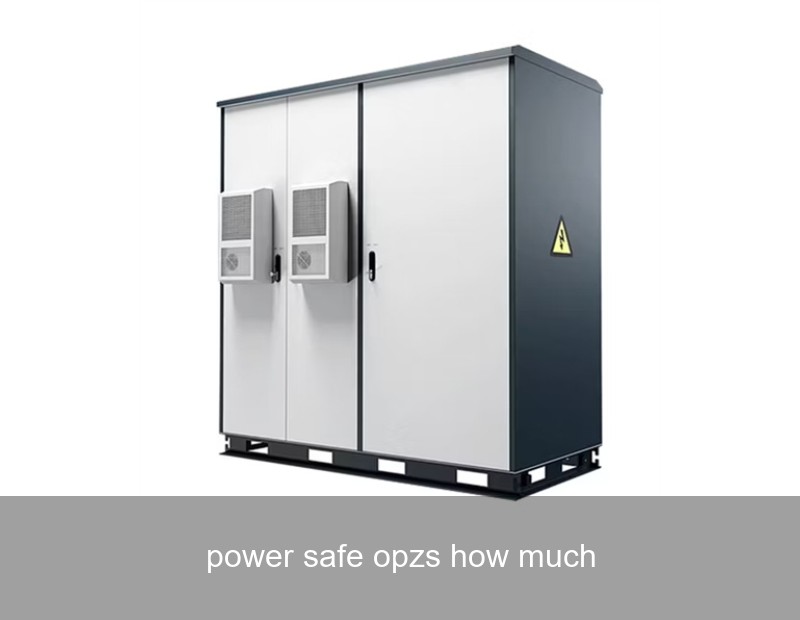
If you're designing a robust off-grid system, a critical industrial backup, or a large-scale renewable energy storage solution, you've likely encountered the term "OPzS." These flooded tubular plate batteries are renowned for durability. But the immediate question arises: Power Safe OPzS, how much does such reliability cost? The answer isn't a simple price tag. It's an investment calculation that spans decades, weighing upfront cost against legendary lifespan and performance in deep-cycle applications. As a product technology expert at Highjoule, a global leader in advanced energy storage since 2005, I'll guide you beyond the sticker price to the true value of OPzS and when modern alternatives might be a smarter power-safe choice.
Table of Contents
- What Exactly is a Power Safe OPzS Battery?
- Decoding the Cost: Key Factors Influencing OPzS Pricing
- The Real Price Tag: Understanding Total Cost of Ownership (TCO)
- Case Study: OPzS in a European Microgrid
- Modern Alternatives: Where Does OPzS Stand Today?
- The Highjoule Approach: Tailored, Intelligent Storage Solutions
What Exactly is a Power Safe OPzS Battery?
Let's break down the name. "OPzS" is a German standard designation (DIN 40736). 'O' stands for Ortsfest (stationary), 'P' for Panzerplatte (tubular plate), 'z' for verschlossen (closed, but with vents), and 'S' for Schwefelsäure (sulfuric acid electrolyte). In essence, it's a flooded lead-acid battery with a unique construction: the positive plate consists of lead alloy spines surrounded by porous, tubular sleeves filled with active material.
This design is the secret to its longevity. The tubes prevent active material from shedding during deep discharge cycles, which is the primary failure mode of standard flat-plate batteries. This makes OPzS batteries the workhorse for applications demanding daily, deep cycling over 15 to 20 years. Think telecommunications in remote areas, uninterruptible power supply (UPS) for critical infrastructure, or off-grid solar storage where maintenance visits are costly and infrequent.

Image Source: Crown Battery (Illustrative diagram of tubular plate design)
Decoding the Cost: Key Factors Influencing OPzS Pricing
Asking "how much for a Power Safe OPzS" is like asking the price of a commercial truck—it depends heavily on specifications. Here are the primary variables:
- Capacity (Ah): This is the biggest driver. OPzS batteries are typically sold in 2V cells. A single 2V 1000Ah cell will cost significantly less than a 2V 2000Ah cell. Systems are built by series-connecting cells for voltage (e.g., 24V = 12 cells) and parallel-connecting for capacity.
- Brand and Quality: Established European manufacturers command a premium due to proven track records, high-quality lead alloys, and rigorous quality control. This directly impacts lifespan.
- Quantity and System Voltage: Purchasing a full 48V bank for a solar farm will have a different per-kWh cost than buying a few cells for a small backup system.
- Accessories & Installation: Don't forget the ancillary costs: robust battery racks, ventilation systems, spill containment, specialized charging controllers, and professional installation. OPzS batteries are heavy and require proper handling.
| Application | Typical System Size | Key Cost Consideration |
|---|---|---|
| Off-Grid Residential (Large) | 20 kWh - 40 kWh | Battery bank, charge controller, reinforced floor, ventilation. |
| Telecom Tower Backup | 10 kWh - 30 kWh | Durability for daily cycling in harsh temperatures. |
| Industrial UPS | 50 kWh - 500+ kWh | Space, maintenance infrastructure, and long-term reliability contracts. |
The Real Price Tag: Understanding Total Cost of Ownership (TCO)
The true cost of an OPzS battery is measured over its service life, not at purchase. This is the Total Cost of Ownership (TCO).
Phenomenon: A project manager sees a lower upfront cost for flat-plate AGM batteries versus OPzS.
Data: While a quality OPzS system might cost 40-60% more upfront than an AGM system of similar capacity, its cycle life at 80% depth-of-discharge (DoD) can be 3,000+ cycles, compared to 500-1,000 for AGM. Over a 20-year design life, you might replace AGM batteries 3-4 times.
Case Insight: For a 30kW off-grid load requiring 8 hours of backup daily, the OPzS solution, despite its higher initial investment, results in a lower cost per cycle and per kilowatt-hour delivered over two decades. You're paying more today for significantly lower operational expenses and downtime risk tomorrow. Regular maintenance (watering, equalization charges, terminal cleaning) is a mandatory operational cost for OPzS, which must be factored in.
Case Study: OPzS in a European Microgrid
Let's examine a real-world scenario to ground our discussion. A remote alpine resort in Switzerland aimed to achieve 95% energy independence using hydro and solar power. They needed a battery bank to handle daily load shifting and multi-day autonomy during winter storms.
- Project: Hybrid Renewable Microgrid for Resort.
- Storage Choice (2015): A 400 kWh OPzS flooded lead-acid battery bank.
- Initial Cost (2015): Approximately €80,000 for the battery cells alone.
- Performance Data: Over 8 years of operation, the bank has provided over 2,500 deep cycles. With disciplined monthly maintenance, capacity degradation remains within 15% of the original specification, well on track to meet the 15-year design life.
- The Trade-off: The resort employs a full-time technician whose duties include battery maintenance. The system requires a dedicated, ventilated battery room. The TCO, when including labor and space, remains favorable compared to the original alternative (generator fuel), but it's not "fit-and-forget."
This case highlights the perfect niche for OPzS: a stationary, managed environment where skilled maintenance is available, and the priority is proven, predictable long-life cycling over ultra-high efficiency or compactness.
Modern Alternatives: Where Does OPzS Stand Today?
The energy storage landscape has transformed with the rise of Lithium-ion (Li-ion), particularly Lithium Iron Phosphate (LFP). So, where does that leave OPzS?
For new projects, the calculus has changed. Highjoule's intelligent BESS (Battery Energy Storage System) solutions predominantly feature LFP chemistry for most commercial and industrial applications. Here's a quick comparison relevant to our "power safe" inquiry:
- Cycle Life & DoD: Modern LFP batteries (like those in Highjoule's H-Series) offer 6,000+ cycles at 90% DoD, outperforming even OPzS in cycle longevity relative to depth of discharge.
- Efficiency & Space: LFP systems are 95-98% efficient (vs. ~80% for lead-acid), meaning more of your solar power is stored. They require about 1/3 the space and have no regular maintenance needs.
- TCO Today: While lithium upfront costs per kWh are now competitive with premium OPzS installations, the zero-maintenance, high-efficiency, and longer warranty (often 10+ years) of LFP typically results in a lower TCO for daily cycling applications.
- The OPzS Niche Remains: OPzS is still a compelling choice for projects with extreme budget constraints upfront, in very high-temperature environments where lithium may require extra cooling, or for engineers and communities who prefer a simple, repairable technology with a 100-year history. It's also a common choice for capacity-driven (vs. power-driven) applications where discharge rates are low and steady.
According to a U.S. Department of Energy report, the levelized cost of storage (LCOS) for lithium-ion has fallen dramatically, making it the dominant new chemistry for broad storage applications.
The Highjoule Approach: Tailored, Intelligent Storage Solutions
At Highjoule, our mission isn't to sell you a specific battery chemistry. It's to provide the most intelligent, sustainable, and economically optimal power-safe solution for your unique need. Our expertise, honed since 2005, allows us to design systems without bias.
For a large, remote microgrid with on-site staff, a Highjoule OPzS-based solution might indeed be the most robust and cost-effective over 20 years. We would integrate it with our smart battery management and monitoring platform to optimize its health and provide predictive maintenance alerts.
However, for the vast majority of our commercial and industrial clients across Europe and the U.S.—from manufacturing plants seeking demand charge reduction to housing developments adding solar storage—our H-Series Lithium-Ion BESS is the benchmark. It's a fully integrated, containerized or rack-mounted system with built-in power conversion, safety systems, and our EnergyOS software for AI-driven energy management. It installs in days, not weeks, and starts saving money from day one with no operational burden.

Image Source: Highjoule.com (Example of a modern, integrated BESS solution)
We also offer OPzV (valve-regulated gel) solutions, a maintenance-free alternative to OPzS with similar durability for specific use cases, bridging the gap between flooded and lithium technologies.
So, How Much for a Power Safe Solution?
Returning to your original question: "Power Safe OPzS how much?" The range is wide—anywhere from several thousand to hundreds of thousands of Euros or Dollars. But the more pertinent question we help you answer is: "What is the optimal storage technology to ensure safe, reliable power for my specific application at the lowest total cost of ownership over the next 20 years?"
The answer involves a detailed analysis of your load profiles, cycling requirements, site conditions, and sustainability goals. Perhaps you need the rugged, timeless reliability of OPzS. Or perhaps the advanced intelligence of a modern lithium system is a better fit. The IEA emphasizes that the right storage choice is critical to integrating renewables and enhancing grid resilience.
What's the primary challenge you're hoping to solve with a long-life, power-safe battery system—is it achieving total energy independence, securing critical backup, or maximizing the return on your solar investment?
 Inquiry
 Online Chat