


Mechanical Battery for Home: The Resilient and Sustainable Energy Future
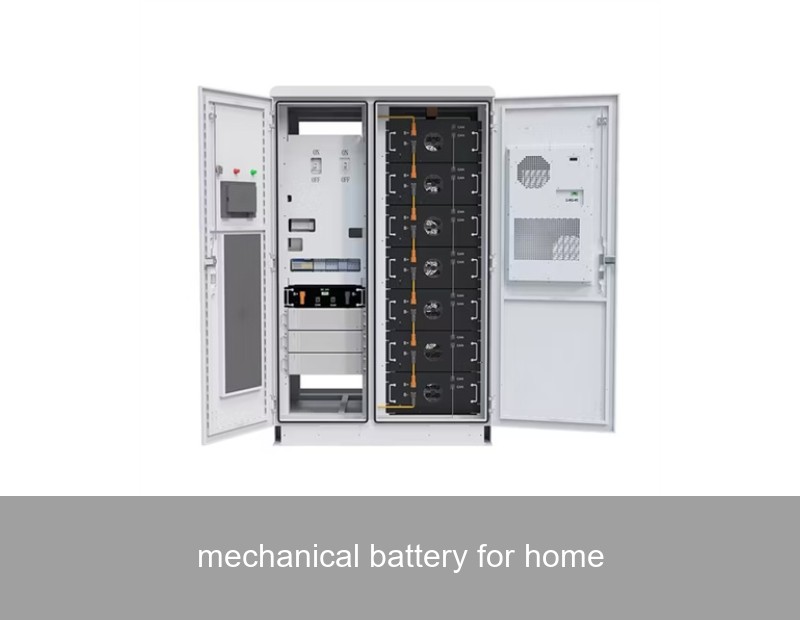
Imagine a home energy system that stores power not in complex chemical reactions, but in the simple, timeless motion of a spinning wheel. This is the promise of the mechanical battery for home, specifically flywheel energy storage. While lithium-ion batteries dominate headlines, a quiet revolution in mechanical storage is offering homeowners unparalleled durability and sustainability. As grid instability and extreme weather events increase, understanding all your storage options is key to true energy independence. In this deep dive, we'll explore how mechanical principles are being reimagined for modern homes and why integrating them with advanced electrochemical systems, like those from Highjoule, creates the ultimate resilient power solution.
Table of Contents
- What is a Mechanical Home Battery?
- Flywheel vs. Chemical Batteries: A Homeowner's Comparison
- The Hybrid Solution: Where Highjoule's Expertise Shines
- A Real-World Case: Frequency Regulation in Vermont
- Is a Mechanical Battery Right for Your Home?
What is a Mechanical Home Battery? Beyond Chemistry
At its core, a mechanical battery stores energy as kinetic energy—the energy of motion. The most developed technology for home-scale use is the flywheel energy storage system (FESS). Picture a heavy rotor spinning at incredibly high speeds in a near-frictionless environment, such as a vacuum chamber with magnetic bearings. When you have excess solar power, an electric motor accelerates the flywheel. When you need power, the spinning rotor acts as a generator, converting kinetic energy back into electricity. It's a beautifully simple concept with profound advantages: minimal degradation over hundreds of thousands of cycles, performance unaffected by temperature extremes, and no hazardous materials.

Image Source: Wikimedia Commons (Creative Commons)
Flywheel vs. Chemical Batteries: A Homeowner's Comparison
Let's break down how flywheel storage stacks up against the familiar lithium-ion battery for residential use.
| Feature | Flywheel (Mechanical) Battery | Lithium-ion (Chemical) Battery |
|---|---|---|
| Lifespan & Cycles | Extremely high (20+ years, 100,000s of cycles) | 10-15 years, 5,000-10,000 cycles (with degradation) |
| Response Time | Near-instantaneous (milliseconds) | Very fast (seconds) |
| Temperature Tolerance | Excellent; operates in wide ranges | Requires thermal management; degrades in extremes |
| Energy Density | Lower; bulkier for long-duration storage | Higher; compact for kWh storage | Primary Home Use Case | Ultra-fast backup, power quality, frequent cycling | Daily load shifting, solar self-consumption, backup for hours |
The table reveals the core truth: they are complementary. A flywheel excels at providing massive power in short bursts and handling constant micro-cycles without wear. A lithium-ion battery is ideal for storing energy over longer periods. This is where a smart, integrated system becomes paramount.
The Hybrid Solution: Where Highjoule's Expertise Powers Your Home
At Highjoule, we believe the future of home energy is not a single technology, but an intelligently orchestrated symphony of storage solutions. Our Adaptive Home Energy Platform (AHEP) is designed to do exactly that. While we specialize in advanced, long-duration lithium-ion and solid-state battery systems, our platform's architecture is agnostic. It can seamlessly integrate a mechanical flywheel for instantaneous power stabilization with our high-capacity battery banks for sustained energy delivery.
Think of it this way: during a brief grid flicker or a cloud passing over your solar array, a flywheel can inject power in milliseconds to keep your sensitive electronics running smoothly. Then, during a prolonged outage, our Highjoule H-Series battery systems take over, powering your essential loads for hours or even days. Our AI-driven energy management system decides, in real-time, the most efficient and protective use of each storage asset. This hybrid approach maximizes the lifespan of all components—handling frequent, small fluctuations with the mechanical battery and deeper cycles with the chemical battery—delivering a system that is more resilient, sustainable, and cost-effective over its lifetime.

Image Source: Unsplash
A Real-World Case: Frequency Regulation in Vermont Paves the Way
While large-scale implementations are more common today, they provide a clear blueprint for home-scale potential. Consider the project in Stephentown, New York, and Hazle Township, Pennsylvania, funded by the U.S. Department of Energy. Beacon Power installed 20 MW of flywheel storage to provide frequency regulation to the grid—constantly absorbing and injecting tiny amounts of power to keep the grid's 60 Hz frequency stable. These flywheels have operated for years, performing over millions of cycles with minimal maintenance, proving the legendary durability of the technology.
Now, translate this to a home with a large solar installation in, say, Texas or Southern Europe. Grid voltage can fluctuate wildly with concentrated solar feed-in. A small-scale flywheel, integrated with a Highjoule system, could act as a local "shock absorber," stabilizing the power for the home and even the local neighborhood circuit. This not only protects appliances but can also provide grid-support services, potentially creating a new revenue stream for the homeowner. The data from these large-scale projects gives us immense confidence in the longevity and reliability of the core technology as it scales down.
Is a Mechanical Battery Right for Your Home? Key Considerations
Integrating a mechanical battery is a sophisticated choice. Here’s what to ponder:
- Your Primary Need: Is it for seamless, sub-second backup to protect high-end home offices and data centers? Or is it primarily for overnight load shifting? For the latter, traditional batteries are optimal.
- Space and Installation: Flywheels require specific installation considerations (like a stable, vibration-tolerant base). Our Highjoule technical team provides full-site audits to assess viability.
- The Integration Imperative: The true value is unlocked only through sophisticated control software. This is the heart of our AHEP platform, which manages the complex handshake between mechanical, chemical, and renewable generation sources.
- Total Cost of Ownership (TCO): While upfront cost may be higher, the 25-30 year lifespan with minimal degradation can make the TCO competitive for specific use cases.
Looking Ahead: Your Home as a Resilient Power Plant
The conversation around home energy storage is moving beyond just "how many kilowatt-hours." It's about quality, resilience, and sustainability. A mechanical battery for home represents the high-performance, long-life end of the spectrum. When harmoniously combined with Highjoule's high-density battery storage and intelligent management, it creates a home energy system that is greater than the sum of its parts—ready to handle both a fleeting voltage dip and a multi-day grid outage.
What specific power quality issues or resilience goals are you hoping to solve with your home energy system that a standard battery alone might not address?
 Inquiry
 Online Chat