


What Are the Largest Solar Panels Available and Why Do They Matter for Your Energy Future?
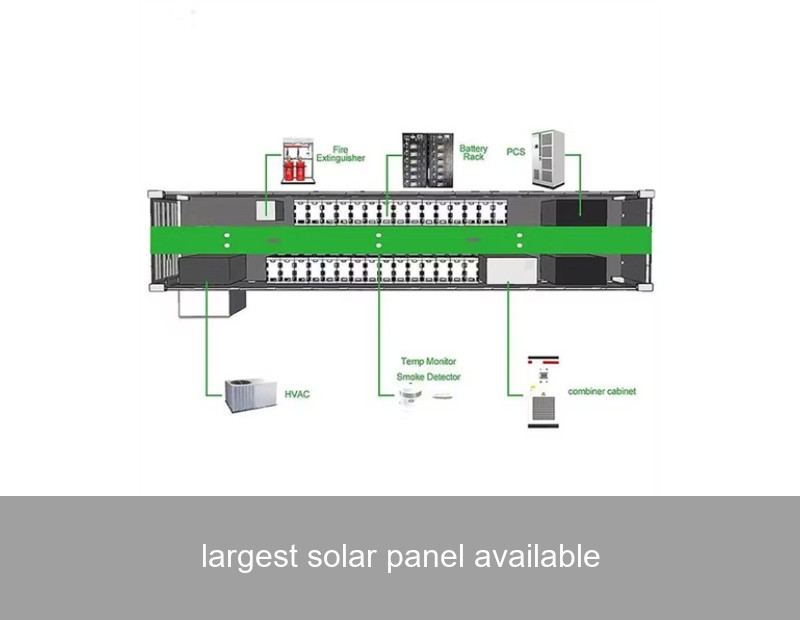
As a homeowner or business leader looking to harness solar power, you've likely asked: "How can I get the most energy from my roof?" This quest for efficiency naturally leads to a fascinating trend in photovoltaics: the race to produce the largest solar panel available. But are these giant panels just a technical marvel, or do they translate into real-world benefits for your energy independence and return on investment? In this article, we'll demystify the world of large-format solar modules, exploring their advantages, key considerations, and how they integrate with modern energy storage to create truly resilient power systems.
Table of Contents
- The Size Evolution: From Standard to "Giant" Panels
- Beyond Dimensions: The Real Benefits of Larger Panels
- Key Considerations Before Choosing the Largest Panels
- Case Study: Maximizing a Commercial Rooftop in Germany
- The Perfect Pair: Large Solar Panels and Intelligent Energy Storage
- Making the Decision: Is Bigger Always Better for You?
The Size Evolution: From Standard to "Giant" Panels
Let's start with some context. For years, the standard 60-cell or 72-cell solar panel dominated the market, with dimensions around 1.7m x 1.0m. Today, the landscape is shifting dramatically. Manufacturers are now producing panels based on larger silicon wafers (like M10, M12, or G12), leading to modules with cell counts of 108, 120, 132, and beyond. So, what qualifies as the largest solar panel available currently? We're now seeing panels exceeding 2.4 meters in length and 1.3 meters in width, with power outputs soaring past 600W, even reaching 700W and above for commercial-grade products.

Image Source: Unsplash - Visual comparison of panel sizes on a commercial roof.
This isn't just about making a bigger rectangle. The drive for size is intrinsically linked to efficiency and economics. Larger panels mean more active solar cells per unit, reducing the proportion of inactive frame area. This, combined with advanced cell technologies like PERC, TOPCon, or HJT, allows each panel to generate significantly more kilowatt-hours over its lifetime. According to the National Renewable Energy Laboratory (NREL), average module efficiencies have climbed steadily, with larger formats often leveraging the latest high-efficiency cell architectures.
Beyond Dimensions: The Real Benefits of Larger Panels
Why should you care about this trend? The advantages extend far beyond a simple power rating.
- Reduced Balance of System (BOS) Costs: Fewer panels are needed to achieve a target system capacity. This means fewer racking components, fewer electrical connections, and less labor time for installation. The result is a lower cost per installed watt.
- Optimal Land/Roof Utilization: For space-constrained projects, maximizing every square meter is critical. Higher-wattage panels allow you to reach your energy goals on a limited footprint, a key factor for commercial and industrial buildings.
- Streamlined Logistics & Design: While handling requires care, using fewer panels simplifies system design and can reduce the number of shipping pallets. For large-scale projects, this logistical efficiency is a major boon.
However, it's crucial to understand that these benefits are fully realized only when the entire system is designed to handle the increased current and physical size of these modules.
Key Considerations Before Choosing the Largest Panels
Before you decide to install the biggest panel on the market, here are some practical factors to weigh:
| Consideration | Question to Ask | Why It Matters |
|---|---|---|
| Structural Integrity | Can my roof support the weight and wind load of larger, heavier panels? | Safety and longevity of your installation. A professional structural assessment is non-negotiable. |
| Handling & Installation | Do my installers have the equipment and experience to safely maneuver these panels? | Larger panels can be more challenging to carry and position, potentially increasing installation complexity. |
| Inverter Compatibility | Are my chosen inverters rated for the higher current (Imp) and voltage (Voc) of these panels? | Mismatched components can lead to clipping (loss of energy) or even system faults. |
The key takeaway? The largest solar panel available is not universally the "best." The optimal choice is the panel that best matches your specific site constraints, energy needs, and budget, when paired with correctly sized supporting equipment.
Case Study: Maximizing a Commercial Rooftop in Germany
Let's look at a real-world application in Europe. A mid-sized manufacturing company in Bavaria, Germany, wanted to offset 80% of its daytime energy consumption. Their rooftop space was ample but had irregular shapes due to ventilation units and skylights.
The Challenge: Maximize energy yield on the available usable roof area.
The Solution: The system designer opted for high-wattage, large-format 670W panels. Compared to a standard 450W panel design:
- Panel Count Reduction: They required 1,200 of the 670W panels versus 1,780 of the 450W panels to achieve the same ~800kWp system size.
- Installation Efficiency: The number of mounting points and DC cable runs was reduced by approximately 33%.
- Space Efficient: The higher density allowed them to fit the required capacity while avoiding shaded areas, which was not possible with the lower-wattage layout.
The project achieved its target generation, and the reduced installation time minimized business disruption. This case highlights how large-format panels solve specific spatial and economic challenges in commercial settings.
The Perfect Pair: Large Solar Panels and Intelligent Energy Storage
Producing abundant solar energy is only half the battle. The true modern energy solution lies in storing and managing that power intelligently. This is where companies like Highjoule excel. Our expertise isn't just in understanding the latest panel technology; it's in seamlessly integrating that generation with advanced Battery Energy Storage Systems (BESS).
Imagine your new array of high-output panels generates a surplus at midday. Without storage, that excess energy might be exported to the grid at a low rate. With a Highjoule system, that clean power is stored in our intelligent battery systems for use when the sun isn't shining—during evening peak demand hours or during a grid outage. Our H-series commercial storage solutions and ResiCore home energy systems are designed to handle the high input from modern, large solar arrays, optimizing every kilowatt-hour you produce.

Image Source: Unsplash - A modern home with solar panels and a wall-mounted battery storage unit.
For microgrids and industrial applications, this synergy is even more critical. Highjoule's GridMax™ microgrid controllers can orchestrate power from massive solar farms using the largest panels, coupled with megawatt-scale storage, to provide reliable, off-grid power or grid stabilization services. By thinking of generation and storage as one cohesive system, you unlock true energy independence and resilience.
Making the Decision: Is Bigger Always Better for You?
So, should your next project feature the largest solar panel available? The answer depends on your unique "energy fingerprint." For a large, unobstructed commercial roof or ground-mount installation, they can be a game-changer for cost and yield. For a residential roof with multiple chimneys and dormers, smaller, more maneuverable panels might allow for a better, higher-yielding layout.
The most successful projects start with a holistic energy assessment. At Highjoule, we begin by analyzing your consumption patterns, physical site, and energy goals. We then model different combinations of generation (including the latest panel technologies) and storage to provide a solution that delivers the highest long-term value and reliability, not just the highest panel wattage.
The solar landscape is evolving rapidly. Staying informed about technology trends is wise, but partnering with an expert who can translate those trends into a reliable, tailored system is paramount. What is the primary challenge you hope to solve with solar energy—reducing peak demand charges, achieving backup power, or simply maximizing your return on investment?
 Inquiry
 Online Chat