


Unlocking Maximum Power: A Guide to the Highest Solar Panel Wattage for Your Energy Independence
Have you ever looked at your roof and wondered just how much power you could really generate? The quest for the highest solar panel wattage isn't just a technical race among manufacturers; it's a direct path to greater energy independence, lower bills, and a more sustainable footprint. For homeowners and businesses across Europe and the U.S., understanding this metric is key to optimizing their solar investment. Higher wattage panels produce more electricity in the same physical space, making them a powerful solution for maximizing limited roof area or achieving ambitious clean energy targets. But what does "wattage" truly mean for your system's performance, and how can you leverage the latest technology effectively? Let's demystify the power behind the panel.
Table of Contents
- What Does "Highest Solar Panel Wattage" Actually Mean?
- The Evolution of Panel Power: From Silicon to Cutting-Edge Cells
- Beyond the Spec Sheet: The Real-World Impact of High-Wattage Panels
- Case Study: Maximizing a Commercial Rooftop in Germany
- The Crucial Synergy: Why Your Inverter and Battery Matter Just as Much
- Future Horizons: What's Next for Solar Panel Efficiency?
- Choosing the Right Panel for Your Energy Goals
What Does "Highest Solar Panel Wattage" Actually Mean?
In simple terms, a solar panel's wattage (measured in watts, W) indicates its maximum power output under ideal laboratory conditions, known as Standard Test Conditions (STC). A panel rated at 450W will produce more electricity per hour of peak sunlight than one rated at 350W. The push for the highest solar panel wattage is fundamentally about power density—getting more kilowatt-hours (kWh) out of every square meter of your roof.
This is particularly crucial in markets like Europe, where roof space can be limited by historic architecture, or in the U.S., where energy demands are high. By choosing higher-wattage panels, you effectively need fewer panels to reach your desired energy production, which can reduce installation hardware and labor costs. However, raw wattage is just one part of the equation. The panel's efficiency percentage tells you how well it converts sunlight into electricity. Today, premium panels combine high wattage with efficiencies exceeding 22%, a feat made possible by advanced cell technology.
The Evolution of Panel Power: From Silicon to Cutting-Edge Cells
The journey to 400W, 500W, and now even 700W+ panels is a story of relentless innovation. It follows a clear logical progression:
- Phenomenon: The need to do more with less space and lower overall system costs.
- Data: In 2010, the average panel wattage was around 250W. By 2023, the National Renewable Energy Laboratory (NREL) charted top commercial modules surpassing 600W.
- Technology Drivers: This leap was driven by:
- Larger Wafer Sizes: The shift from M2 to M6, G12, and now shingled cells that minimize gaps.
- Cell Architecture: The dominance of PERC (Passivated Emitter and Rear Cell), followed by the rise of TOPCon (Tunnel Oxide Passivated Contact) and HJT (Heterojunction) cells, which reduce electrical losses.
- Bifacial Design: Panels that capture light from both sides, increasing total energy yield beyond their rated front-side wattage.

Image Source: Unsplash - High-efficiency solar panels enable greater power generation per square meter.
Beyond the Spec Sheet: The Real-World Impact of High-Wattage Panels
So, you install these high-powered panels—what changes? The benefits cascade through your entire energy system:
| Benefit | Impact for Homeowners | Impact for Businesses |
|---|---|---|
| Reduced Balance of System (BOS) Costs | Fewer panels, racks, and less wiring needed for the same output, potentially lowering upfront cost. | Significant savings on large-scale installations; faster installation time. |
| Overcoming Space Constraints | Meet 100% of energy needs even on smaller or partially shaded roofs. | Maximize energy yield from every available rooftop or carport area. |
| Higher Energy Yield in Low Light | Advanced cells in high-wattage panels often perform better in morning, evening, and cloudy conditions. | More consistent daily production, smoothing out the energy curve. |
This is where a holistic system design becomes critical. At Highjoule, we understand that the panel is only the beginning. Our smart energy management platforms are engineered to integrate seamlessly with the latest high-wattage panels, ensuring not only that you capture every possible watt but also that you store and use it intelligently.
Case Study: Maximizing a Commercial Rooftop in Germany
Consider a real-world example: A medium-sized manufacturing facility in Bavaria, Germany, had a 5,000 sqm rooftop but ambitious sustainability goals. Their challenge was to generate the maximum possible on-site power to offset high operational energy costs.
- Old Approach (Hypothetical): Using 350W panels, they could fit approximately 2,800 panels, yielding a 980 kWp system.
- Solution with High-Wattage Panels: By utilizing 550W bifacial panels, they could fit the same number of panels but achieve a system rating of 1,540 kWp—a 57% increase in potential power from the same footprint.
- Highjoule's Role: The facility paired this array with a Highjoule Industrial Battery Storage System (IBSS) and our GridSync™ Inverter. The inverter's wide voltage range and high efficiency were crucial for handling the increased power input from the high-wattage strings without clipping. The battery system then stored excess midday production for use during expensive evening peak periods.
- Result: The system is projected to cover over 65% of the facility's annual energy consumption and reduce its grid dependence during peak pricing windows by 90%, delivering a return on investment in under 7 years. This case demonstrates that the value of the highest solar panel wattage is fully realized only when paired with equally advanced balance-of-system components.
The Crucial Synergy: Why Your Inverter and Battery Matter Just as Much
Installing the most powerful panels on the market with an undersized or incompatible inverter is like putting a Formula 1 engine in a car with bicycle tires. The inverter must be able to handle the higher current and voltage strings that these panels are configured into. Similarly, without intelligent storage, surplus energy generated by these high-output panels is wasted.
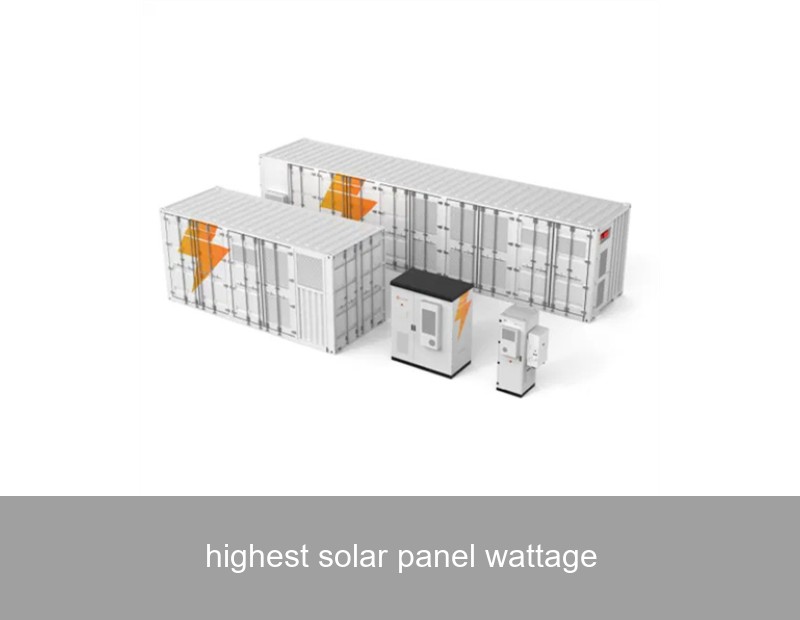
This is the core of Highjoule's integrated solution. Our GridSync™ Hybrid Inverters are designed for the future of solar, featuring high input capacities and multiple MPPT trackers to optimize the performance of high-wattage, complex roof layouts. They are the perfect bridge to our EnerCore™ residential and industrial battery systems. These systems use lithium iron phosphate (LFP) chemistry, renowned for its safety, longevity, and deep cycling capability—essential for capturing and utilizing the abundant energy from your high-performance array day after day.

Image Source: Unsplash - A modern inverter and battery system is essential for managing high solar output.
Future Horizons: What's Next for Solar Panel Efficiency?
The race for power is far from over. Research into perovskite-silicon tandem cells promises to push commercial efficiencies toward 30% and beyond, as noted by the Journal of Joule. Furthermore, smart panel-level electronics, like integrated microinverters or optimizers, will become increasingly important to manage the output of these powerful panels, especially when partially shaded.
For the end-user, the future is about system intelligence. Highjoule's EnergyOS platform exemplifies this, using AI-driven forecasting and load management to autonomously decide when to store solar energy, power your home, or sell back to the grid, maximizing the financial return on every high-wattage watt you produce.
Choosing the Right Panel for Your Energy Goals
Selecting a panel isn't just about picking the highest number. Consider:
- Your Roof's Physical & Financial Constraints: Space, budget, and local incentives.
- Product Warranty: Look for robust performance warranties (25+ years) that guarantee power output over time.
- Compatibility: Ensure your chosen installer and system provider (like Highjoule) have experience integrating these advanced panels into a cohesive, reliable system.
The pursuit of the highest solar panel wattage is ultimately a pursuit of freedom—energy freedom. It empowers you to generate more of what you consume, buffer against rising utility rates, and contribute meaningfully to grid stability.
What's the first question you will ask your installer about your potential system's design to ensure you're getting the most out of your rooftop's true power potential?
 Inquiry
 Online Chat