


The Silent Revolution: Why Energy Storage and Transport Are Inseparable
Imagine a highway where cars can only drive at noon, and the roads are empty at night. That's the paradox of our modern electricity grid, brimming with solar power by day and often reliant on traditional sources after sunset. The critical link to solve this? Energy storage and transport. It's not just about having a big battery; it's about creating an intelligent, flexible network that can move electricity from where and when it's generated to where and when it's needed most. This isn't a future concept—it's the foundational shift enabling the renewable age, and companies like Highjoule are at its forefront, building the infrastructure for a resilient, sustainable power system.
The Grid Strain Phenomenon: More Renewables, New Challenges
Across Europe and the U.S., the surge in wind and solar installations is a success story. However, this influx of variable generation creates a fundamental mismatch. The sun doesn't shine on demand, and the wind blows on its own schedule. This intermittency creates two core problems for grid operators: congestion during peak generation (too much power in one place) and scarcity during calm, dark periods. Without a solution, this leads to curtailment (wasting clean energy), higher costs, and grid instability.
The Data Dilemma: Intermittency by the Numbers
Let's look at the data. In California, the now-famous "duck curve" illustrates the dramatic midday dip in net load due to solar, followed by a steep evening ramp-up as the sun sets and demand rises. In 2022, the U.S. curtailed over 5% of its total available wind and solar energy—enough to power millions of homes. In Europe, a study by IRENA highlights that system integration costs become significant as renewable penetration exceeds 30-40% of the generation mix. The numbers are clear: generation alone is insufficient. We need a dynamic system for energy storage and transport to bridge time and space.

Image Source: Unsplash - A solar farm highlighting the generation side of the energy equation.
A Case from Bavaria: Stabilizing the Local Grid
Consider a real-world example from Southern Germany. A mid-sized industrial park with significant rooftop solar faced a dual challenge: their solar output frequently exceeded local consumption at noon, threatening to overload the local transformer, while their evening production needs required expensive grid power. The solution was an integrated energy storage and transport system. A 2 MWh battery energy storage system (BESS) was installed on-site. Now, excess solar energy is not fed back into the strained local grid but is stored. Later, during the evening peak, the stored energy powers operations. The results? A 40% reduction in peak grid demand charges, near-zero solar curtailment, and the deferral of a costly transformer upgrade for the local utility. This micro-example scales to national grids.
The Core Solution: Intelligent Energy Storage and Transport Systems
So, what does an effective system look like? It's a multi-layered approach:
- Temporal Transport (Storage): This is the "time machine" for electrons. Advanced battery systems, like lithium-ion and emerging technologies, store energy for hours or days.
- Spatial Transport (Grid Management): This involves both physical infrastructure (strengthened transmission lines) and virtual power plants (VPPs) that aggregate distributed resources.
- Intelligence & Software: The brain of the operation. AI-driven energy management systems (EMS) predict generation, consumption, and market prices to optimize when to store, discharge, or sell energy.
True energy storage and transport seamlessly blends these three layers into a responsive, economic asset.
How Highjoule Enables Efficient Energy Storage and Transport
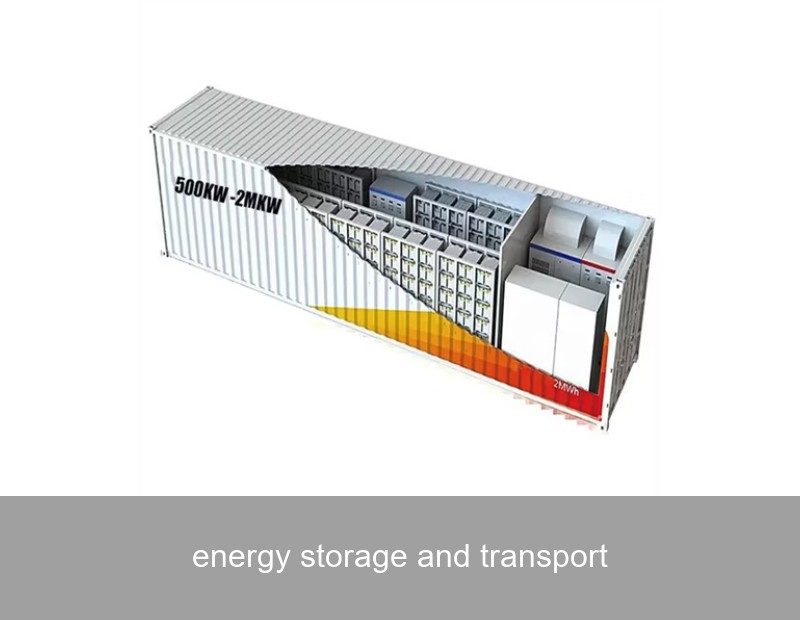
This is where Highjoule's expertise comes into play. Since 2005, we've moved beyond simply supplying batteries to delivering holistic energy storage and transport solutions. Our HPS Series for commercial and industrial applications is a prime example. It's a containerized, all-in-one system that combines high-density lithium iron phosphate (LFP) batteries, a built-in power conversion system (PCS), and our proprietary JouleMind AI platform.
Think of JouleMind as the air traffic control for your energy. It doesn't just manage the battery; it connects to solar inverters, building management systems, and even grid signals. For a factory, it can perform automated peak shaving, store midday solar, and provide backup power—all while participating in grid service programs for additional revenue. This transforms a static storage unit into a dynamic node for intelligent energy transport within a facility and beyond.
| Challenge | Traditional Approach | Highjoule's Integrated Solution |
|---|---|---|
| High Peak Demand Charges | Reduce operational hours; costly grid upgrades | JouleMind AI predicts peaks and discharges battery to "shave" demand, cutting costs by up to 30% |
| Solar Over-Generation | Curtail (waste) excess solar energy | Intelligently store 100% of excess generation for later use, maximizing ROI on solar assets |
| Grid Instability | Rely on fossil-fuel peaker plants | Aggregated systems can provide fast-frequency response and voltage support, stabilizing the grid |
Beyond the Battery: The Full Ecosystem of Transport
For utilities and microgrid developers, the transport element scales further. Highjoule's GridMax portfolio is designed for front-of-the-meter and large-scale microgrid applications. These systems are engineered for high-cycle life and can be strategically placed to relieve transmission congestion (a concept known as "grid stacking") or to create resilient community microgrids. In a microgrid setting, our systems enable the effective transport of energy between various generation sources (solar, wind, gensets) and multiple load centers, ensuring reliability even during main grid outages.

Image Source: Unsplash - Technician inspecting a large-scale battery storage system.
Future Horizons: What's Next for Our Energy Networks?
The journey of energy storage and transport is accelerating. We're seeing the rise of long-duration storage (LDES) technologies for multi-day transport, vehicle-to-grid (V2G) integration that turns electric fleets into mobile storage assets, and increasingly sophisticated market mechanisms that reward flexibility. The grid is evolving from a one-way delivery street into a multi-lane, bidirectional energy internet.
Is your business or community simply generating renewable energy, or are you building a resilient, cost-effective system to store and transport it intelligently? The difference between the two approaches will define your energy independence and economic advantage for decades to come.
 Inquiry
 Online Chat