


Double-Sided Solar Panel Price in Sweden: A Smart Investment for Northern Climates?
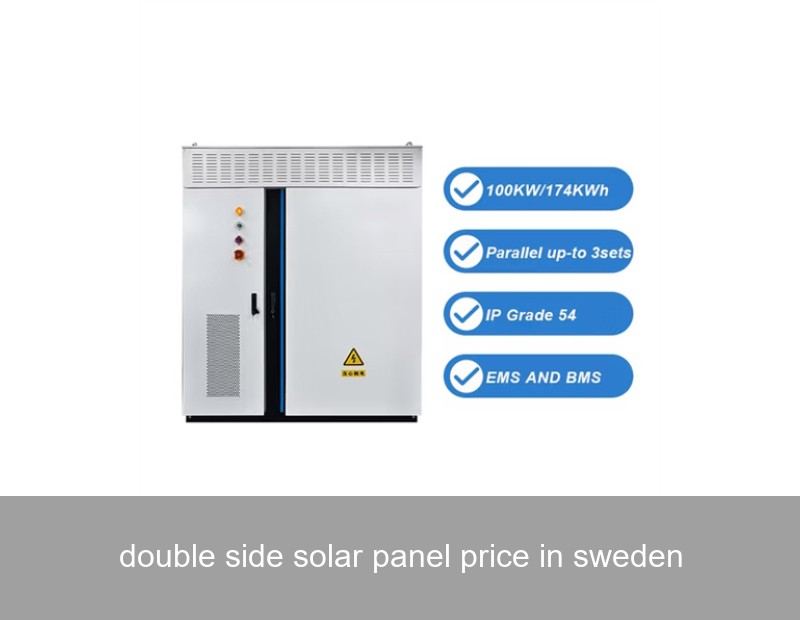
If you're exploring solar options in Sweden, you've likely encountered the term "bifacial" or double-sided solar panels. Touted for their higher energy yield, a key question emerges: what does the double-sided solar panel price in Sweden really look like, and does the premium justify itself under the Swedish sun? As a product technology expert at Highjoule, a global leader in advanced energy storage, I see this as more than just a panel discussion. It's about the total system value. Let's cut through the snow and shine a light on the costs, performance, and real-world viability of bifacial technology in the Swedish market.
Understanding Double-Sided Solar Panels: More Than Meets the Eye
Unlike traditional monofacial panels that only capture direct sunlight on their front side, bifacial panels have a transparent backsheet. This allows them to generate electricity from both sides, capturing direct sunlight on the front and reflected or albedo light on the rear. This reflected light can come from a variety of surfaces: a white TPO roof, light-colored gravel, or, quite relevant for Sweden, a blanket of snow.

Image source: Unsplash. A close-up view highlighting the unique structure of a bifacial solar panel.
The principle is simple, but the gain is significant. Studies and real-world data show that under optimal conditions, bifacial panels can produce 5% to 30% more energy than their monofacial counterparts of the same rated power. This extra "free" energy is the core value proposition that influences the double-sided solar panel price in Sweden.
The Price Breakdown: What to Expect in the Swedish Market
Let's talk numbers. As of 2024, the price premium for bifacial panels themselves is narrowing but still exists. You can expect to pay roughly 10-20% more per panel compared to a high-efficiency monofacial panel. However, the sticker price of the panel is just one piece of the puzzle.
To understand the true cost, we must consider the total installed system cost and the Levelized Cost of Energy (LCOE). Here’s a simplified comparison table for a typical residential system in Sweden:
| Cost Component | High-Efficiency Monofacial System | Double-Sided (Bifacial) System | Notes |
|---|---|---|---|
| Panel Cost (per kWp) | SEK 2,000 - 2,800 | SEK 2,300 - 3,200 | Bifacial carries a ~15% premium. |
| Installation & Mounting | SEK 1,500 - 2,200 | SEK 1,700 - 2,500 | Bifacial often requires specialized racking (e.g., elevated trackers or raised frames) to maximize rear-side gain, adding to cost. |
| Estimated Annual Yield (per kWp) | 850 - 950 kWh | 950 - 1,150 kWh | Bifacial gain highly depends on installation site. Snow reflection can boost winter production. |
| Effective Cost per kWh (over 25 years) | SEK ~0.45 - 0.55 | SEK ~0.40 - 0.50 | Higher upfront cost is offset by higher long-term generation, improving LCOE. |
The key takeaway? While the initial double-sided solar panel price in Sweden is higher, the increased energy harvest can lead to a lower lifetime cost per kilowatt-hour. This makes bifacial technology particularly compelling for commercial and industrial projects where maximizing energy yield per square meter is critical for ROI.
Real-World Case Study: A Swedish Agricultural Business
Let's move from theory to practice. Consider a case from Västra Götaland, where a medium-sized agricultural business installed a 250 kWp ground-mounted solar array in 2022. Their goal was to power cold storage and irrigation systems.
- Choice: They opted for bifacial panels mounted on single-axis trackers over a light-colored, gravel-covered surface.
- Data & Results: Monitoring data from the first two full years of operation shows an average 22% higher energy yield compared to a nearby, similarly sized monofacial fixed-tilt system. Specifically, their system averaged 1,210 kWh/kWp annually, significantly above the regional average for monofacial systems.
- Financial Impact: This extra yield translated to an additional ~55,000 kWh per year. At the prevailing commercial electricity price (which has been volatile), this extra generation significantly accelerated their payback period, bringing it down from an estimated 8.5 years to just under 7 years.
This case underscores a vital point: the optimal value of bifacial panels in Sweden isn't just about the panel cost; it's about intelligent system design that leverages the local environment—snow, albedo, and installation height—to unlock that extra generation.
Maximizing Your Investment: Beyond the Panel Price
Focusing solely on the double-sided solar panel price in Sweden is a common pitfall. To truly capitalize on this technology, you need a holistic approach:
- The Right Installation: Bifacial panels perform best when elevated (e.g., on ground mounts or flat roofs with raised rails) over highly reflective surfaces. A dark asphalt roof will offer minimal rear-side gain.
- The Swedish Snow Bonus: In winter, a snowy ground can act as a giant reflector, potentially boosting bifacial output when the sun is low—a unique advantage in Nordic climates. Research from institutions like Fraunhofer ISE has documented this "snow albedo" effect.
- The Storage Imperative: Higher generation is fantastic, but what happens to that extra energy? This is where the conversation naturally evolves from solar panels to complete energy management.
The Highjoule Integrated Solution: Where Smart Solar Meets Smarter Storage
At Highjoule, founded in 2005, we view high-yield solar arrays as the first step in a sustainable energy ecosystem. A bifacial system that produces 20% more power also creates more potential energy that can be stored and used on demand, increasing your energy independence dramatically.
Our role is to ensure no watt of that valuable, double-harvested electricity goes to waste. For our clients in Sweden and across Europe, we integrate advanced bifacial systems with our HPS (Highjoule PowerStack) commercial and industrial battery storage systems. This combination is transformative:
- Maximizes Self-Consumption: Store the excess daytime production (enhanced by bifacial gain) and use it during expensive evening peaks or on cloudy days.
- Stabilizes Your Microgrid: For farms, factories, or remote facilities, this solar-storage combo provides a resilient and predictable power supply.
- Future-Proofs Your Investment: With intelligent energy management software, our systems can participate in grid services, turning your solar investment into a potential revenue stream.
Image source: Unsplash. Representative image of a modern battery energy storage system (BESS) in an industrial setting.
By pairing high-efficiency generation with high-efficiency storage, you're not just buying panels or batteries; you're investing in a predictable, low-cost energy outcome. This system-level approach is what ultimately defines the true value of your investment, far beyond the initial price per panel.
Is Double-Sided Solar Right for You? Key Questions to Ask
So, should you be factoring the double-sided solar panel price in Sweden into your plans? Start by answering these questions:
- What is your installation surface? Is it a reflective, elevated ground mount, a flat white roof, or a standard dark-tiled pitched roof?
- What is your primary goal? Is it to maximize total lifetime energy yield (favoring bifacial) or to achieve the absolute lowest upfront installation cost (potentially favoring monofacial)?
- What is your long-term energy strategy? Are you planning to add storage, electrify heating or transport, or create a fully independent microgrid?
The energy landscape is shifting from simple generation to intelligent management. With technologies like bifacial solar and advanced storage, the opportunity for Swedish homes and businesses to achieve unprecedented levels of efficiency and independence is real.
Given the unique potential of snow albedo in Sweden, what local condition around your property could you optimize to unlock the highest return from a double-sided solar system?
 Inquiry
 Online Chat