


Battery Storage Developers: The Architects of a Resilient, Renewable-Powered Grid
Imagine a world where the sun doesn't set on solar power, and the wind's energy can be saved for a calm day. This isn't science fiction; it's the reality being built today by battery storage developers. These are the master planners and engineers who are transforming intermittent renewable energy into a reliable, 24/7 power source. For businesses, communities, and entire grids, their work is the critical link between green ambition and operational reality. As a global leader in advanced energy storage since 2005, Highjoule partners with these developers to turn complex blueprints into high-performance, sustainable power solutions.
Table of Contents
The Challenge: From Intermittency to Reliability
The renewable energy revolution has a well-known puzzle: the sun and wind are fantastic fuel sources, but they don't follow our electricity demand schedules. This creates a phenomenon known as the "duck curve"—where net demand plummets during peak solar production hours and then skyrockets as the sun sets. Without a solution, this leads to grid instability, wasted renewable energy (curtailment), and continued reliance on fossil-fuel peaker plants.
This is the core problem that battery storage developers are hired to solve. Their mission is to architect systems that capture excess renewable generation and dispatch it precisely when it's needed most. It's not just about installing batteries; it's about designing an intelligent asset that provides multiple value streams: energy arbitrage, frequency regulation, capacity support, and backup power.

Image Source: National Renewable Energy Laboratory (NREL) - nrel.gov
What Do Battery Storage Developers Actually Do?
The role of a battery storage developer is multifaceted, blending technical expertise with financial and project management acumen. It's a journey from concept to commissioning.
- Site Identification & Feasibility: Analyzing locations for grid connection strength, renewable resource proximity, and market revenue opportunities.
- Financial Modeling & Securing Offtake: Building complex models to project ROI and securing agreements (like PPAs or with grid operators) to guarantee revenue.
- System Design & Technology Selection: This is the core engineering phase. Developers must choose the right battery chemistry (like lithium-ion LFP for safety and longevity), inverter technology, and energy management system (EMS) software.
- Permitting & Interconnection: Navigating local, state, and federal regulations, as well as the often lengthy utility interconnection process.
- EPC Management & Commissioning: Overseeing the Engineering, Procurement, and Construction process, followed by rigorous testing before commercial operation.
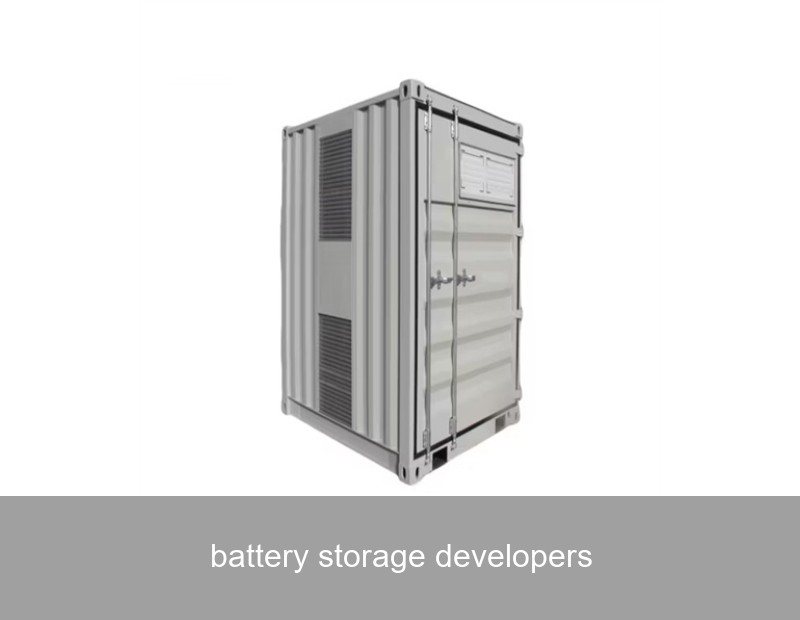
Throughout this process, the choice of technology partner is paramount. A partner like Highjoule, which offers fully integrated, containerized Battery Energy Storage Systems (BESS), de-risks this phase. Our H-Joule Cube series comes pre-assembled and tested, significantly reducing on-site construction complexity and time for developers.
Data & Case Study: A Developer's Success in California
Let's look at a real-world example. In 2022, a developer partnered with Highjoule to deploy a 20 MW / 80 MWh standalone storage facility in Southern California's CAISO market. The project's goal was to provide peak shaving services and participate in the wholesale energy market.
| Project Metric | Data | Outcome |
|---|---|---|
| System Size | 20 MW / 80 MWh | Can power ~15,000 homes for 4 hours during peak |
| Annual Revenue Streams | Energy Arbitrage, Resource Adequacy | Multiple stacked value streams |
| Key Technology | Highjoule H-Joule Cube with LFP cells & AI-powered EMS | High cycle life, safety, and optimized dispatch |
| Development Time | From contract to COD: 14 months | Accelerated by pre-integrated system design |
The Highjoule system's AI-driven EMS continuously analyzes market prices and grid signals, autonomously deciding when to charge and discharge to maximize revenue. In its first year, the project helped avoid an estimated 12,000 tons of CO2 by displacing natural gas peaker plants and provided critical grid stability during a major heatwave. This case exemplifies how the right technology empowers battery storage developers to deliver tangible economic and environmental impact. For more on grid storage growth, see the U.S. Energy Information Administration's reports here.
Technical Considerations for Modern Developers
Today's developers must look beyond basic capacity. The sophistication of grid demands requires next-generation thinking.
- DC vs. AC Coupling: For new solar+storage projects, DC-coupled systems are gaining favor for higher round-trip efficiency. Highjoule's platform-agnostic design supports both, allowing developers to choose the optimal architecture.
- Thermal Runaway Mitigation: Safety is non-negotiable. Developers must prioritize systems with built-in, multi-layer protection. Our solutions feature advanced liquid cooling, passive fire suppression, and cell-level fusing.
- Grid-Forming Inverters: The future is "grid-forming" BESS that can stabilize the grid without relying on traditional fossil-fuel plants. Forward-thinking developers are already planning for this capability.
- Software & Long-Term Performance: The brain of the BESS is its software. A robust EMS with predictive analytics and remote monitoring is crucial for long-term asset health and profitability.
Highjoule: The Strategic Partner for Storage Developers
At Highjoule, we don't just sell hardware; we provide a development partnership. We understand that for battery storage developers, time is money, and performance is reputation. Our product suite is engineered to accelerate your success.
For utility-scale and commercial & industrial (C&I) projects, our H-Joule Cube is the industry benchmark. Its modular, containerized design scales from 1 MWh to hundreds of MWh. More importantly, it comes integrated with our JouleMind AI platform, which handles everything from market bidding to preventative maintenance alerts, maximizing your asset's lifetime value.
For residential and small commercial aggregations, our H-Joule Home+ system allows developers to build virtual power plants (VPPs). We provide the aggregated control software, enabling you to offer grid services to utilities by pooling the capacity of hundreds of behind-the-meter systems.

Image Source: Unsplash (Representative image of a BESS installation)
The Future Horizon for Storage Development
The landscape is evolving rapidly. With the U.S. Inflation Reduction Act (IRA) and similar European policies like the Green Deal Industrial Plan, the financial incentives for storage have never been stronger. However, interconnection queue backlogs and supply chain nuances present new challenges. The most successful developers will be those who partner with resilient, vertically-integrated technology providers who can ensure delivery and support over the 15-20 year lifespan of a project.
We're also seeing a shift towards hybrid renewable plants—solar + wind + storage—designed from the ground up as a single, optimized power plant. This requires even closer collaboration between renewable and storage developers from day one.
An Open Question for Our Industry
As grid demands grow more complex, the role of the battery storage developer will expand from asset builder to grid architect. So, here's a question we're pondering at Highjoule and discussing with our partners: As we move towards a 100% clean grid, what will be the more critical metric—the sheer megawatt-hours of storage deployed, or the intelligence of the software that orchestrates it all? We'd love to hear your perspective as you plan your next project.
Ready to see how a partnership can streamline your next development? Explore our developer resources and technical specifications, or contact our solutions architecture team for a project consultation.
 Inquiry
 Online Chat