


Automatic Rotating Solar Panel: Maximize Your Energy Harvest
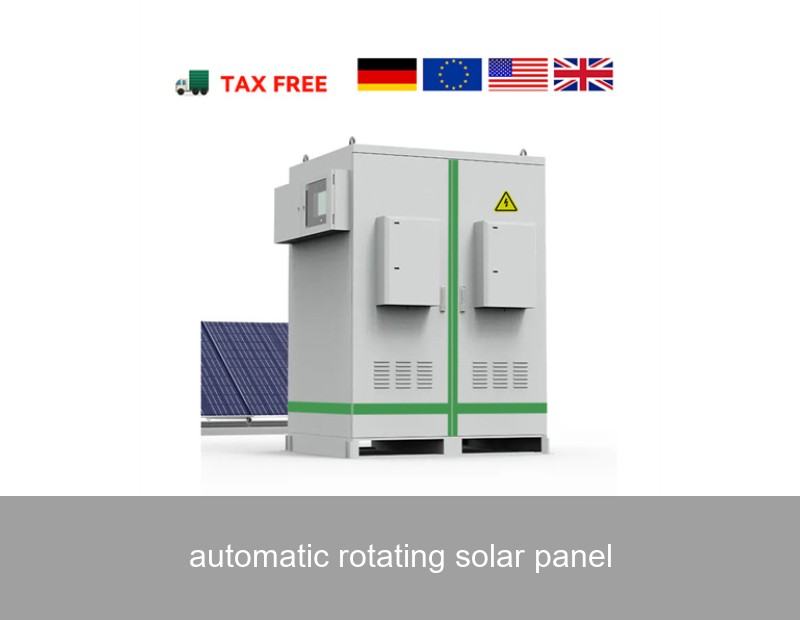
Imagine your standard rooftop solar array. It's a fantastic investment, silently converting sunlight into clean electricity. But have you ever noticed it seems most productive around midday? That's because automatic rotating solar panels, also known as solar trackers, are designed to solve a fundamental inefficiency: the sun moves, but fixed panels don't. For homeowners and businesses across Europe and the US looking to squeeze every possible kilowatt-hour from their investment, this technology presents a compelling upgrade. This article delves into how automatic rotation works, its real-world benefits, and how integrating it with a complete energy ecosystem, like those from Highjoule, can unlock true energy independence.
What is an Automatic Rotating Solar Panel?
At its core, an automatic rotating solar panel system is a dynamic mounting solution. Unlike fixed racks, these systems use motors and sensors to slowly pivot the panels throughout the day, following the sun's path across the sky. There are two main types:
- Single-Axis Trackers: These rotate on one axis, typically following the sun from east to west. They are common in large-scale commercial and utility installations.
- Dual-Axis Trackers: These add a second axis of movement, tilting to also account for the sun's changing height in the sky across seasons. This offers the absolute maximum energy capture.
The "automatic" part is key. A smart controller uses astronomical algorithms or light sensors to determine the sun's position, making minute adjustments without any manual intervention. This transforms a passive solar collector into an active energy-harvesting machine.
The Problem: A Sun That Never Stands Still
The phenomenon is simple. A fixed panel only receives direct, optimal sunlight for a few hours around solar noon. In the early morning and late afternoon, sunlight hits the panel at a sharp angle, significantly reducing energy production. This creates a steep, "duck curve" generation profile—a peak at midday and a long tail on either side.
For the average household, this means you might be overproducing when demand is low and underproducing when you need power most (like in the evening). For a business, this mismatch can lead to higher demand charges from the grid during non-peak solar hours. The static nature of traditional installations leaves a lot of potential energy literally sliding off the surface of your panels.
The Data: How Much More Energy Can You Really Get?
The promise of rotation isn't just theoretical; it's quantifiable. The exact gain depends on your geographic location. The further you are from the equator, the greater the seasonal variation in the sun's path, and the more benefit you can derive from tracking, especially dual-axis.
| Location | Fixed Panel Yield | Single-Axis Tracker Gain | Dual-Axis Tracker Gain | Notes |
|---|---|---|---|---|
| Southern US (e.g., Arizona) | Base 100% | +15% to +25% | +25% to +35% | High direct sunlight, less seasonal tilt variation. |
| Northern US / Central Europe (e.g., Germany) | Base 100% | +20% to +30% | +30% to +45% | Lower sun angles, greater benefit from tilt adjustment. |
As you can see, in markets like Germany or the northern United States, gains of 30% or more are achievable. That's like adding several extra panels to your system without needing the extra roof space. A study by the National Renewable Energy Laboratory (NREL) consistently highlights tracking as a key technology for increasing solar capacity factors. However, this increased harvest is only half of the equation. What you *do* with that extra energy determines its true value.
A Real-World Case Study: Boosting a German Dairy Farm
Let's look at a concrete example. A medium-sized dairy farm in Bavaria, Germany, was operating with a 100 kW fixed-roof solar array. While it helped offset daytime costs, the milking parlors and cooling systems ran heavily in the early morning and evening, forcing heavy reliance on the grid.
In 2023, they partnered with Highjoule for a holistic upgrade. The solution wasn't just to add trackers. Here's what we implemented:
- Added a Ground-Mounted Solar Array with Single-Axis Trackers: A new 50 kW system on unused pasture land, using trackers to flatten the generation curve.
- Integrated a Highjoule HI-Stack Commercial Battery Storage System (250 kWh): This critical component stores the surplus midday energy from *both* the fixed and tracking arrays.
- Deployed Highjoule's Energy Management System (EMS): The brain of the operation, our EMS intelligently decides when to charge the battery, power the farm, or sell back to the grid based on real-time pricing and consumption patterns.
Image: Solar trackers in an agricultural setting. Source: Unsplash (Credit: American Public Power Association)

- Total Energy Harvest Increase: 42% (from the combined effect of the new tracker array and optimized usage).
- Grid Energy Independence: Increased from 35% to 78% during operational hours.
- Payback Period: Reduced by an estimated 2 years due to avoided peak-time grid charges and optimized feed-in tariffs.
The trackers generated more energy, but the Highjoule battery and EMS ensured none of it was wasted, turning increased generation into tangible economic resilience.
Key Considerations Before You Invest
Automatic rotating solar panels aren't a one-size-fits-all solution. Here are key factors to weigh:
- Upfront Cost & ROI: Trackers have higher hardware and (minimal) maintenance costs. The ROI depends on your local energy prices, incentives, and the increased yield you can achieve.
- Space and Site: They often require ground space. Wind loading is also a consideration; reputable systems have sturdy designs and stow mechanisms for high winds.
- The System Integration Imperative: This is the most crucial point. More solar energy without a plan to use or store it can be inefficient. The true potential of tracking is unlocked when paired with smart storage and management.
This is where choosing a provider with end-to-end expertise matters. Highjoule doesn't just sell components; we design integrated power solutions. Whether for a residential homeowner seeking backup power, a commercial business aiming to cut demand charges, or an industrial microgrid project, we assess if tracking is right for you and ensure it works in concert with our high-efficiency battery systems and intelligent software.
The Future of Solar with Highjoule's Smart Integration
The evolution of solar isn't just about better panels; it's about smarter, more adaptive systems. Automatic rotating solar panels represent a significant step towards making solar a more consistent and reliable baseload power source.
Image: A modern home energy system featuring solar and storage. Source: Unsplash (Credit: Andreas Gücklhorn)
Looking ahead, the integration will become even more seamless. Imagine your Highjoule EMS not only managing battery charge cycles but also slightly adjusting the angle of your trackers based on real-time grid congestion signals or weather forecasts to optimize for the most valuable generation periods.
The question for any energy consumer today is no longer simply "Should I get solar?" It's: "How can I design the most resilient and economical energy system for my specific needs?" In that equation, does the dynamic harvest of an automatic rotating system, perfectly balanced by smart storage, provide the key to your energy independence?
 Inquiry
 Online Chat