


Understanding Different Watts of Solar Panels: A Guide to Sizing Your System Right
So, you've decided to explore solar power. That's fantastic! But as you start researching, you're immediately met with a dizzying array of numbers: 350W panels, 400W panels, 450W, and beyond. What do these different watts of solar panels actually mean for your home or business? Is a higher wattage panel always the better choice? The answer, like most things in energy, is: it depends. Choosing the right panel wattage isn't about picking the biggest number; it's about matching the technology to your specific energy needs, roof space, and long-term sustainability goals. Let's demystify the world of solar panel wattage together and see how it fits into a complete, intelligent energy solution.
Table of Contents
- What Does "Wattage" Really Mean for a Solar Panel?
- Key Factors Influencing Solar Panel Wattage
- How to Choose the Right Wattage for Your Project
- Thinking Beyond the Panel: The Critical Role of Energy Storage
- Case Study: Maximizing Limited Space in Urban California
- The Future of Panel Wattage and System Design
What Does "Wattage" Really Mean for a Solar Panel?
In simple terms, the wattage (W) of a solar panel, also referred to as its power rating, indicates the amount of electrical power it can produce under ideal laboratory conditions, known as Standard Test Conditions (STC). A 400-watt panel will produce 400 watts of power when the sun is shining brightly at a specific angle and temperature. However, real-world conditions are rarely ideal.
It's crucial to understand that this is a measure of instantaneous power, not energy. Energy is what powers your appliances and is measured in kilowatt-hours (kWh). To estimate how much energy a panel will produce in a day, you need to consider its wattage and the local "peak sun hours." For example, a 400W panel in a location with 5 peak sun hours can generate roughly 400W x 5 hours = 2,000 Wh or 2 kWh per day. The progression of panel wattage over the years tells a story of rapid innovation:
| Era | Typical Panel Wattage | Primary Technology |
|---|---|---|
| Early 2000s | 150W - 200W | Polycrystalline Silicon |
| 2010s | 250W - 320W | Monocrystalline Silicon |
| 2020s (Current) | 370W - 450W | PERC, Half-Cell, Bifacial Monocrystalline |
| Emerging | 500W+ | N-Type TOPCon, HJT, Advanced Bifacial |
Key Factors Influencing Solar Panel Wattage
Why are there so many different watts of solar panels on the market? Several technological advancements drive these differences:
- Cell Technology: Monocrystalline silicon cells are more efficient than polycrystalline, allowing for higher power in the same physical size.
- Cell Efficiency: This is the percentage of sunlight hitting the panel that gets converted into electricity. Modern panels exceed 21-22% efficiency, up from around 15% a decade ago. Higher efficiency directly translates to higher wattage for a given panel area.
- Panel Size and Number of Cells: The physical dimensions matter. Most residential panels today use 60 or 72 cells. However, manufacturers are now using larger wafer sizes (like M10, G12) to create panels with more surface area for capturing light, pushing wattages above 400W.
- Advanced Features: Innovations like PERC (Passivated Emitter and Rear Cell) technology, half-cut cells that reduce resistive losses, and bifacial designs (which capture light from both sides) all contribute to boosting the final power output.

Image Source: Unsplash (Representative image of modern solar panels)
How to Choose the Right Wattage for Your Project
Selecting between different watts of solar panels is a balancing act. Here’s a simple framework:
- For Limited Roof Space (Urban Homes, Small Businesses): Higher wattage panels (400W+) are often ideal. You can generate more total system power from a smaller area. This maximizes your energy production where it's most constrained.
- For Large, Unconstrained Roofs or Ground Mounts: Mid-to-high wattage panels (370W-420W) often offer the best value. Since space isn't an issue, you can prioritize cost-per-watt, potentially using more panels of a slightly lower rating to meet your energy target at a lower overall system cost.
- For Complex Roof Layouts: Smaller, lower-wattage panels might be easier to arrange around vents, chimneys, and other obstructions to fully utilize available space.
Remember, the panel is just one component. The inverter must be compatible with the total system wattage and voltage. This is where working with a system integrator like Highjoule proves invaluable. We don't just sell panels; we design integrated energy systems. Our experts analyze your consumption patterns, site specifics, and goals to specify the optimal panel wattage and the perfect Highjoule energy storage system to pair with it, ensuring every watt generated is used intelligently.
Thinking Beyond the Panel: The Critical Role of Energy Storage
Here's the pivotal insight: the sun doesn't shine 24/7. A system designed only around different watts of solar panels captures energy only during daylight. What happens in the evening, during peak demand, or a grid outage? Without storage, excess solar energy is often exported to the grid at low rates, and you draw power back at high rates.
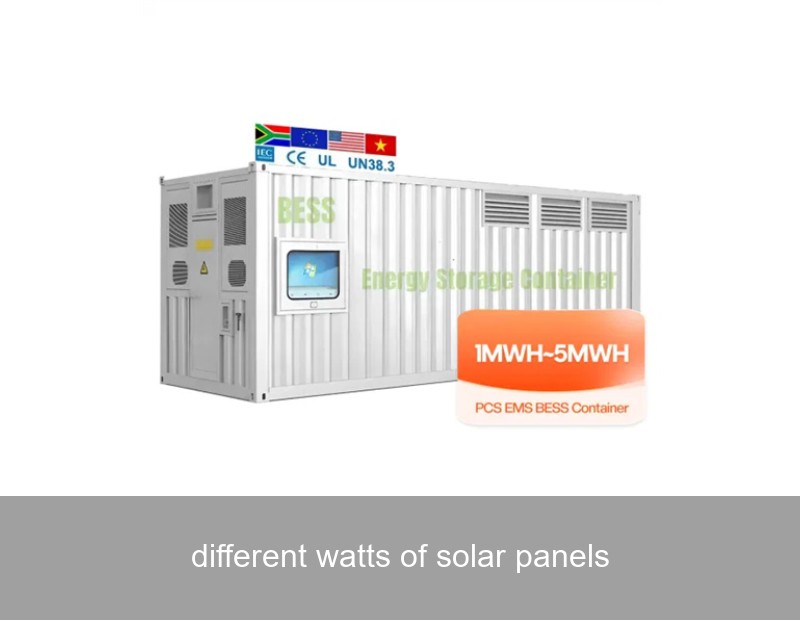
This is the core of Highjoule's mission. Our intelligent battery energy storage systems (BESS) transform your solar array from a daytime generator into a 24/7 power asset. By storing surplus solar energy, our systems provide:
- Energy Independence: Reduce reliance on the grid, especially during expensive peak tariff periods.
- Backup Power: Seamless transition to battery power during grid failures.
- Maximized Self-Consumption: Use more of the solar energy you produce, dramatically improving your return on investment.
Whether for a residential customer looking for resilience, a commercial facility aiming to shave peak demand charges, or an industrial microgrid requiring stable power, Highjoule's scalable storage solutions ensure the power from your carefully chosen panels is never wasted.
Case Study: Maximizing Limited Space in Urban California
Let's look at a real-world application. A medium-sized winery in Napa Valley, California, wanted to reduce its operational carbon footprint and hedge against rising energy costs. Their challenge? Limited roof space on their historic main building for solar panels.
The Solution: A Highjoule-designed system utilized 120 high-efficiency 415-watt bifacial panels (a total of ~49.8 kW). The high wattage was critical to meet a significant portion of their energy needs within the constrained area. Crucially, this was paired with a Highjoule 50 kWh commercial battery storage unit and our advanced energy management system (EMS).
- Solar generation covers ~65% of their total annual electricity consumption.
- The storage system enables 85% self-consumption of solar energy, up from an estimated 40% without storage.
- By discharging the battery during daily "peak" utility periods (4 PM - 9 PM), they achieve a 30% reduction in monthly demand charges.
- The system provides critical backup for refrigeration units, protecting inventory during the region's increasing Public Safety Power Shutoff (PSPS) events.
This case demonstrates that selecting the right high-wattage panel was the first step, but the true value and financial return were unlocked by integrating intelligent storage. (NREL report on solar-plus-storage value streams).

Image Source: Unsplash (Representative image of commercial solar installation)
The Future of Panel Wattage and System Design
The trend toward higher-wattage panels will continue with technologies like TOPCon and heterojunction (HJT). However, the future of energy is not just about generation; it's about intelligent management and resilience. The next evolution is the prosumer—a consumer who also produces, stores, and manages energy dynamically.
Highjoule is at the forefront of this shift. Our systems are designed with software-defined intelligence, allowing them to adapt to changing utility rates, weather forecasts, and your personal usage habits. We see the solar panels, whether 350W or 500W, as the fuel source for a much smarter energy ecosystem. For a deeper dive into grid integration, the U.S. Department of Energy provides excellent resources here.
Your Energy, Your Choice
Navigating the world of different watts of solar panels can be complex, but it's a journey worth taking. The optimal choice hinges on your unique physical space, financial goals, and appetite for energy independence. The most important question to ask yourself is no longer just "How many panels do I need?" but rather "How can I build a resilient, efficient, and intelligent energy system for my future?"
What's the biggest challenge you face when considering solar power for your home or business—is it understanding the true long-term value, navigating available space, or something else entirely?
 Inquiry
 Online Chat