


Unlocking Grid Resilience: The Critical Role of Advanced Energy Batteries
Imagine a world where a cloudy day doesn't threaten your factory's operations, and a sudden heatwave doesn't lead to rolling blackouts. This isn't a distant utopia; it's the reality being built today with advanced energy batteries. For homeowners, businesses, and entire communities, these sophisticated systems are transforming how we generate, store, and consume electricity. At Highjoule, a global leader in advanced energy storage since 2005, we've witnessed this evolution firsthand. The journey from simple backup power to intelligent, grid-forming assets represents a fundamental shift toward a resilient and sustainable energy future. This article delves into the technology, impact, and real-world applications of these game-changing systems.
Table of Contents
- The Phenomenon: From Passive Backup to Active Grid Partner
- The Data: Quantifying the Surge in Advanced Storage
- Core Technologies Behind Advanced Energy Batteries
- Case Study: A U.S. Manufacturing Plant's Transformation
- Highjoule's Role: Delivering Intelligent Storage Solutions
The Phenomenon: From Passive Backup to Active Grid Partner
For decades, batteries were seen as a simple, albeit expensive, emergency stopgap. They sat idle, waiting for a grid failure. The modern phenomenon is different. Today's advanced energy batteries are proactive, intelligent systems. They constantly communicate with solar arrays, building management systems, and even the utility grid. Why the shift? The explosive growth of variable renewable energy, like solar and wind, has created a new challenge: balancing supply and demand in real-time. When the sun sets or the wind stops, the grid needs instant, clean power to fill the gap. This is where advanced storage shines, moving far beyond the role of a silent sentinel to become an active grid citizen.

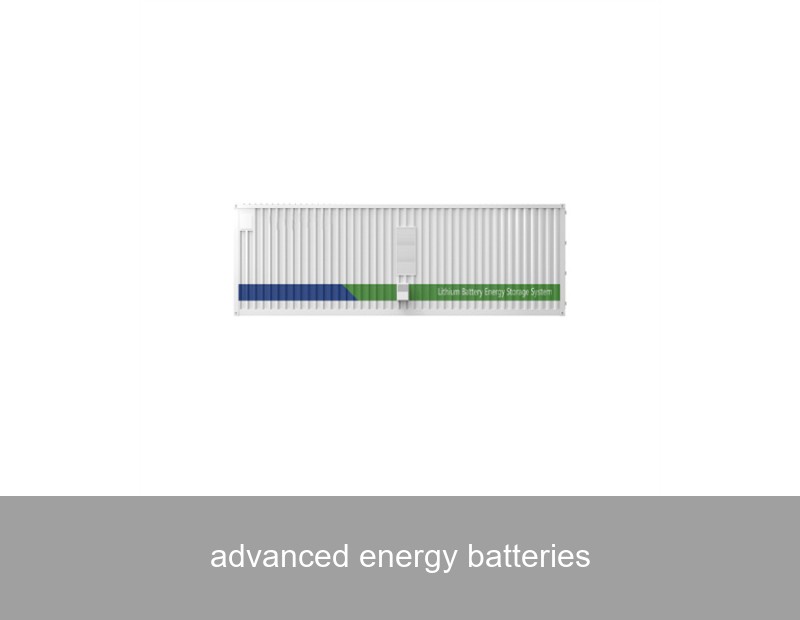
Image Source: Unsplash - Representative image of a contemporary BESS installation.
The Data: Quantifying the Surge in Advanced Storage
The numbers tell a compelling story. According to the U.S. Energy Information Administration (EIA), the country's battery storage capacity is projected to nearly double in 2024 alone (EIA, 2024). In Europe, the European Association for Storage of Energy (EASE) estimates that to meet the EU's 2030 climate targets, energy storage deployment needs to grow to over 200 GW, a massive leap from current levels (EASE, 2023). This isn't just about capacity; it's about value. A study by the National Renewable Energy Laboratory (NREL) highlights that advanced energy batteries can provide over a dozen distinct services, from frequency regulation to transmission upgrade deferral, creating a multi-layered economic case for their adoption.
Core Technologies Powering the Revolution
So, what makes a battery "advanced"? It's the seamless integration of hardware, software, and innovative chemistry.
- Intelligent Battery Management Systems (BMS): The true brain of the operation. A superior BMS doesn't just prevent overcharging; it precisely manages the state of charge and health of each individual cell, maximizing lifespan and safety.
- Thermal Management: Consistent, optimal temperature is key for performance and longevity. Advanced systems use liquid cooling or sophisticated air management to maintain cells within a tight thermal band, whether in a desert or a cold climate.
- Grid-Forming Inverters: This is a revolutionary leap. Traditional "grid-following" inverters need an existing grid signal to operate. Grid-forming inverters can create their own stable voltage and frequency, essentially "black-starting" a microgrid or providing critical stability to a grid with high renewable penetration.
- AI-Driven Energy Management Software (EMS): This is where the magic of optimization happens. The EMS analyzes weather forecasts, electricity price signals, and consumption patterns to autonomously decide when to charge, discharge, or hold, maximizing financial return and grid support.
Case Study: Boosting Competitiveness for a Midwest U.S. Manufacturing Plant
Let's move from theory to a tangible example. A mid-sized automotive parts manufacturer in Ohio faced a dual challenge: volatile energy costs eating into margins and a corporate mandate to reduce carbon footprint. Their rooftop solar array helped, but excess energy at noon was sold back to the grid at low rates, and they still drew expensive power during peak evening hours.
The Solution: The facility partnered with Highjoule to design and install a 2 MWh / 1 MW advanced energy battery system, integrated with their existing solar and controlled by Highjoule's proprietary Neuron AI-EMS.
The Data-Driven Outcome: The system was programmed for solar self-consumption optimization and peak shaving. Here are the results after the first year:
| Metric | Result |
|---|---|
| Annual Electricity Bill Savings | 28% reduction |
| Peak Demand Charges Reduced | Over 40% |
| Solar Self-Consumption Rate | Increased from 35% to over 80% |
| Grid Services Revenue (Frequency Regulation) | ~$15,000 annually |
| Estimated Carbon Footprint Reduction | Equivalent to 75 passenger vehicles/year |
The battery stores cheap midday solar, then powers the facility during expensive peak periods. During times of low plant activity, it even earns revenue by providing fast-response frequency regulation to the regional grid. The project delivered a return on investment in under 5 years while significantly advancing the company's sustainability goals.
Highjoule's Role: Engineering Confidence into Every Storage Project
At Highjoule, our mission is to translate the potential of advanced energy batteries into reliable, profitable outcomes for our clients. We provide end-to-end solutions, from initial consultancy and system design to long-term monitoring and support.
Our flagship product, the H-Series Commercial & Industrial (C&I) Energy Storage System, embodies this philosophy. It features industry-leading liquid cooling for unmatched cell longevity, a grid-forming inverter ready for the most demanding applications, and is natively integrated with the Highjoule Neuron AI Platform. Neuron doesn't just react; it predicts. By learning your facility's unique load profile and integrating real-time market data, it makes optimal decisions 24/7, ensuring you capture every possible value stream—from demand charge reduction and energy arbitrage to participation in utility programs.

Image Source: Unsplash - Representative image of energy system monitoring.
For residential and smaller commercial applications, our Eclipse Home Battery System brings advanced technology to your doorstep. With seamless solar pairing, storm-resistant backup power, and user-friendly app control, it empowers homeowners to take charge of their energy independence.
The Future: What's Next for Grid Intelligence?
The landscape is evolving rapidly. We're moving toward virtual power plants (VPPs), where thousands of distributed advanced energy batteries, like those in homes and businesses, are aggregated to act as a single, large-scale power plant. This creates unprecedented flexibility for grid operators. Furthermore, the exploration of next-generation chemistries like solid-state and sodium-ion promises even greater safety, density, and sustainability in the coming decade. The question is no longer *if* advanced storage will become the cornerstone of our energy infrastructure, but *how quickly* we can integrate it.
Is your business or community merely weathering the storm of energy volatility, or are you ready to harness it? What would a 25% reduction in your annual energy costs and a strengthened sustainability profile mean for your future?
 Inquiry
 Online Chat