


Understanding the 19 kW Solar System Price: A Smart Investment for Your Energy Independence
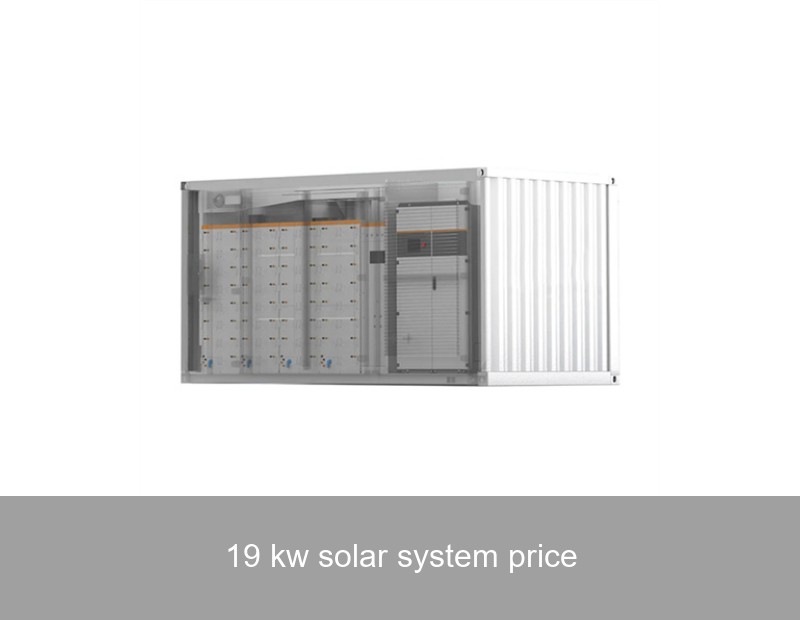
So, you're considering a 19 kW solar system. That's a significant and savvy step towards energy independence. A system of this size is no longer just for niche enthusiasts; it's becoming a mainstream powerhouse for large homes, small businesses, and farms looking to slash electricity bills and lock in energy costs for decades. But when you start researching, the 19 kW solar system price can seem like a complex puzzle. Why such a range? What are you really paying for? As a product technology expert at Highjoule, a global leader in advanced energy storage since 2005, I'll demystify the costs and show you how the right components—especially the battery system—transform this investment from a simple saver to a resilient energy asset.
Table of Contents
- The Price Puzzle: Breaking Down a 19 kW System Cost
- Beyond Panels: The Hidden Game-Changer in Your Quote
- A Real-World Case: The German Farmstead Transformation
- Highjoule's Role: Engineering Intelligence into Your Storage
- Calculating Long-Term Value, Not Just Upfront Price
- Your Energy Future: What's the Right Balance for You?
The Price Puzzle: Breaking Down a 19 kW System Cost
Let's address the big question first. In markets like the U.S. and Europe, the gross price for a 19 kW solar system typically ranges from $45,000 to $65,000 before incentives. That's a wide band, and it's crucial to understand what drives it. The price isn't just for hardware; it's for a complete energy solution.
Here’s a typical breakdown of where your investment goes:
| Component | Approx. Share of Cost | What It Encompasses |
|---|---|---|
| Solar Panels & Mounting | 25-30% | High-efficiency modules (e.g., monocrystalline), racking, and hardware for your roof or ground. |
| Inverter System | 15-20% | Critical for converting DC to AC power. For 19 kW, often multiple or three-phase commercial-grade inverters. |
| Energy Storage (Battery) | 25-40% | The heart of modern systems. Adds self-consumption, backup power, and grid services capability. |
| Balance of System & Installation | 25-35% | Wiring, electrical panels, monitoring tech, permits, and the skilled labor to integrate it all safely. |
Notice the significant portion for energy storage. A decade ago, this line item was minimal or absent. Today, it's central because it defines the system's functionality. The 19 kW solar system price with a basic, low-capacity battery will be very different from one with a robust, intelligent storage system designed for 25-year performance.

As you can see, the installation of a large-scale system requires precision and expertise, factors that are baked into the overall value.
Beyond Panels: The Hidden Game-Changer in Your Quote
Think of it this way: the solar panels are the harvesters, but the battery and inverter are the brain and the bank. They determine how much of your harvested energy you actually get to use and when. In regions with time-of-use rates (common in California and parts of Europe) or less favorable net metering policies, self-consumption is key. Without storage, excess energy you produce at noon is sold to the grid at a low rate, only for you to buy it back at night at a high rate.
An intelligent battery system flips this script. It stores your midday surplus for use during the expensive evening peak. This directly increases your Return on Investment (ROI). Therefore, evaluating the 19 kW solar system price requires asking: Does this quote include a storage system with enough capacity and software intelligence to maximize my self-consumption and provide backup during outages?
A Real-World Case: The German Farmstead Transformation
Let's look at concrete data from a project in Bavaria, Germany—a market with high electricity prices and a mature solar landscape. A family-run dairy farm with high, consistent energy use installed a 19.2 kW solar array. Their goal wasn't just to reduce bills but to ensure operational resilience during grid fluctuations.
- System Specs: 48 high-efficiency panels, a three-phase inverter, and a Highjoule H2-Cube 20 battery storage system with 22 kWh usable capacity.
- Pre-Installation: Annual electricity cost: €8,400. Grid dependency: 100%.
- Post-Installation (12-month data): Grid energy consumption reduced by 92%. Self-consumption rate of solar production reached 89% (far above the ~30% typical for systems without storage).
- Financial Impact: Annual electricity bill reduced to approximately €700. The system provided full backup for critical cooling and milking equipment during two prolonged grid outages.
This case, documented in a Fraunhofer ISE report on renewable integration, highlights that the premium for a quality storage solution isn't an extra cost—it's the feature that unlocks nearly all the financial and resilience benefits. The farm's 19 kW solar system price was evaluated on its 7-year payback period and 25+ year asset life, not just its sticker price.
Highjoule's Role: Engineering Intelligence into Your Storage
This is where Highjoule's expertise, honed since 2005, becomes critical. For a 19 kW system, the storage isn't an accessory; it's the core control unit. Our H2-Cube Commercial series is specifically engineered for this scale. What differentiates it in the context of your total system price?
- Scalable & Stackable Architecture: Start with what you need and expand capacity without replacing the entire system. This protects your investment as your needs grow.
- Advanced Battery Management (BMS): Our proprietary BMS ensures each cell operates at peak efficiency and safety, extending the system's lifespan well beyond warranty periods, which directly improves long-term ROI.
- Grid-Interactive Intelligence: The system doesn't just store; it optimizes. It can be programmed to respond to grid signals (where allowed), participate in virtual power plants, or prioritize backup power for essential circuits—all managed via an intuitive app.
When you see a 19 kW solar system price that includes a Highjoule solution, you're investing in an integrated energy platform, not just a battery box. We provide the smart, efficient, and sustainable backbone that turns a large solar array into a true microgrid for your home or business.

Calculating Long-Term Value, Not Just Upfront Price
So, how should you assess value? Look beyond the per-watt panel cost. Consider:
- Total Cost of Ownership (TCO): A cheaper battery may need replacement in 10 years. A premium, long-lifecycle product like ours is designed to last the 25+ year life of the solar panels.
- Energy Bill Savings Forecast: Ask your installer for a detailed projection using your actual usage data and local rate structures. The National Renewable Energy Laboratory (NREL) provides tools professionals use for this.
- Resilience Value: Can you quantify the cost of a power outage to your home or business? For many, the value of uninterrupted power justifies a significant portion of the system cost.
Your Energy Future: What's the Right Balance for You?
The conversation about a 19 kW solar system price ultimately leads to a more personal question: What are your true energy goals? Is it purely about the fastest financial payback, or is it about achieving maximum independence and contributing to grid stability? The beauty of today's technology is that it can be tuned to your priorities.
As you gather quotes, don't just compare bottom-line numbers. Compare the depth of the energy analysis, the quality and intelligence of the storage solution, and the partner's ability to provide a system that will perform for decades. At Highjoule, we believe the right system is one you stop thinking about because it just works—intelligently, reliably, and sustainably.
What specific energy challenge in your home or business would a 19 kW system paired with intelligent storage solve first?
 Inquiry
 Online Chat