


What's Needed for Solar Power: The Complete Guide to a Truly Smart System
You've seen the sleek, dark panels gleaming on rooftops and in fields, promising clean, free energy from the sun. The decision to go solar is exciting! But if you think the answer to "what's needed for solar power" is simply "solar panels," you're only seeing the tip of the iceberg. A reliable, efficient, and truly valuable solar energy system is a sophisticated symphony of components, each playing a critical role. Let's pull back the curtain and explore the complete ecosystem required to capture, convert, manage, and utilize solar energy effectively for your home or business.
The Core Ecosystem: What's Really Needed for Solar Power?
Think of a solar power system like a human body. The panels are the muscles, but they need a skeleton, a brain, a nervous system, and a way to store energy for later use. Here’s the breakdown of the essential hardware.
Solar Panels (The Generators)
Of course, this is where it starts. Photovoltaic (PV) modules convert sunlight into direct current (DC) electricity. Key considerations here include panel efficiency (how much sunlight they convert), degradation rate, and warranty. Monocrystalline panels are typically the most efficient and space-effective, a crucial factor for roof-limited installations.

Image Source: Unsplash - A modern solar panel installation.
Inverters (The Translators)
This is the brain of your PV system. Solar panels produce DC electricity, but your home and the grid run on alternating current (AC). The inverter's job is this critical conversion. There are several types:
- String Inverters: Cost-effective for simple, unshaded arrays.
- Microinverters: Attached to each panel, optimizing output per panel (great for shaded roofs).
- Hybrid Inverters: The intelligent choice for modern systems. They not only convert DC to AC but are also designed to seamlessly integrate with battery storage, a feature becoming essential.
Mounting & Racking (The Foundation)
This unsung hero holds everything in place, literally. A robust mounting system must withstand decades of wind, rain, snow, and thermal cycles. Poor racking can lead to roof damage, panel misalignment, and even system failure. It's not just metal; it's engineered security.
Wiring & Monitoring (The Nervous System)
Properly sized DC and AC wiring ensures safe, efficient power flow with minimal losses. A monitoring system, however, is what gives you insight. It tells you how much energy you're producing and consuming in near real-time, alerting you to any performance dips. This data is key to maximizing your return on investment.
The Critical Missing Link: Energy Storage
Here’s the pivotal moment in our understanding of what's needed for solar power today. A traditional grid-tied system without storage has a fundamental limitation: it produces power only when the sun shines. At night or on cloudy days, you pull from the grid. Worse, you often export excess midday power to the grid at a low rate, only to buy it back at night at a higher price.
This is where Battery Energy Storage Systems (BESS) change the game. Adding a battery like those from Highjoule transforms your solar array from a daytime generator into a 24/7 personal power plant. You store your surplus solar energy and use it on demand, dramatically increasing your self-consumption rate—the percentage of your solar energy you use directly. According to data from the U.S. Department of Energy, pairing storage with solar can increase the self-use of solar electricity from a typical 20-40% to over 80%.
| System Type | Self-Consumption | Grid Dependence at Night | Power During Outages |
|---|---|---|---|
| Solar Only | 20-40% | 100% | No (safety shutoff) |
| Solar + Storage | 60-90%+ | Minimal | Yes (Backup Power) |
From Theory to Practice: A German Case Study
Let's look at real data. A medium-sized bakery in Bavaria, Germany, installed a 50 kWp solar rooftop system in 2020. While it cut daytime energy costs, the ovens and refrigeration running early in the morning and late afternoon still relied heavily on the grid, especially with Germany's high electricity prices.
In 2023, they integrated a Highjoule HES-50 commercial battery system (50 kWh capacity). The results after one year were compelling:
- Grid Independence: Increased self-consumption of solar power from 35% to 88%.
- Cost Savings: Reduced their annual electricity bill by an additional €8,200, on top of the initial solar savings.
- Demand Charge Management: The battery's intelligent software discharged during short peaks of high energy use, smoothing demand and reducing monthly capacity charges—a major cost for commercial users.
- Sustainability: Their carbon footprint from grid electricity use decreased by over 70%.
This case underscores that for businesses, what's needed for solar power is not just generation, but intelligent load management, which is precisely what a modern BESS provides.
Highjoule's Integrated Solutions: Completing the Picture
Since 2005, Highjoule has been at the forefront of solving this exact puzzle. We understand that a truly effective solar power system is an integrated solution. Our expertise goes beyond providing individual components; we deliver intelligent, synergistic systems.
For residential customers, our Home Energy Hub combines a high-efficiency hybrid inverter with our modular lithium-ion battery storage. It's designed for easy installation and is managed by an intuitive app that lets you optimize for self-consumption, time-of-use savings, or backup readiness. Imagine telling your system, "Ensure the house has backup power if the grid fails," and it automatically manages the charge.

Image Source: Unsplash - A clean home battery installation in a garage.
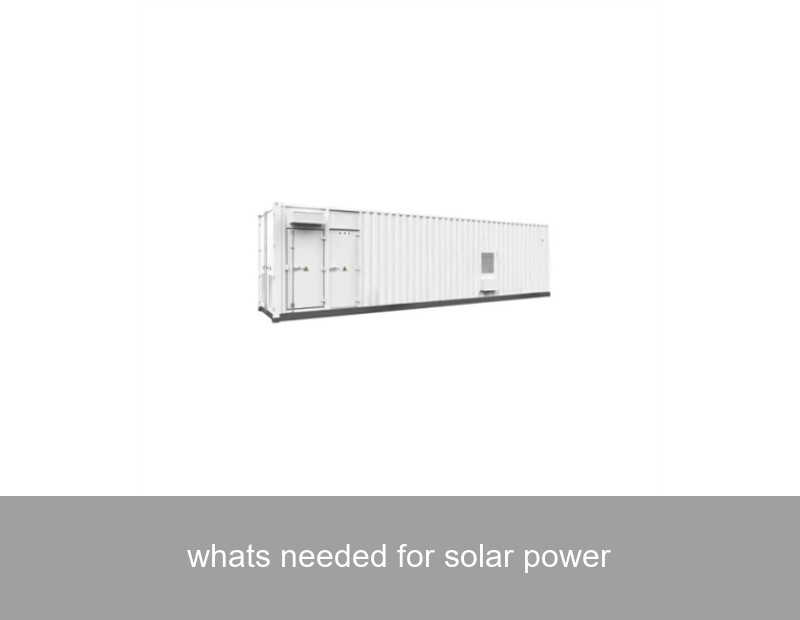
For commercial and industrial (C&I) applications, our Industrial PowerPack series offers scalable, containerized solutions. These systems manage complex demands: they integrate with large solar arrays, perform peak shaving, provide uninterruptible power for critical processes, and can even participate in grid services. For microgrids, our technology acts as the stabilizing heart, balancing variable solar generation with steady load requirements.
In essence, Highjoule provides the brains and the battery that turn a simple solar generator into a resilient, money-saving, and grid-supportive asset.
Building a Future-Ready Solar Power System
The energy landscape is shifting. Grids are becoming more dynamic, with variable pricing and increasing weather-related instability. Therefore, planning your solar installation today requires a forward-looking approach. The most future-proof systems are built with flexibility and intelligence at their core.
When you ask, "what's needed for solar power," the answer must evolve from a list of parts to a vision of a smart, integrated energy asset. It needs the generation (panels), the conversion and brains (hybrid inverter), the foundation (racking), the insight (monitoring), and, most importantly, the autonomy and control (storage).
As you contemplate your journey to energy independence, what role do you see intelligent storage playing in not just saving costs, but also in strengthening the resilience of your home or business against the evolving energy challenges of the next decade?
 Inquiry
 Online Chat