


The Utility Interactive Inverter: Your Gateway to a Smarter, More Resilient Energy System
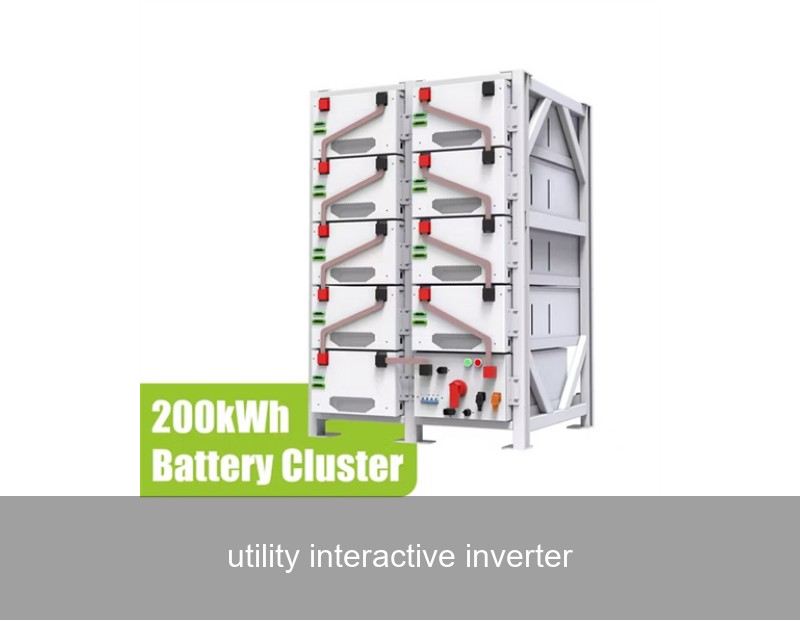
Have you ever wondered how solar panels on a roof or a battery in a garage seamlessly connects to the sprawling public electricity grid? The magic happens through a critical, yet often overlooked, device: the utility interactive inverter (also known as a grid-tie inverter). Unlike a simple plug, this intelligent device is the essential translator and safety manager between your private energy generation and the utility grid. For homeowners and businesses across Europe and the US investing in solar and storage, understanding this component is key to unlocking true energy independence and financial savings.
The Grid Partner: More Than Just Conversion
At its most basic, an inverter's job is to convert Direct Current (DC) from sources like solar panels or batteries into the Alternating Current (AC) that powers our homes and the grid. A utility interactive inverter, however, is a sophisticated piece of grid technology. It doesn't just convert; it synchronizes. It constantly monitors the grid's voltage, frequency, and phase, matching its own output perfectly to these parameters before allowing any energy to flow. This harmonious synchronization is what makes "net metering" possible, allowing you to send excess solar energy back to the grid for credit.
But its role as a safety guardian is even more crucial. In the event of a grid power outage, a standard grid-tie inverter is required to shut down immediately—a feature known as "anti-islanding." This protects utility workers repairing downed lines from unexpected live feeds. This is where advanced systems with utility interactive inverters equipped with islanding capabilities or paired with specialized backup gateways come in, enabling safe, isolated power during blackouts.

Image Source: Unsplash - A modern inverter is the brain of a grid-connected energy system.
Key Benefits for Homeowners and Businesses
Why should you care about the specifics of your inverter? Choosing the right utility interactive inverter technology directly impacts your system's value, resilience, and intelligence.
- Maximized Financial Return: By efficiently converting and synchronizing every watt of solar energy, these inverters ensure you maximize self-consumption and the value of energy exported to the grid under net metering or feed-in tariff schemes.
- Enhanced Grid Support: Modern inverters can provide "grid services" like voltage and frequency regulation. This means your system can help stabilize the local grid, especially important as renewable penetration increases.
- Foundation for Resilience: When integrated with a battery and proper control systems, advanced interactive inverters enable backup power functionality, keeping essential loads running during outages.
- Intelligent Energy Management: Today's inverters are communication hubs. They gather performance data and can be orchestrated by energy management systems to optimize when to use solar power, when to store it, and when to draw from the grid based on time-of-use rates.
A Real-World Case: The German Bakery Project
Let's look at a concrete example from Bavaria, Germany. A mid-sized artisan bakery with high refrigeration loads and daytime operations installed a 120 kWp rooftop solar system. Their goal wasn't just to save on bills, but to ensure production continuity during brief grid fluctuations common in their rural area.
They chose a system centered around a high-capacity, three-phase utility interactive inverter with advanced grid-support functions. The results, monitored over two years, are compelling:
| Metric | Result | Impact |
|---|---|---|
| Solar Self-Consumption | Increased from 35% to over 68% | Dramatically reduced grid purchases |
| Grid Export Quality | Provided reactive power support (cos φ ~1) | Improved local grid voltage stability |
| Production Downtime | Zero during 4 minor grid disturbances | Inverter's "ride-through" capability kept critical loads online |
| Annual Energy Cost Savings | €14,300 | ROI period reduced by ~1.5 years |
This case, documented in a Fraunhofer ISE report on photovoltaic trends, illustrates how the right interactive inverter technology moves savings beyond simple kilowatt-hours, adding layers of operational resilience and grid citizenship value.
Choosing the Right Inverter for Your System
With options ranging from central string inverters to modular microinverters and hybrid battery-ready units, selection depends on your site specifics, shading, expansion plans, and backup needs. Key considerations include:
- Efficiency: Look for peak and weighted efficiencies (e.g., Euro, CEC) above 97%.
- Grid Compliance: It must meet strict local grid codes (like VDE-AR-N 4105 in Germany or UL 1741 SA in the US).
- Smart Features: Built-in monitoring, software-upgradability, and compatibility with energy management platforms.
- Warranty & Support: A 10+ year warranty from a reputable manufacturer is standard for quality products.
Engineered for Performance: Highjoule's Smart Energy Solutions
At Highjoule, with nearly two decades of experience since 2005, we design our utility interactive inverter technology not as a commodity, but as the intelligent core of a holistic energy system. Our H-PowerCube Commercial and H-Volt Residential Series inverters are engineered for maximum reliability, efficiency, and grid intelligence.
They form the heart of our integrated storage solutions, such as the Highjoule H-Cell Industrial BESS and residential H-EcoStack. These systems leverage our inverters' advanced communication protocols to create self-optimizing microgrids. For instance, our proprietary GridSync algorithm allows our inverters to not only meet grid codes but proactively support grid stability, a feature increasingly valued by utilities in both Europe and North America. Whether it's a factory seeking demand charge reduction or a homeowner wanting reliable backup during storms, Highjoule's inverter-centric design ensures seamless, safe, and profitable interaction with the utility grid.

Image Source: Unsplash - Integrated solar and storage systems provide independence and insight.
The Future Grid: Interactive and Intelligent
The transition towards a decarbonized grid, as highlighted by the International Energy Agency (IEA), is fundamentally a shift from a one-way power delivery system to a two-way, interactive network. In this future, every utility interactive inverter becomes a node of intelligence—managing local energy flows, providing critical grid services, and empowering consumers.
The question is no longer *if* you should connect distributed energy resources to the grid, but *how intelligently* you can do it. The sophistication of your inverter determines your role: a passive consumer-turned-producer, or an active participant in a more resilient and sustainable energy ecosystem.
Is your current energy system simply offsetting bills, or is it actively working to protect your operations, support your community's grid, and prepare for the energy landscape of tomorrow? What would true energy resilience look like for your home or business?
 Inquiry
 Online Chat