


Thuisbatterij Zonder Zonnepanelen: Your Complete Guide to Off-Peak Power Independence
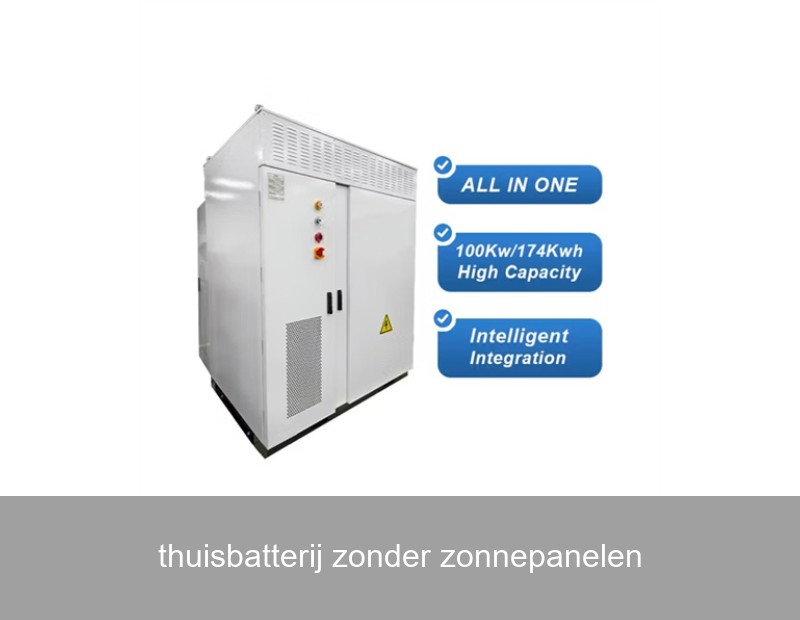
You’ve likely heard about the energy independence that home batteries bring. But what if we told you that you don't need a roof full of solar panels to start benefiting from one? The concept of a thuisbatterij zonder zonnepanelen (home battery without solar panels) is gaining remarkable traction across Europe and North America. It's a powerful strategy for savvy homeowners looking to take control of their electricity bills, enhance resilience, and contribute to grid stability—all without generating a single watt of their own solar power. Let's explore how this intelligent approach to energy consumption is reshaping modern households.
Table of Contents
- The Phenomenon: Why Consider a Battery Without Solar?
- The Data & Economic Reality
- Case Study: A Dutch Household's Success
- How Does a Standalone Home Battery System Work?
- Smart Solutions for Intelligent Storage: Highjoule's Role
- Key Considerations Before You Invest
- The Bigger Picture: Your Home and the Future Grid
The Phenomenon: Why Consider a Battery Without Solar?
Traditionally, home batteries have been marketed as the essential companion to solar PV systems. They store excess solar energy for use at night. However, a significant shift is occurring. Energy markets, particularly in regions with variable electricity pricing like time-of-use (TOU) tariffs, are creating a compelling new value proposition. A standalone home battery allows you to become a "smart consumer." You can buy and store electricity when it's cheap (often during the night or when renewable generation is high) and use it during expensive peak hours. This isn't just about saving money; it's about energy arbitrage and providing valuable services to an increasingly strained electrical grid.
The Data & Economic Reality
Let's talk numbers. In many European countries and US states, the difference between off-peak and on-peak electricity rates can be substantial. For instance, in California under some TOU plans, the peak rate can exceed $0.50 per kWh, while the off-peak rate can be as low as $0.25 per kWh (California Energy Commission). That's a 100% price difference. A household with a 10 kWh battery could theoretically save $2.50 per cycle by charging cheap and discharging during peak times. Over a year, with one cycle per day, that's over $900 in potential savings, not even factoring in backup power value during outages.
The economics become even more attractive when considering rising energy costs and potential incentives. Countries like Belgium and Germany have had subsidy programs that apply to storage systems, even those not directly paired with new solar installations.
Case Study: A Dutch Household's Success
Consider the real-world example of the Van Dijk family in Utrecht, Netherlands. Facing a north-facing roof unsuitable for efficient solar panels, they sought another way to reduce their reliance on the grid and manage costs. In early 2023, they installed a 12.8 kWh Highjoule H2-Core residential battery system without any solar panels.
The Strategy: Their system is programmed to charge automatically between 1:00 AM and 6:00 AM, when Dutch nighttime tariffs are lowest. It then powers their home throughout the morning and evening peak periods (7:00-9:00 AM and 5:00-10:00 PM).
- Grid Consumption During Peak Hours Reduced by 85%: They barely draw from the grid during expensive times.
- Monthly Electricity Bill Savings: Averaging €75-€90 per month, projecting a payback period well within the system's warranty.
- Backup Power: The system provided seamless backup during two short grid outages, keeping lights, internet, and refrigeration running.
"We thought a battery was only for solar homes," said Mr. Van Dijk. "This has given us control we never thought possible. We're buying low, using smart, and our kids are learning about energy management firsthand."

Image Source: Unsplash (Representative image of a residential battery system)
How Does a Standalone Home Battery System Work?
The technology is elegant in its simplicity. A modern thuisbatterij zonder zonnepanelen system consists of three core components:
- The Battery Module: Typically lithium-ion (like Lithium Iron Phosphate or LFP for safety and longevity), this is the energy storage unit.
- The Hybrid Inverter/Charger: This is the brain. It converts AC power from the grid to DC to charge the battery, and then back to AC to power your home. It communicates with your energy meter and is programmable.
- The Energy Management System (EMS): Intelligent software that learns your consumption patterns, connects to electricity price forecasts (where available), and automates the charge/discharge schedule for maximum economic benefit.
The system is installed between your main electrical panel and the utility meter, operating silently and automatically once set up.
Smart Solutions for Intelligent Storage: Highjoule's Role
At Highjoule, we've been at the forefront of advanced energy storage since 2005. We understand that the future of energy isn't just about generation—it's about intelligent management and storage. Our residential product line, particularly the H2-Core Series, is engineered precisely for scenarios like a standalone home battery application.
What makes our systems ideal for a thuisbatterij zonder zonnepanelen setup?
- High Round-Trip Efficiency (Over 96%): For every 100 kWh of cheap electricity you put in, you get over 96 kWh back out. This maximizes your financial return on every charge-discharge cycle.
- Scalable Capacity: Modules from 5 kWh to 25+ kWh, allowing you to right-size your system based on your daily consumption and peak shaving goals.
- Advanced Grid-Support Features: Our systems are designed with grid-friendliness in mind, supporting features that can help stabilize local voltage and frequency—a key consideration for utilities.
- Robust Software with API Integration: The Highjoule Energy OS allows for sophisticated programming and can integrate with third-party energy price data feeds for fully automated, optimized operation.
Our services extend beyond hardware. We provide comprehensive system design support, ensuring your battery is correctly sized and configured for your specific tariff structure and consumption profile, whether you're in Munich or Michigan.
Highjoule H2-Core Series Key Specifications
| Feature | Specification | Benefit for Non-Solar Use |
|---|---|---|
| Usable Capacity | 5 - 25+ kWh (modular) | Match to your daily peak consumption |
| Continuous Power Output | 5 kW / 10 kW (peak) | Runs major household appliances simultaneously |
| Chemistry | Lithium Iron Phosphate (LFP) | Superior safety, long cycle life (6000+ cycles) |
| Grid Interaction | UL 9540 / VDE-AR-E 2510-50 certified | Meets strict EU & NA safety and grid standards |
Key Considerations Before You Invest
Is a thuisbatterij zonder zonnepanelen right for you? Ask these questions:
- What is my electricity tariff structure? Time-of-Use rates with large spreads are ideal. A flat rate offers less immediate financial benefit.
- What is my daily energy consumption pattern? Analyze your bill to see how much energy you use during projected peak vs. off-peak times.
- Are there local incentives or regulations? Some utilities offer rebates for storage, while others may have specific interconnection rules. Research is key (DSIRE Database for US Incentives).
- Do I need backup power? If grid reliability is a concern, ensure the system you choose has a seamless backup functionality.

Image Source: Unsplash (Representative image of energy management software analytics)
The Bigger Picture: Your Home and the Future Grid
Your decision goes beyond personal savings. By adopting a standalone home battery, you're becoming an active participant in the energy transition. You help flatten the demand curve, reducing the need for utilities to fire up polluting "peaker" plants during high-demand periods. In the future, programs like virtual power plants (VPPs) may allow you to earn additional income by allowing your battery to provide services to the grid during critical times. A report by the International Energy Agency highlights the critical role of demand-side flexibility, including storage, in achieving net-zero goals.
So, while the sun might not be powering your battery directly, you are leveraging market dynamics to create a more resilient and sustainable energy footprint for your household and your community.
Ready to Explore Your Energy Independence?
What does your current electricity bill look like, and how much of your consumption occurs during those costly peak hours? Could your home be the next smart node in a cleaner, more resilient grid?
 Inquiry
 Online Chat