


Finding the Right Solar Photovoltaic kW for Sale: A Guide to Smart Energy Investment
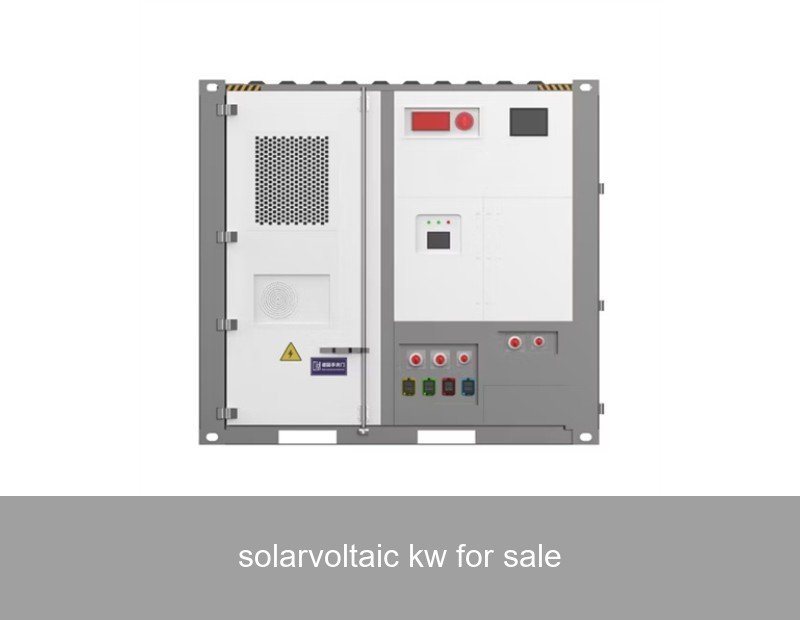
You've seen the headlines about energy prices, felt the push for sustainability, and are now seriously considering solar panels. The question shifts from "if" to "how much?" Specifically, you're searching for the right solar photovoltaic kW for sale. But here's the insight many miss: buying solar kW isn't like buying apples by the pound. It's about purchasing a system—a long-term energy partner whose performance, durability, and intelligence matter just as much as its nameplate power. This article will guide you through what truly defines value when evaluating solar photovoltaic kW offerings, ensuring your investment delivers maximum return for years to come.
Table of Contents
- The kW Illusion: More Than a Nameplate Number
- The Data: Understanding the Performance Gap
- Case Study: A California Warehouse's Strategic Upgrade
- Beyond the Panels: The Critical Role of Storage and Intelligence
- Highjoule's Integrated Approach: Delivering True kW Value
- Making Your Choice: Key Questions to Ask
The kW Illusion: More Than a Nameplate Number
When you see "5 kW solar system for sale," it's natural to focus on that number. It represents the system's potential power output under ideal, laboratory-standard test conditions (STC). However, the real world is rarely ideal. Shading, temperature fluctuations, dust, and equipment efficiency create a gap between theoretical and actual output. A cheaper, lower-quality 5 kW system might consistently produce only 3.8 kW of usable power on a hot afternoon, while a robust, well-engineered 5 kW system could deliver 4.5 kW or more under the same conditions. The key metric isn't the kW for sale; it's the kilowatt-hours (kWh) delivered to your home or business over the system's lifetime.
The Data: Understanding the Performance Gap
The performance ratio (PR) measures this efficiency gap. According to a report by the National Renewable Energy Laboratory (NREL), while module efficiencies have improved, system-level losses can still range from 10% to 25%, depending on components and design. This means two systems advertised with the same "kW for sale" can have a 15% or greater difference in annual energy yield. The table below breaks down common loss factors:
| Loss Factor | Typical Impact | Mitigation Strategy |
|---|---|---|
| Inverter Inefficiency | 2-5% | Using premium, high-efficiency inverters |
| Temperature & Soiling (Dust) | 3-7% | Optimal panel selection & regular maintenance |
| Mismatch & Wiring Losses | 1-3% | Professional system design & quality components |
| Suboptimal Tilt/Azimuth | Varies Widely | Advanced site analysis and mounting solutions |
As you can see, the components and design surrounding the panels are paramount. This is where partnering with a system-level expert, rather than just a panel supplier, becomes critical.
Case Study: A California Warehouse's Strategic Upgrade
Let's look at a real example from our work at Highjoule in Southern California. A logistics company was comparing two bids for a rooftop installation. Both offered "250 kW for sale."
- Bid A (Lowest Cost): Focused solely on panel cost per watt. Used a standard string inverter.
- Bid B (Highjoule's Solution): Included a detailed shading analysis, proposed module-level power electronics (MLPE) to mitigate roof vent shadows, and specified a higher-tier, temperature-resilient panel.
The upfront cost of Bid B was 12% higher. However, our energy simulation projected a 21% higher annual production (415,000 kWh vs. 343,000 kWh) due to minimized losses. With California's high energy rates and time-of-use tariffs, the payback period for our solution was actually shorter. Three years post-installation, monitoring data confirms the system consistently meets and exceeds projections, saving the owner over $65,000 more than the cheaper alternative would have in the same period. This proves that evaluating the lifetime cost per generated kWh is far more insightful than the initial cost per installed kW.

Image Source: Unsplash (A commercial solar installation similar to the case study).
Beyond the Panels: The Critical Role of Storage and Intelligence
In today's energy landscape, a solar photovoltaic kW is most valuable when it's dispatchable. What does that mean? Simply put, can you use the power when you need it most? Solar generation peaks midday, but energy demand and peak tariffs often hit in the early evening. Without storage, you're exporting excess power at low rates and buying it back at high rates.
Integrating a battery energy storage system (BESS) transforms your solar investment. It captures excess generation for later use, provides backup power during outages, and allows for participation in grid services in some markets. The intelligence of the system's energy management software is the brain that orchestrates this, optimizing for self-consumption, cost savings, or grid support based on your goals.
Highjoule's Integrated Approach: Delivering True kW Value
At Highjoule, we've focused on this integrated reality since 2005. We don't just sell kW of solar; we provide intelligent, optimized power solutions. Our HI-Stack Commercial & Industrial Energy Storage System is a prime example. It's a modular, containerized BESS designed to seamlessly pair with new or existing solar arrays, turning intermittent generation into a firm, reliable resource.
For residential and smaller commercial clients, our EcoHome+ platform combines high-efficiency solar with our integrated EcoCell lithium-ion storage and smart energy management. The system doesn't just produce kW; it learns your usage patterns, weather forecasts, and utility rate structures to autonomously maximize your financial return and energy independence. When you inquire about solar photovoltaic kW for sale with us, you receive a proposal centered on your unique energy profile and economic outcomes, not just a hardware quote.

Image Source: Unsplash (Residential solar and battery storage system).
Making Your Choice: Key Questions to Ask
So, as you evaluate providers for your solar photovoltaic kW project, move beyond the price per watt. Ask these strategic questions:
- What is the estimated first-year and lifetime energy yield (kWh) of your proposed system, and how is it modeled?
- How do you account for real-world loss factors like shading, soiling, and temperature in your design?
- What are the efficiency ratings of the proposed inverter and other balance-of-system components?
- How can this solar system be integrated with storage now or in the future to maximize ROI?
- What intelligent energy management capabilities are included to adapt to changing tariffs and usage?
By focusing on these questions, you shift the conversation from commodity purchasing to value engineering.
Ready to See the Difference?
The journey to energy independence is exciting, but the path is paved with more than just panels. What specific energy challenge—be it rising costs, demand charges, or sustainability goals—is driving your search for solar photovoltaic kW today, and how can a system that thinks for itself provide the solution?
 Inquiry
 Online Chat