


Unlocking Grid Independence: The Power of a Solaredge Energy Storage Cabinet Three Phase System
Have you ever watched your solar panels working hard on a bright afternoon and wondered, "Where is all that extra energy going?" For businesses and larger homes, this question isn't just philosophical—it's financial. A significant amount of self-generated, clean power often flows back to the grid for minimal compensation, only for you to buy it back at a premium in the evening. This frustrating cycle is the key challenge modern energy consumers face. The solution lies in sophisticated, three-phase energy storage. Specifically, integrating a robust Solaredge energy storage cabinet three phase system can transform how you generate, store, and consume electricity, moving you from passive consumer to active energy manager. Let's explore how this technology works and why it's becoming indispensable for commercial and industrial applications across Europe and the U.S.
Table of Contents

Image Source: Unsplash - Representative image of commercial solar and electrical infrastructure.
The Three-Phase Imperative: Beyond Residential Storage
Most residential energy storage systems are single-phase, designed to handle the relatively lower and balanced loads of a home. But step into a factory, a farm, a mid-sized business, or a large multi-family dwelling, and the electrical landscape changes completely. These operations typically run on three-phase power. It's the standard for higher-power equipment—think industrial motors, HVAC systems, commercial refrigeration, and heavy machinery. It provides a more stable and efficient way to distribute larger amounts of electricity.
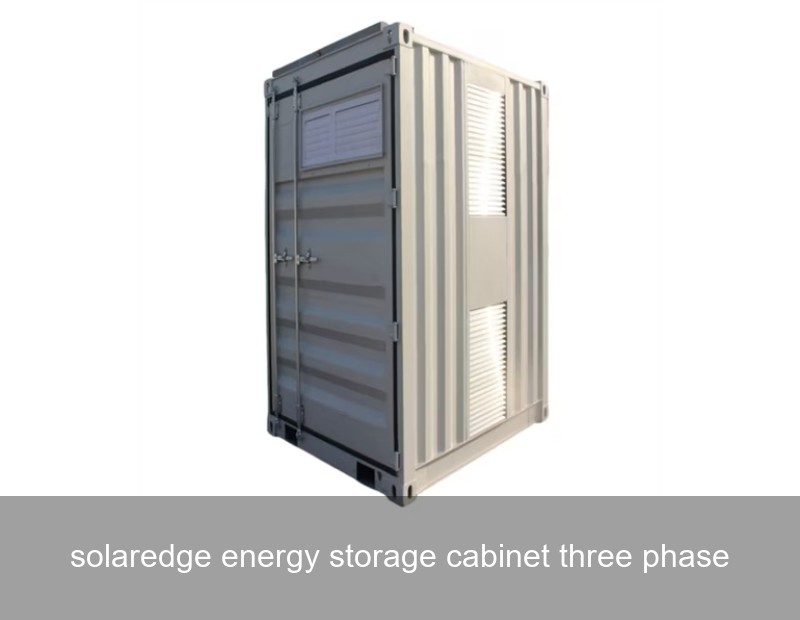
Attempting to back up or optimize a three-phase building with a single-phase battery system is, frankly, ineffective. It can lead to phase imbalances, potentially damaging sensitive equipment and failing to support critical loads. This is where a dedicated Solaredge energy storage cabinet three phase unit comes in. It's engineered to seamlessly integrate with three-phase infrastructures, ensuring balanced storage and discharge across all phases. The "cabinet" aspect is crucial: it's a complete, pre-engineered system that houses the battery modules, power conversion electronics, cooling, and safety systems in one robust, manageable enclosure, simplifying installation and maintenance.
Key Components of a Three-Phase Storage Cabinet
- Three-Phase Hybrid Inverter: The brain of the operation, managing AC/DC conversion bidirectionally across all three phases.
- High-Voltage Battery Bank: Lithium-ion battery modules (often LFP chemistry for safety and longevity) configured for high capacity and power.
- Integrated Energy Management System (EMS): Software that intelligently decides when to charge, store, or discharge based on tariffs, consumption, and solar production.
- Grid-Forming Capability: Advanced systems can create a stable microgrid, providing backup power even if the main grid is down.
The Data Reality: Why Three-Phase Storage is No Longer Optional
The drive isn't just theoretical. The economics of energy are shifting rapidly, especially in our target markets. Let's look at the numbers.
In Germany, for instance, feed-in tariffs for new solar installations have plummeted, while retail electricity prices for commercial users have consistently risen, exceeding €0.30/kWh in 2023 for many businesses (source: Energy-Charts). In California (USA), commercial time-of-use (TOU) rates see a massive delta between off-peak and on-peak periods, sometimes a difference of over $0.20/kWh. The financial model is clear: maximize self-consumption of your solar energy.
Data from the Solar Energy Industries Association (SEIA) shows commercial solar adoption growing steadily, but without storage, average self-consumption rates often cap at 30-40%. Adding a three-phase storage cabinet can push this to 70% or higher, dramatically slashing demand charges and insulating businesses from volatile spot prices.
| Challenge | Without 3-Phase Storage | With a SolarEdge 3-Phase Storage Cabinet |
|---|---|---|
| Solar Self-Consumption | ~35% (Excess sold cheaply) | >70% (Excess stored for later use) |
| Grid Outage Impact | Full Operational Halt | Seamless backup for critical loads |
| Demand Charge Management | Limited control, high peaks | Peak shaving, predictable costs |
| ROI on Solar Investment | 5-7 year typical payback | Can reduce to 4-6 years with added savings |
Case Study: A Bavarian Brewery's Recipe for Energy Resilience
Let's make this tangible with a real-world example from our work at Highjoule.
The Client: A traditional, family-owned brewery in Bavaria, Germany, with a 250 kWp rooftop solar array. Their processes—refrigeration, brewing kettles, bottling lines—are energy-intensive and three-phase reliant.
The Problem: Despite significant solar generation, their afternoon peak production didn't align with their evening and early morning energy needs for cooling. They were exporting over 60% of their solar yield at low feed-in rates, then drawing expensive grid power at night. A single grid outage could spoil an entire batch, representing a massive financial loss.
The Highjoule Solution: We designed and deployed a turnkey system centered around a Solaredge energy storage cabinet three phase solution, coupled with their existing SolarEdge PV inverters. The cabinet housed 100 kWh of LFP battery storage with a three-phase inverter capable of grid-forming.
The Results (12 Months Post-Installation):
- Self-Consumption Rate: Increased from 38% to 82%.
- Grid Energy Costs: Reduced by 68%.
- Demand Charges: Lowered by approximately 40% through active peak shaving.
- Resilience: The system successfully provided backup power during two brief grid outages, preventing spoilage and maintaining critical cooling.
The brewery now views its energy system not as an overhead cost, but as a core, resilient, and profitable part of its production infrastructure.

Image Source: Unsplash - Representative image of a technician servicing industrial energy equipment.
The Highjoule & SolarEdge Synergy: Optimized Three-Phase Solutions
As a global leader in advanced energy storage systems since 2005, Highjoule doesn't just supply hardware; we provide intelligent, integrated power solutions. Our expertise lies in selecting and configuring the right components for your specific load profile and economic goals. The SolarEdge three-phase storage cabinet is a premier component in our portfolio for good reason.
Its DC-coupled architecture, when paired with SolarEdge PV inverters, allows for highly efficient, direct charging of the batteries from the solar array. This avoids the double conversion losses (DC to AC, then back to DC) common in AC-coupled systems. For our commercial and industrial clients, this efficiency gain translates directly to a faster return on investment.
Furthermore, Highjoule's proprietary Energy Management Platform adds a layer of intelligence on top. We can tailor the system's operation to local utility rate structures in the U.S. or Europe, participate in demand response programs where available, and provide you with granular, actionable insights into your energy flows. Our service includes comprehensive system design, professional installation, grid compliance support, and long-term monitoring and maintenance—ensuring your Solaredge energy storage cabinet three phase system delivers optimal performance for its entire lifespan.
Ideal Applications for Highjoule's Three-Phase Systems
- Commercial Facilities: Retail stores, office buildings, hotels.
- Industrial Operations: Manufacturing plants, workshops, warehouses.
- Agricultural Businesses: Farms with cold storage, irrigation, and processing.
- Community & Microgrids: Multi-tenant buildings, small remote communities.
The Future is a Dynamic Grid: Your Role in It
The energy transition is accelerating. We're moving away from a centralized, one-way grid to a decentralized, dynamic network of prosumers. By investing in a three-phase energy storage solution, you're not just saving on your bill; you're becoming an active node in a more resilient and sustainable grid. Your stored energy can, in future frameworks, provide valuable services to stabilize the local network.
The technology is proven, the economics are compelling, and the need for energy independence has never been greater. Whether your primary driver is financial savings, sustainability goals, or operational resilience, the question is no longer if you should consider storage, but how to implement it effectively for your three-phase needs.
What is the single biggest energy cost driver your business faces today—is it peak demand charges, volatile time-of-use rates, or the ever-present risk of disruptive outages?
 Inquiry
 Online Chat