


Solar Systems for Apartments: Your Guide to Clean Energy in Multi-Unit Buildings
Imagine this: you live in an apartment, you're passionate about sustainability, and your electricity bill seems to climb every month. You've seen houses with sleek solar panels and wondered, "Is that even possible for me?" For years, the answer for apartment dwellers was often a disappointing "no." But the energy landscape is changing rapidly. Today, innovative solar systems for apartments are not just a possibility; they are a powerful and growing reality for tenants and building owners across Europe and the U.S. This guide will demystify how you can access solar power without owning a rooftop, the technologies making it happen, and the tangible benefits for your wallet and the planet.
Table of Contents
The Challenge: Why Apartments Are Different
Traditional home solar setups are relatively straightforward: a single owner, a single roof, a single meter. Apartments introduce complexity: shared rooftops, multiple stakeholders (owners, tenants, associations), limited physical space per resident, and utility billing structures designed for single families. The primary hurdle isn't technology—it's governance and economics. Who pays for the installation? How is the generated power allocated and billed fairly? Overcoming these barriers requires smart technology and even smarter collaboration models.
Modern Solutions for Apartment Solar
Thankfully, the industry has risen to the challenge with several accessible models. The right solution depends on your building's structure, local regulations, and energy goals.
1. Community Solar Gardens
This is perhaps the most accessible entry point. You subscribe to a portion of a larger, off-site solar farm. The energy it produces feeds into the local grid, and you receive credits on your utility bill for your share. It's like having a "slice" of a solar farm without any hardware on your building. According to the National Renewable Energy Laboratory (NREL), the U.S. community solar market is projected to grow significantly, offering savings of 10-15% on average for subscribers.
2. The Game-Changer: Battery Energy Storage Systems (BESS)
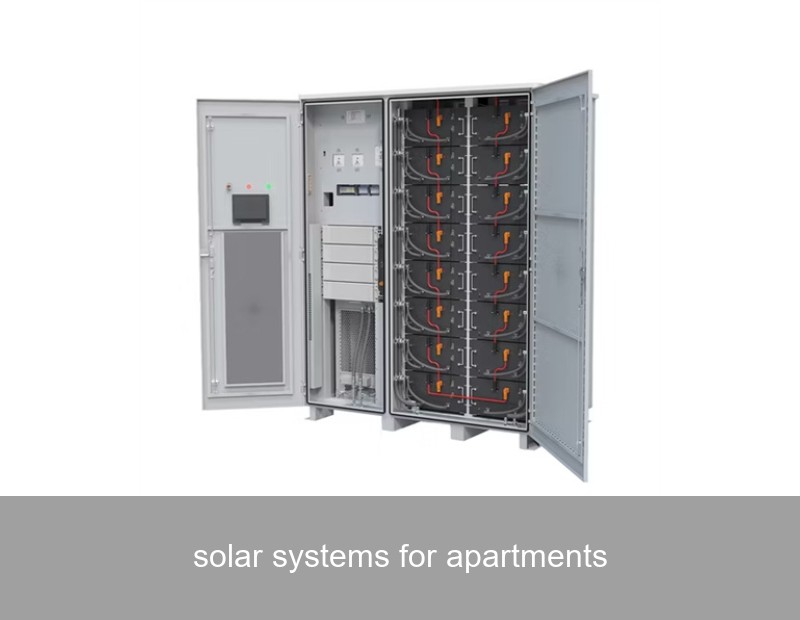
For on-site generation, the key to unlocking solar for apartments is integrating a Battery Energy Storage System. Here's why: solar panels on an apartment roof produce power mostly during midday. But apartments have diverse energy demands throughout the day and night. A BESS stores excess solar energy for use in the evening peak, maximizing self-consumption and providing critical resilience.
This is where a company like Highjoule becomes a vital partner. Highjoule's IntelliStoreTM Commercial & Industrial BESS is engineered for multi-tenant applications. Its intelligent energy management software can dynamically allocate stored solar power to common areas (lighting, elevators) or to individual tenant circuits based on pre-agreed rules. This turns a building from a passive energy consumer into an active, intelligent microgrid.

Image: Example of balcony-integrated solar solutions. Source: Unsplash
3. Balcony Power Plants & Plug-in Systems
For renters or buildings where major retrofits aren't feasible, plug-and-play solar systems are gaining traction, especially in Europe. These are small, certified PV modules (often 300-600W) that can be mounted on a balcony, terrace, or facade and plugged directly into a standard outdoor outlet. They immediately offset a portion of your apartment's base load. While individual units are small, their collective impact in a dense urban setting is substantial.
Case Study: Solar Success in a Berlin Apartment Complex
Let's look at real data. A 24-unit apartment building in Berlin, built in the 1990s, embarked on a sustainability upgrade in 2022. The goal: reduce common area electricity costs and carbon footprint.
- Solution Installed: A 45 kWp solar array on the entire south-facing roof, coupled with a 40 kWh Highjoule IntelliStore BESS in the basement.
- Energy Management: The system prioritizes powering the building's LED corridor lighting, ventilation, and elevator. Excess solar charges the battery. In the evening, the battery powers these loads, avoiding expensive grid electricity.
- Results After 12 Months:
- An 85% reduction in grid electricity consumption for common areas.
- Annual CO2 savings of approximately 12.5 tonnes.
- The building owners' association reported a payback period of under 7 years, factoring in local grants.
"The battery was the missing piece," the property manager noted. "Without it, we would have been sending most of our solar power to the grid at low rates. Now, we use almost every kilowatt-hour we produce, which makes the economics work for all residents."
How Highjoule Powers Intelligent Apartment Communities
As a global leader in advanced energy storage since 2005, Highjoule's expertise is crucial for making solar systems for apartments viable and profitable. Our solutions address the core challenges of multi-unit buildings:
| Challenge | Highjoule Solution | Benefit for Apartments |
|---|---|---|
| Fair Energy Allocation | Highjoule EMS (Energy Management System) with virtual metering | Enables precise tracking and billing of solar energy usage per tenant or common area. |
| Maximizing Self-Consumption | IntelliStore BESS with AI-driven charge/discharge cycles | Stores midday solar surplus for use during high-rate evening hours, slashing bills. |
| Grid Stability & Revenue | Grid-service ready inverters and system design | In some markets, buildings can participate in grid-balancing programs for additional income. |
| Reliability & Safety | UL/Certified, modular, containerized or rack-mounted BESS | Industry-leading safety standards and scalable design for basements or rooftops. |
For new construction or major retrofits, Highjoule works directly with developers, building owners, and engineering firms to design integrated solar-plus-storage systems that become a central feature of the property's value proposition.

Image: A modern Battery Energy Storage System (BESS) unit. Source: Unsplash
Your Path to Apartment Solar Power
So, where do you begin? The journey differs if you're a tenant, a condo owner, or a property manager.
- For Tenants: First, investigate plug-in balcony systems if you have a sunny spot. Check your lease and local electrical codes. Second, research local community solar programs—many states in the U.S. and countries in Europe have active offerings. Bring the idea to your landlord or building association.
- For Condo Owners & Property Managers: Start with an energy audit. Then, engage a solar installer experienced in multi-family buildings for a feasibility study. Crucially, involve all stakeholders early—transparency and education are key. Discuss financing options, including grants and incentives like those in the U.S. Inflation Reduction Act or EU renovation funds.
- For Developers: Integrate solar and storage into your blueprints from day one. This future-proofs the building, reduces long-term operational costs, and creates a powerful marketing advantage for eco-conscious tenants.
The dream of powering your apartment life with clean, affordable solar energy is now within reach. It requires a shift from thinking about "my roof" to thinking about "our energy system." With the right partnership and technology, apartment buildings can transform from energy-intensive structures into resilient, clean power hubs for their communities. What's the first question you will ask your neighbors or building manager about harnessing the sun's power together?
 Inquiry
 Online Chat