


Demystifying the Solar Set Price for Sale: Your Key to Energy Independence and Revenue
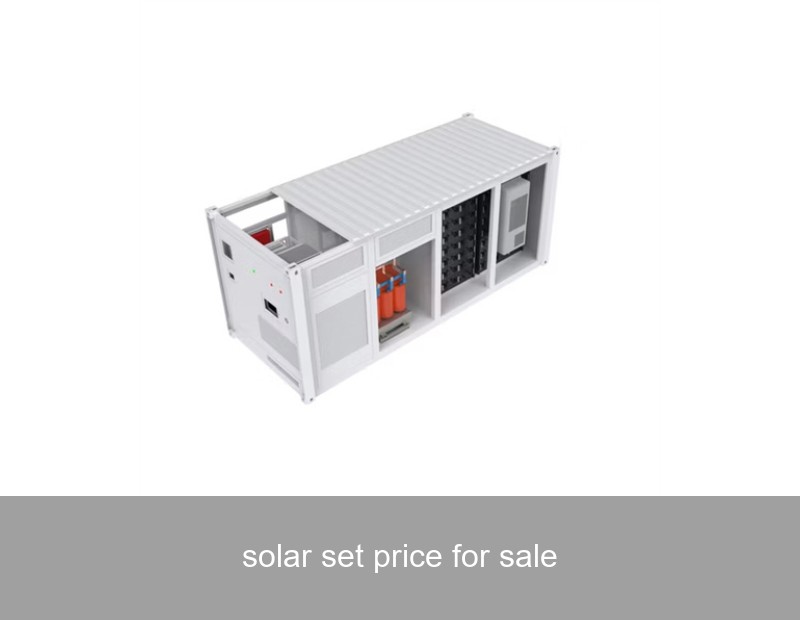
You've made the smart decision to install solar panels. Your roof is generating clean, free electricity. But what happens when the sun is blazing, and you're producing more power than you can use? This is where understanding the solar set price for sale becomes crucial. It's not just a technical term; it's the gateway to turning your solar investment into a revenue stream and a cornerstone of a truly resilient energy strategy. In this guide, we'll break down what it is, why it matters, and how pairing it with the right technology unlocks its full potential.
Table of Contents
What is a Solar Set Price for Sale?
Simply put, the solar set price for sale (often called a feed-in tariff or export rate) is the price you agree to sell your excess solar electricity back to the utility grid. This rate can be structured in several ways:
- Fixed Rate: A guaranteed price per kilowatt-hour (kWh) for a set contract period.
- Time-of-Use (TOU) Export: The price varies based on the time of day, often higher during peak evening demand.
- Wholesale/Dynamic Rate: The price changes in real-time based on grid conditions, similar to how energy markets operate.
Historically, fixed rates were common and generous, acting as a major incentive for early solar adopters. However, as solar penetration has skyrocketed—with the U.S. alone seeing a 33% increase in capacity in 2023—utilities are shifting toward more complex, variable rates. This evolution presents both a challenge and an opportunity for the modern solar owner.
The Challenge: Variable Export Rates and Wasted Energy
The fundamental issue with relying solely on grid export is misalignment. Solar panels produce the most during midday, precisely when wholesale electricity prices (and thus, many export rates) are often at their lowest. You're selling cheap. Then, in the evening when the sun sets and grid demand peaks, you're forced to buy back electricity at a premium rate. This price arbitrage eats into your savings.
Furthermore, without a way to store surplus energy, any excess beyond what the grid agrees to take is literally wasted. It's like having a second income stream, but you can only deposit the money between 10 AM and 2 PM, and the rest vanishes.
The Data Behind the Mismatch
| Time of Day | Solar Production | Typical Grid Demand | Export Rate Value |
|---|---|---|---|
| Midday (11 AM - 3 PM) | Very High | Moderate | Low |
| Evening (5 PM - 9 PM) | Low/None | Very High (Peak) | High |
This table illustrates the core problem. To truly benefit, you need a way to shift your solar energy from low-value periods to high-value periods.

Credit: Photo by Andreas Gücklhorn on Unsplash. The setting sun marks the time when solar production falls but household energy demand rises.
The Solution: Battery Storage and Intelligent Optimization
This is where a home battery energy storage system (BESS) transforms the equation. Instead of automatically exporting all excess solar, an intelligent system stores it in a high-performance battery. Now, you have control over when to use that energy and when to sell it.
- Step 1: Self-Consumption First. Your home uses your stored solar energy in the evening, avoiding expensive grid imports.
- Step 2: Strategic Export. You can program your system to export energy only when the solar set price for sale reaches a profitable threshold you define.
- Step 3: Grid Services. Advanced systems can even provide grid stability services, creating an additional revenue stream.
The key is the intelligence of the system's energy management software. It must continuously monitor production, consumption, storage levels, and—critically—real-time or forecasted export prices to make the most profitable decision every minute of the day.
Case Study: Maximizing Returns in a Variable Market
Let's look at a real-world scenario in California, a leader in both solar adoption and time-based rates. Under a net billing tariff structure, export rates can fluctuate dramatically.
The Setup: A residential customer in Northern California with a 8kW solar array and a 13.5kWh battery system (like Highjoule's ResiPro 13). The utility's export rate ranges from $0.08/kWh in the afternoon to over $0.60/kWh during extreme grid events in the evening.
The Strategy: The Highjoule system's AI-driven controller was configured to prioritize charging the battery with midday solar surplus. It then set a minimum solar set price for sale trigger of $0.45/kWh for any export.
The Data-Driven Result: Over a 3-month summer period, the system's behavior was clear: - 72% of the solar surplus was used for self-consumption, eliminating grid purchases during peak hours. - 28% was exported, but 90% of that export occurred during high-price periods above $0.45/kWh. - Compared to a standard solar-only system exporting at low midday rates, the intelligent battery system increased the total financial value of the solar generation by approximately 40%.
This case shows that the right technology doesn't just store energy; it stores value, waiting for the optimal moment to release it.
The Highjoule Advantage: Smart Systems for Smart Sellers
At Highjoule, we've been designing advanced energy storage solutions since 2005. We understand that the hardware is only half the story. Our products, like the ResiPro Series for homes and the Commander Series for commercial sites, are built around our proprietary Adaptive Energy OS.
This intelligent platform does the heavy lifting for you:
- Dynamic Price Tracking: Integrates with utility rate schedules and wholesale market data (where available) to forecast price windows.
- Adaptive Set-Point Control: Allows you to set your desired minimum solar set price for sale or let the system's AI recommend optimal settings based on your usage patterns.
- Resilience First: Even while optimizing for revenue, the system always ensures a reserve of backup power for outages, a critical feature as noted by the U.S. Department of Energy's focus on grid resilience.
For businesses and microgrids, this capability scales further. A Highjoule Commander system can manage multiple revenue streams—arbitraging time-of-use rates, participating in demand response programs, and providing firm capacity—all while ensuring operational continuity.

Credit: Photo by American Public Power Association on Unsplash. A modern home battery system, the key to controlling when to use and when to sell your solar energy.
The Future: Your Home as a Power Plant
The energy landscape is moving towards decentralized, transactive grids. In the UK and parts of Europe, virtual power plants (VPPs) are already aggregating thousands of home batteries to act as a single, dispatchable resource for the grid. In this future, your solar set price for sale could be a dynamic bid into a real-time marketplace.
Preparing for this requires a system that is not just a passive storage unit, but a smart, grid-interactive asset. It requires technology that can communicate, respond to signals, and execute complex strategies autonomously. This is the core of Highjoule's design philosophy: building storage systems that are future-proof, maximizing your investment today while being ready for the energy markets of tomorrow.
As the International Energy Agency highlights, storage is the essential enabler for high renewable penetration. The question is no longer just about generating your own power, but about managing it with the sophistication of a professional energy trader.
Ready to Take Control of Your Energy Value?
What minimum solar set price for sale would make exporting worthwhile for you, and how much could you save by using that energy yourself during peak times? Explore the possibilities with our system configurator or speak with one of our energy specialists to model your specific scenario.
 Inquiry
 Online Chat