


Why the Solar PV & Energy Storage World Expo 2025 is a Pivotal Moment for Global Energy
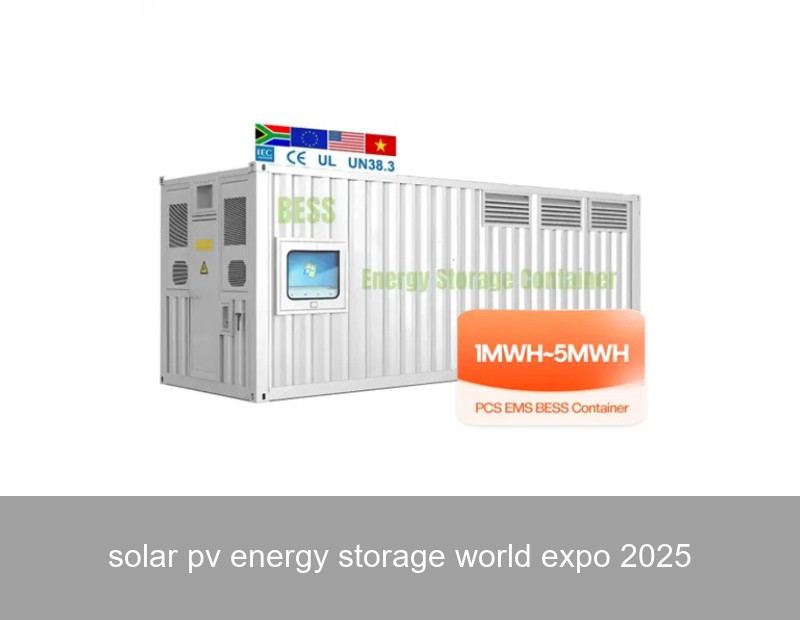
If you're involved in the energy sector, you've likely marked your calendar for the Solar PV & Energy Storage World Expo 2025. But this isn't just another industry event. As we approach this key date, a powerful convergence of market forces, technological breakthroughs, and urgent climate goals is setting the stage for what could be the most significant expo yet. For professionals, businesses, and communities worldwide, understanding the trends that will dominate the Solar PV & Energy Storage World Expo 2025 is crucial for navigating the future of power. This article delves into the "why" behind the excitement, exploring the real-world phenomena driving this evolution and what it means for a sustainable energy future.
Table of Contents
- The Phenomenon: More Than Just Panels and Batteries
- The Data Reality: Grids Under Pressure and Rising Demand
- The Case Study: A German Industrial Park's Transformation
- Key Trends to Watch at the Solar PV & Energy Storage World Expo 2025
- Highjoule's Vision: Intelligent Systems for a Resilient Future
- Your Next Step: From Expo Insights to Action
The Phenomenon: More Than Just Panels and Batteries
Gone are the days when solar and storage were simple, standalone solutions. The industry is experiencing a fundamental shift from hardware-centric to intelligence-centric systems. The modern challenge isn't just generating clean energy; it's about managing it intelligently. We're seeing homeowners who want to power their EVs, run appliances during peak rates, and still have backup during outages—all automatically. Utilities are scrambling to integrate volatile renewable sources while maintaining grid stability. This complex dance between generation, consumption, storage, and grid services is what will define the next era, and it's the core conversation that will animate every hall at the Solar PV & Energy Storage World Expo 2025.
The Data Reality: Grids Under Pressure and Rising Demand
The numbers paint a clear picture of urgency. According to the International Energy Agency (IEA), global renewable capacity is set to grow by a staggering 2.5 times by 2030. Solar PV alone accounts for three-quarters of this expansion. However, this rapid growth exposes a critical vulnerability: grid congestion and intermittency. In markets like California and parts of Europe, curtailment (where renewable energy is wasted because the grid can't absorb it) is becoming a multi-billion dollar problem. Simultaneously, electrification of transport and heating is driving up electricity demand. The solution lies not in building more fossil-fuel peaker plants, but in sophisticated energy storage systems (ESS) that can time-shift energy, provide grid services, and create resilient local microgrids.
The Case Study: A German Industrial Park's Transformation
Let's make this concrete with a real-world example. A medium-sized manufacturing park in North Rhine-Westphalia, Germany, faced volatile energy costs and sought to meet stringent corporate sustainability targets. Their 2.5 MW rooftop solar array often produced excess energy during midday lows, which was sold back to the grid at low prices, while they purchased power during expensive evening peaks.
Their solution, implemented in 2023, was a integrated 1.8 MWh battery energy storage system (BESS) coupled with advanced energy management software. The results after one year of operation are telling:
| Metric | Before BESS | After BESS |
|---|---|---|
| Grid Energy Consumption at Peak | 95% | 35% |
| Solar Self-Consumption Rate | ~45% | >92% |
| Annual Energy Cost Savings | Baseline | €184,000 |
| Grid Services Revenue (Frequency Regulation) | €0 | €31,000 |
This case exemplifies the dual value stream: cost avoidance and revenue generation. The BESS stores cheap midday solar and grid power, discharges during peaks, and even earns money by helping stabilize the regional grid. This is the model that will be replicated globally, and it's exactly the kind of application that will be showcased and refined at the upcoming Solar PV & Energy Storage World Expo.

Image: An industrial site with integrated solar and storage. (Source: Unsplash, Representative Image)
Key Trends to Watch at the Solar PV & Energy Storage World Expo 2025
Based on the market phenomenon and data, here are the key technological and business trends that will dominate the Expo floor.
Trend 1: The Rise of the Software-Defined Power Plant
The hardware—solar panels and battery cells—is becoming increasingly commoditized. The true differentiator is now the brain: the energy management system (EMS) and operating system. Advanced software platforms use AI and machine learning to optimize every kilowatt-hour. They forecast energy production and consumption, decide when to charge or discharge based on real-time electricity prices, and seamlessly participate in grid service markets. At the Solar PV & Energy Storage World Expo 2025, expect to see less "box-selling" and more demonstrations of intelligent, cloud-connected platforms that turn a static battery into a dynamic financial asset.
Trend 2: Safety and Longevity Take Center Stage
As BESS deployments scale, especially in densely populated areas, safety is non-negotiable. The industry is moving beyond basic compliance to engineered safety. This includes advancements in cell chemistry (like lithium iron phosphate/LFP, known for its thermal stability), sophisticated thermal propagation prevention systems, and multi-layered fire suppression integrated into the BESS design. Furthermore, warranties and performance guarantees are extending to 15 years and beyond. For commercial and industrial clients, the levelized cost of storage (LCOS) depends on a safe, long-lasting system, making this a critical evaluation point at the Expo.
Trend 3: Grid-Forming BESS for True Energy Independence
This is a game-changer for microgrids and areas with weak grids. Traditional "grid-following" inverters need an existing grid signal to synchronize. Grid-forming inverters can create a stable voltage and frequency waveform from scratch, essentially "starting" a grid. This allows a solar-plus-storage system to form an islanded microgrid during a blackout, keeping critical facilities online indefinitely. This technology is pivotal for enhancing community resilience and will be a highlight at the Solar PV & Energy Storage World Expo 2025.

Image: Advanced control systems are key to modern energy storage. (Source: Unsplash, Representative Image)
Highjoule's Vision: Intelligent Systems for a Resilient Future
At Highjoule, we've been anticipating this intelligent energy transition since our founding in 2005. Our presence at the Solar PV & Energy Storage World Expo 2025 will showcase how our philosophy translates into tangible solutions. We don't just supply components; we deliver integrated, intelligent power ecosystems.
Our flagship product line, the H-Series Commercial & Industrial BESS, is built from the ground up for the trends discussed. It features industry-leading LFP battery technology for maximum safety, is powered by our Neuron OS—a proprietary energy management platform that handles everything from peak shaving to virtual power plant (VPP) aggregation—and offers optional grid-forming capabilities for ultimate resilience.
For residential and small commercial applications, our Echo Home Ecosystem provides a seamless all-in-one solution. It integrates solar inverters, battery storage, and an intuitive user app that allows homeowners to maximize self-consumption, set backup preferences, and even participate in utility demand-response programs, turning their home into a node of a smarter grid.
Our approach is to partner with developers, EPCs, and businesses to provide not just technology, but the expertise to design, finance, and maintain systems that deliver predictable returns and unwavering reliability for decades.
Your Next Step: From Expo Insights to Action
The Solar PV & Energy Storage World Expo 2025 will be a treasure trove of innovation, but the real work begins when you return to your projects and plans. The energy landscape is shifting from a one-way street to a dynamic, interactive network. The question is no longer *if* you should integrate solar and storage, but *how* to do it most intelligently for your specific economic and operational goals.
Are you ready to move beyond theory and explore what an intelligent, Highjoule-powered storage system could look like for your facility, community, or portfolio? What specific challenge—be it demand charge reduction, renewable integration, or backup power resilience—will you bring as your first case to solve?
 Inquiry
 Online Chat