


Solar Power Energy Generation: Illuminating the Path to a Sustainable Future
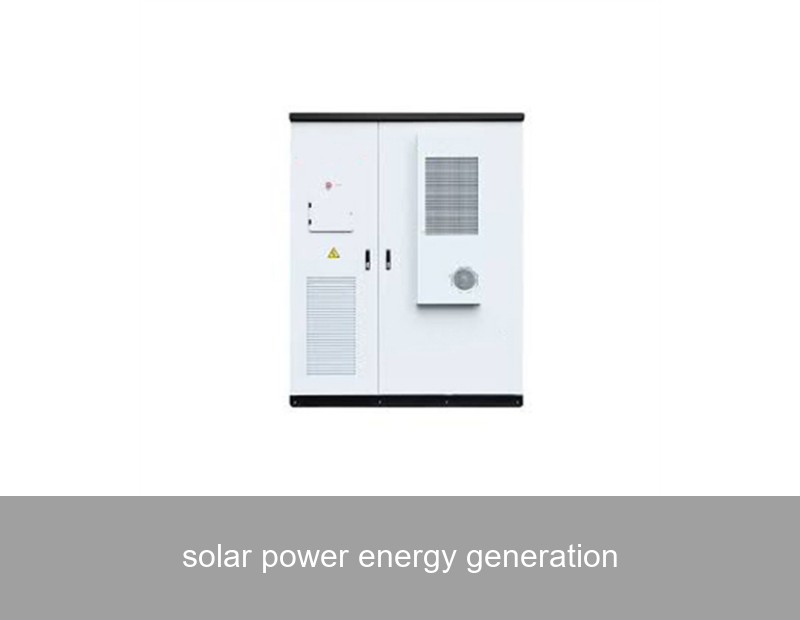
Have you ever looked at your electricity bill on a sunny day and wondered, "With all this free sunlight, why am I still paying so much?" You're not alone. Across Europe and the US, homes and businesses are increasingly turning to solar power energy generation to take control of their energy costs and reduce their carbon footprint. But simply installing panels is only half the story. The true revolution lies in how we capture, store, and intelligently manage that abundant solar energy. This is where modern energy storage systems become the indispensable brain and battery of your solar setup, ensuring not a single sunray goes to waste.
Table of Contents
- The Sunny Phenomenon & The Intermittency Challenge
- Data Reveals: The Storage Gap in Solar's Success
- Case Study: A German Bakery's Recipe for Energy Independence
- Expert Insights: Beyond the Battery Box
- Highjoule's Role: Intelligent Storage for Maximum Solar Harvest
- The Future Horizon: Your Energy, Your Control
The Sunny Phenomenon & The Intermittency Challenge
The surge in rooftop and utility-scale solar installations is a global success story. The technology is proven, costs have plummeted, and the desire for clean energy is stronger than ever. However, anyone with solar panels experiences a fundamental truth: the sun doesn't shine on a utility's schedule. Generation peaks at midday, often exceeding immediate consumption, while demand spikes in the evening when solar production falls to zero. This creates the "duck curve" – a graph familiar to grid operators showing a deep midday dip in net demand followed by a steep evening ramp. This imbalance can strain the grid, lead to curtailment (wasting excess solar energy), and leaves consumers reliant on the grid precisely when electricity is most expensive.

Image Source: U.S. Department of Energy, illustrating the "Duck Curve"
Data Reveals: The Storage Gap in Solar's Success
The numbers paint a clear picture of both the opportunity and the challenge. According to the International Energy Agency (IEA), solar PV generation surged by a record 270 TWh in 2022, becoming the cheapest source of electricity in many regions. Yet, the same report highlights that to meet net-zero goals, global solar capacity needs to triple by 2030, and this growth must be paired with a massive expansion of energy storage. In the US alone, the Solar Energy Industries Association (SEIA) reports that while the market installed a record 32.4 GWdc of solar capacity in 2023, the pairing rate with storage, though growing, still lags. This "storage gap" means a significant portion of generated solar power isn't optimized for when it's needed most, undermining its full economic and environmental value.
Key Consequences of Unpaired Solar:
- Economic Loss: Excess midday energy is sold back to the grid at low rates, while expensive grid power is purchased at night.
- Grid Instability: Unmanaged solar influx can cause voltage fluctuations, requiring costly grid upgrades.
- Wasted Potential: Curtailment of solar energy means clean, generated power is literally thrown away.
Case Study: A German Bakery's Recipe for Energy Independence
Let's bring this to life with a real-world example. "Bäckerei Schmidt" (name changed for privacy), a medium-sized artisan bakery in Bavaria, Germany, installed a 100 kW rooftop solar system in 2020. Their energy profile was perfect for solar: high refrigeration and oven usage during daylight hours. Initially, they achieved 40% self-consumption of their solar generation, selling the rest. However, their early morning and late afternoon energy draws from the grid remained high and costly.
In 2022, they decided to integrate a Highjoule HES-50 commercial battery energy storage system (BESS). The results, monitored over one year, were transformative:
| Metric | Before Highjoule BESS | After Highjoule BESS | Change |
|---|---|---|---|
| Solar Self-Consumption | 40% | 92% | +130% |
| Grid Energy Import (kWh/year) | 185,000 | 32,000 | -83% |
| Annual Energy Cost | €48,000 | €11,500 | -76% |
| Grid Demand Peak Reduction | 0% | 68% | N/A |
The Highjoule system's intelligent energy management software learned the bakery's load patterns. It stored excess midday solar energy to power the ovens during the morning bake-off and kept the cold storage humming through the night. This not only slashed costs but also provided backup power during brief grid outages, protecting perishable inventory. The project's payback period is calculated at under 5 years, a compelling financial and operational decision.
Expert Insights: Beyond the Battery Box
As a product technology expert at Highjoule, I often emphasize that a storage system is far more than just a bank of batteries. It's an integrated energy asset. The core technology—whether lithium-ion phosphate (LFP) for safety and longevity, or other advanced chemistries—is crucial. But the real magic lies in the power conversion system (PCS) and the energy management system (EMS).
Think of it this way: the batteries are the muscles, but the PCS is the heart, and the EMS is the brain. A sophisticated EMS, like the one in Highjoule's IntelliGrid Platform, uses weather forecasting, tariff schedules, and consumption algorithms to make real-time decisions: store now, discharge now, or participate in a grid services program. This turns a passive storage unit into an active grid citizen and a revenue-protection tool for the owner.
Highjoule's Role: Intelligent Storage for Maximum Solar Harvest
Founded in 2005, Highjoule has dedicated nearly two decades to solving this exact puzzle: how to make renewable energy reliable, efficient, and economically superior. We understand that solar power energy generation achieves its highest potential only when coupled with smart storage.
Our product suites are designed to seamlessly integrate with both new and existing solar installations:
- For Homes (Residential Series): Our compact, wall-mounted HES-10 and HES-15 systems are designed for safety and simplicity. They come with a user-friendly app that allows homeowners to monitor their solar production, storage status, and household consumption, maximizing self-use and providing peace-of-mind backup power.
- For Businesses & Industry (Commercial & Industrial Series): Scalable solutions like the HES-50 and modular HES-500 systems are engineered for demanding loads. They focus on peak shaving (reducing demand charges), load shifting, and ensuring power quality for sensitive equipment.
- For Microgrids & Utilities (Utility-Scale Series): Our containerized MegaJoule solutions provide grid stability, renewable energy time-shifting, and black-start capabilities, facilitating the integration of large-scale solar farms into the energy mix.
What unites all Highjoule systems is our commitment to safety (with multi-layer protection systems), longevity (with robust thermal management and cycling algorithms), and intelligence (with our proprietary, adaptive EMS software).

Image Source: Unsplash - Representative image of a modern battery storage installation
The Future Horizon: Your Energy, Your Control
The narrative around solar is shifting from "how much can I generate" to "how well can I use what I generate." With volatile energy prices and increasing climate-driven grid disruptions, the value of energy resilience is skyrocketing. The combination of solar and storage is no longer just an environmental statement; it's a strategic financial decision for a household, a critical operational investment for a business, and a cornerstone for a modern, decentralized grid.
As we look ahead, innovations in battery chemistry, software-driven grid integration, and new business models for energy sharing (like virtual power plants) will continue to enhance the value proposition. The goal is a truly autonomous, efficient, and sustainable energy ecosystem.
So, as you consider your own energy journey, whether for your home or your enterprise, I leave you with this question: Is your current solar investment working as hard as it could be for you, or is a significant part of its potential still setting with the sun each day?
 Inquiry
 Online Chat