


Understanding Solar Per Watt Price Today: Your Guide to Smart Solar Investment
If you're considering solar power for your home or business, you've likely encountered the term "solar per watt price." It's the fundamental metric that breaks down the cost of a solar installation, and understanding solar per watt price today is crucial for making an informed, cost-effective decision. But what does this number actually include? Why does it vary so much? More importantly, how can you ensure you're getting true long-term value, not just the lowest upfront cost? As energy costs remain volatile, the question isn't just about the price tag—it's about the quality, performance, and intelligence behind every watt you install. Let's demystify the current landscape.
Table of Contents
- What is Solar Price Per Watt?
- Key Factors Influencing Today's Solar Price Per Watt
- Looking Beyond the Panel Price: The Total System Value
- Case Study: Maximizing ROI with a Holistic System
- The Highjoule Approach: Intelligent Storage for Optimal Cost-Per-Watt Performance
What is Solar Price Per Watt?
Simply put, the solar price per watt ($/W) is the cost of your solar energy system divided by its total power output in watts (or kilowatts). It's a standardized way to compare quotes. For example, a 10 kW (10,000-watt) system priced at $30,000 has a price of $3.00 per watt. This figure typically includes solar panels, inverters, mounting hardware, installation labor, and permitting. However, and this is a critical point, the solar per watt price today you see advertised often excludes crucial long-term value components like advanced monitoring, extended warranties, and most importantly, energy storage.
Image: Professional installation ensures safety and performance. Credit: Unsplash
Key Factors Influencing Today's Solar Price Per Watt
The solar per watt price today isn't a single number. It's a range influenced by several interconnected factors:
- System Size: Larger systems generally have a lower cost per watt due to economies of scale.
- Equipment Tier: High-efficiency monocrystalline panels from tier-1 manufacturers cost more than standard polycrystalline panels but produce more energy in less space.
- Inverter Technology: Microinverters or DC power optimizers (which optimize each panel's output) add cost but significantly boost energy harvest, especially on shaded roofs, compared to traditional string inverters.
- Roof Complexity & Location: Steep pitches, multiple stories, and difficult access can increase installation labor costs.
- Local Market & Incentives: Competition, labor rates, and available state or federal incentives, like the U.S. Investment Tax Credit (ITC), dramatically affect net cost. According to the National Renewable Energy Laboratory (NREL), installed prices continue to vary widely by region.
| System Component Tier | Price Per Watt Range | Key Characteristics |
|---|---|---|
| Value-Oriented | $2.50 - $3.00 | Standard efficiency panels, string inverter, basic warranty. |
| Mainstream / Premium | $3.00 - $3.80 | High-efficiency panels, microinverters/optimizers, strong warranty, better service. |
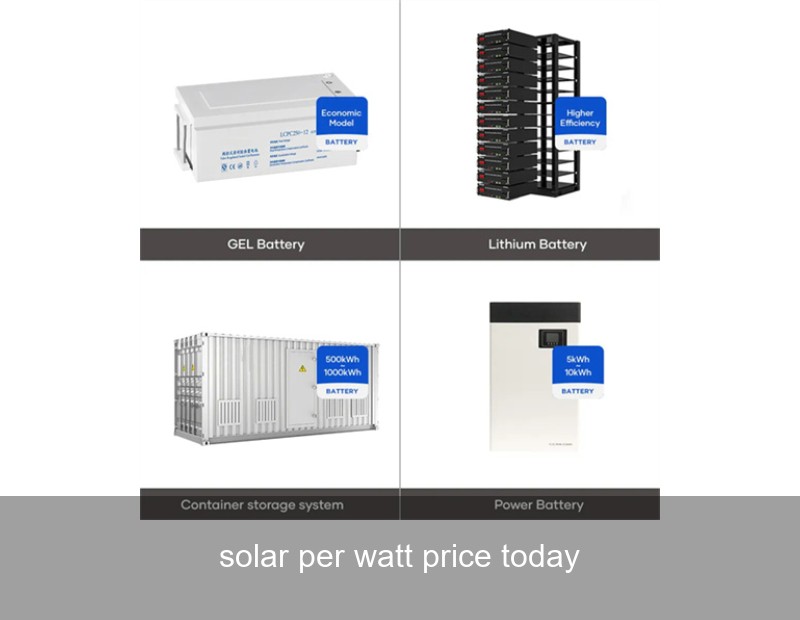
| Integrated Premium + Storage | $4.00+ | Includes high-performance solar AND a battery storage system (like Highjoule's HES Series) for full energy resilience. |
Looking Beyond the Panel Price: The Total System Value
Focusing solely on the lowest solar per watt price today can be a costly mistake. Think of it like buying a car: the sticker price is one thing, but fuel efficiency, reliability, and maintenance costs define its true value. In solar terms, true value is measured in levelized cost of energy (LCOE)—the average cost per kWh of electricity your system produces over its lifetime.
A system with a slightly higher upfront $/W but superior efficiency, longer lifespan, and paired storage will deliver a lower LCOE. Why? It maximizes self-consumption, protects you from rising utility rates, and provides power during outages. This is where the conversation shifts from just buying panels to investing in a comprehensive energy resilience solution.
Case Study: Maximizing ROI with a Holistic System
Consider a real-world scenario in Southern California. A medium-sized manufacturing facility was quoted two options in early 2023:
- Option A (Lowest Upfront Cost): 250 kW system at $2.70/W = $675,000. Basic string inverter, no storage.
- Option B (Integrated System): 250 kW system at $3.20/W, INCLUDING a 500 kWh Highjoule HES-500 commercial battery storage unit. Total: $800,000.
On paper, Option A saved $125,000 upfront. However, by modeling their load profile and local utility rate structure (including steep demand charges and time-of-use rates), the facility's managers chose Option B with Highjoule. The Highjoule energy management system intelligently dispatches stored solar energy to shave peak demand and avoid the highest tariff periods. The result? Their simple payback period was actually 18 months shorter due to dramatically lower demand charges and greater energy independence. During a brief grid outage in Q4 2023, the facility continued operations uninterrupted, avoiding an estimated $50,000 in production losses. This case shows how the functional integration of solar and smart storage creates economic value far beyond the base solar per watt price today.

Image: Commercial solar systems gain resilience and savings with storage. Credit: Unsplash
The Highjoule Approach: Intelligent Storage for Optimal Cost-Per-Watt Performance
At Highjoule, we believe the true metric of success is not the cheapest installation, but the most valuable kilowatt-hour over 20+ years. Since 2005, we've evolved from a component provider to a global solutions architect for intelligent storage. Our role is to ensure the solar energy you produce is available precisely when you need it most.
Our product suites, like the HES (Home Energy System) for residences and the scalable CES (Commercial Energy System), are designed to seamlessly integrate with new or existing solar arrays. They don't just store energy; our AI-driven Energy Operating System (EOS) learns your consumption patterns, weather forecasts, and utility rates to autonomously optimize energy flow. This means your effective "cost per usable watt" plummets because you waste less energy and buy less from the grid. For microgrid and industrial applications, our systems provide grid-forming capabilities and advanced stability services, turning a cost center into a strategic, revenue-capable asset.
When you evaluate the solar per watt price today, ask your provider about integration with Highjoule storage. It's the upgrade that transforms a simple solar generator into a 24/7 personal power plant.
Making the Smart Choice for Your Energy Future
So, how should you proceed? First, get multiple detailed quotes that specify equipment models, warranties, and projected production. Second, insist on a detailed financial analysis that models scenarios with and without storage, using your actual utility bills. Third, partner with installers who are certified to integrate sophisticated storage solutions like Highjoule's—it's a sign of technical expertise.
The landscape of solar per watt price today is more than a number—it's a doorway to energy independence. The most pertinent question now is: What value do you place on controlling your energy costs and securing your power supply for the next two decades?
 Inquiry
 Online Chat