


Solar Panels Connected to the Grid: Your Gateway to Energy Independence and Savings
Have you ever watched your electricity meter spin backwards? It’s a satisfying sight for any homeowner or business owner with solar panels connected to the grid. This setup, known as a grid-tied solar system, is the most common and efficient way to harness the sun's power. It allows you to generate your own clean electricity, slash your energy bills, and contribute excess power back to the community grid. But how does it truly work, and what does it take to maximize its benefits? Let's demystify the process and explore how modern technology, like intelligent energy storage, is revolutionizing this green energy solution.
Table of Contents
- How Grid-Tied Solar Systems Work: The Basic Circuit
- The Intermittency Challenge: When the Sun Doesn't Shine
- Real-World Impact: A Case Study from California
- How Highjoule Optimizes Your Grid-Connected Solar Investment
- Looking Ahead: The Future of Grid-Connected Solar
How Grid-Tied Solar Systems Work: The Basic Circuit
At its core, a grid-tied system is elegantly simple. Your rooftop solar panels connected to the grid convert sunlight into direct current (DC) electricity. An inverter then transforms this DC power into the alternating current (AC) that powers your home and the wider electrical grid. Here's the key interaction:
- Daytime Production: During sunny hours, your solar panels often produce more electricity than your home consumes. This surplus energy automatically flows back to the utility grid.
- Net Metering: Your utility meter tracks this two-way flow. For every kilowatt-hour (kWh) you export, you typically receive a credit, offsetting the cost of power you draw from the grid at night or on cloudy days. This mechanism is the financial heart of grid-tied solar.
- Seamless Supply: When your panels aren't producing enough, your home instantly and automatically draws power from the grid, ensuring an uninterrupted electricity supply.

This symbiotic relationship with the grid has fueled the solar revolution. However, it also introduces a fundamental dependency.
The Intermittency Challenge: When the Sun Doesn't Shine
Here’s the paradox: you're generating clean energy, but you're still vulnerable to grid outages. Why? For safety reasons, most standard grid-tied inverters are required to shut down during a blackout. This is to prevent sending power back to the grid and endangering utility workers repairing the lines. So, even with the sun blazing, a grid outage means your home goes dark.
Furthermore, the economics are evolving. As noted by the National Renewable Energy Laboratory (NREL), the value of exported solar energy is shifting in some regions, with feed-in tariffs decreasing. This means simply sending all your excess energy back might not be as lucrative as it once was.
The Modern Solution: Adding Intelligence with Battery Storage
The next evolutionary step for solar panels connected to the grid is clear: integrate a battery energy storage system (BESS). This transforms a one-way export system into a smart, resilient energy hub. Think of it as adding a sophisticated energy bank account.
- Energy Independence: Store your solar surplus for use in the evening, dramatically reducing your grid purchases.
- Backup Power: During a grid outage, a system like Highjoule's HES Series Hybrid Energy System can automatically island your home, keeping critical loads powered by the sun and your stored energy.
- Grid Services & Savings: Advanced systems can participate in utility demand response programs or intelligently dispatch stored energy during peak rate periods, turning your storage into a financial asset.
Real-World Impact: A Case Study from California
Let's look at real data. California, a leader in solar adoption, also faces grid reliability challenges and has moved to time-of-use (TOU) rate structures that incentivize storage.
The Scenario: A mid-sized commercial facility in Fresno, CA, with a 250 kW rooftop solar array. Despite significant solar generation, the facility faced high demand charges and saw its exported solar energy compensated at lower rates in the afternoon.
The Solution: In 2023, the facility integrated a 500 kWh Highjoule CES Commercial Energy Storage system. The intelligent controller was programmed to store excess midday solar energy and discharge it during the 4-9 pm peak period when grid electricity rates were highest.
The Data-Driven Result (First 12 Months):
| Metric | Before Highjoule BESS | After Highjoule BESS | Change |
|---|---|---|---|
| Monthly Grid Energy Import (Peak Period) | 18,000 kWh | 4,500 kWh | -75% |
| Average Monthly Demand Charge | $8,400 | $3,100 | -63% |
| Annual Energy Cost Savings | -- | -- | $112,000 |
| Self-Consumption of Solar Generation | 35% | 85% | +143% |
This case demonstrates that adding storage isn't just about backup; it's a strategic financial decision that maximizes the return on investment for solar panels connected to the grid.

How Highjoule Optimizes Your Grid-Connected Solar Investment
As a global provider with nearly two decades of experience since 2005, Highjoule designs solutions that address these exact challenges. We don't just sell batteries; we provide integrated, intelligent energy systems.
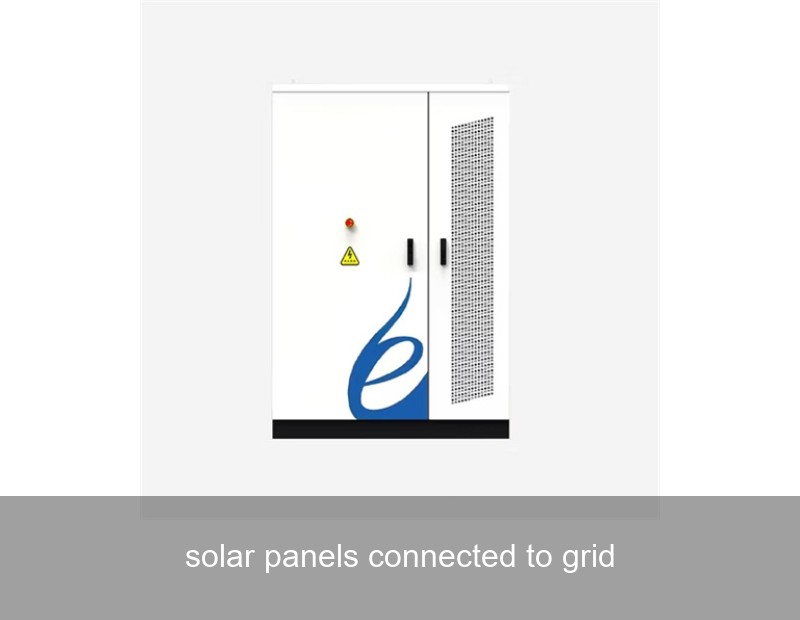
For residential clients, our HES Series is an all-in-one unit that combines a hybrid inverter, battery management, and grid interconnection in one sleek cabinet. Its AI-driven energy management software learns your consumption patterns and automatically optimizes for self-consumption, cost savings, or backup readiness.
For commercial and industrial (C&I) applications, our modular CES Series scales to meet large energy demands. These systems can be configured for peak shaving, renewable firming, and even providing grid stability services, creating new revenue streams. For microgrids and larger utility-scale projects, our containerized MGS Power Platform offers utility-grade storage and control.
Our philosophy is simple: your solar panels connected to the grid should be the beginning of your energy journey, not the end. By adding Highjoule's intelligence, you gain control, resilience, and superior economics.
Looking Ahead: The Future of Grid-Connected Solar
The grid is evolving from a one-way street into a dynamic network of prosumers—consumers who also produce. Technologies like vehicle-to-grid (V2G) and virtual power plants (VPPs) are on the horizon. In a VPP, thousands of distributed systems like Highjoule-powered homes and businesses can be aggregated to act as a single, large power plant, supporting the grid during times of high stress, as explored by research from the U.S. Department of Energy.
This future hinges on intelligent, grid-interactive storage. It’s no longer just about having solar panels connected to the grid; it's about how smartly your system can interact with it.
So, as you consider harnessing the sun, ask yourself this: Is your goal simply to offset your bill, or is it to build a truly resilient, intelligent, and future-proof energy asset for your home or business? What energy challenges are you hoping to solve in the next decade?
 Inquiry
 Online Chat