


Solar Panel Production in China: Powering the Global Energy Transition
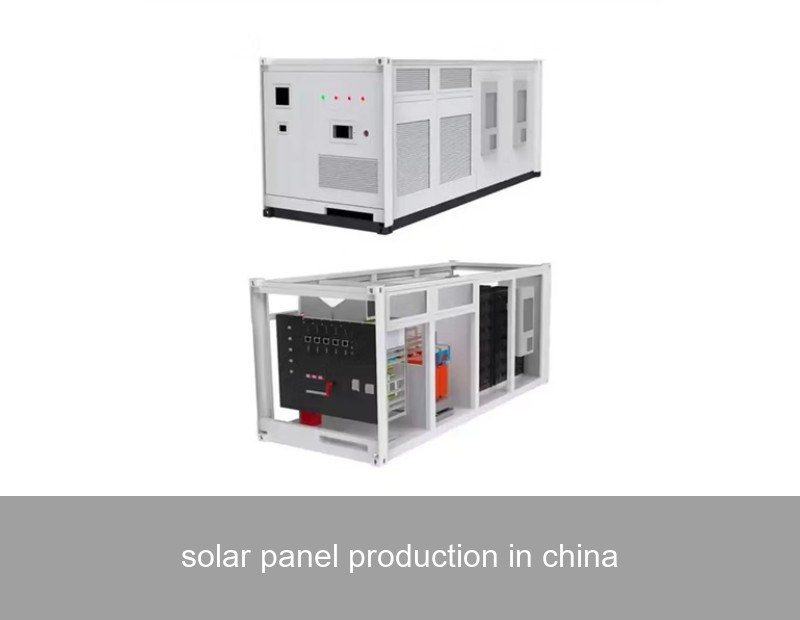
Table of Contents
- The China Phenomenon: A Manufacturing Juggernaut
- By the Numbers: Scale, Cost, and Innovation
- A European Case Study: Integrating Chinese Solar with Local Storage
- Beyond the Panel: The Critical Role of Smart Energy Storage
- Highjoule's Role: Making Global Solar Production Reliable
- Future Considerations: Resilience and Sustainability
If you've looked into installing solar panels for your home or business recently, there's a very high probability the modules were manufactured in China. This isn't just a trend; it's the defining reality of the global photovoltaic (PV) industry. The story of solar panel production in China is one of staggering scale, relentless innovation, and falling costs that have made solar energy accessible worldwide. But what does this dominance mean for energy security, quality, and the complete renewable energy system? Let's explore.
The China Phenomenon: A Manufacturing Juggernaut
China's ascent to becoming the world's solar factory is a masterclass in industrial policy and vertical integration. Starting in the early 2000s, strategic government support fueled massive investment in polysilicon production, wafer slicing, cell fabrication, and module assembly. Today, this integrated supply chain is unparalleled. From raw material processing to the final packaged panel rolling off the line, Chinese manufacturers control over 80% of the global production capacity across all key stages. This concentration brings incredible efficiencies and lower prices, but it also shapes global energy infrastructure, making understanding its dynamics crucial for any business or homeowner investing in solar.
By the Numbers: Scale, Cost, and Innovation
The data behind China's solar dominance tells a compelling story. According to the International Energy Agency (IEA), China's share in all key manufacturing stages of solar panels exceeds 80% (IEA, 2022). This scale has driven a more than 90% reduction in the cost of solar PV modules over the last decade. But it's not just about volume. Chinese companies are also at the forefront of technological innovation, pushing the efficiency limits of mainstream PERC cells and mass-producing advanced technologies like TOPCon and heterojunction (HJT) cells. This means the panels available today are not only cheaper but significantly more powerful and durable than those from five years ago.
| Manufacturing Stage | China's Estimated Global Share | Impact |
|---|---|---|
| Polysilicon | >80% | Controls the key raw material supply |
| Wafers | >95% | Unprecedented dominance in a critical component |
| Cells | ~85% | Drives global pricing and tech adoption |
| Modules | ~75% | Defines the final product market |
Source: Compiled from IEA and industry reports (2023).
A European Case Study: Integrating Chinese Solar with Local Storage
Consider a mid-sized dairy farm in Bavaria, Germany. In 2022, facing soaring energy costs, the farm invested in a 250 kW rooftop solar system using high-efficiency panels from a leading Chinese manufacturer. The system generates ample energy, but a key challenge remained: much of the production happened during midday, while energy-intensive milking and cooling processes ran from early morning to evening.
The solution wasn't more panels—it was intelligent storage. The farm integrated a Highjoule C&I Battery Energy Storage System (BESS). Our system stores the excess solar generation at noon and dispatches it during peak evening hours and on cloudy days. The result? The farm increased its on-site consumption of solar power from 35% to over 80%, slashing its grid electricity purchases by 60%. This case shows that the true value of solar panel production in China is unlocked not in isolation, but when paired with smart, localized storage that matches supply to demand.

Image Source: Unsplash (Representative image of agricultural solar installation)
Beyond the Panel: The Critical Role of Smart Energy Storage
This leads us to a vital insight. A solar panel is a brilliant energy generator, but it's an intermittent one. The sun doesn't shine on command. Therefore, the modern energy conversation must shift from "solar production" to "solar utilization." This is where advanced battery storage systems become the indispensable counterpart to solar panels, regardless of their origin.
- Maximizing Self-Consumption: Store surplus daytime solar energy for use at night, dramatically increasing your energy independence and return on investment.
- Grid Stability: Storage can smooth out solar feed-in, reducing grid congestion and providing valuable frequency regulation services, especially crucial as grid solar penetration grows.
- Backup Power: Ensure critical operations continue during grid outages—a key concern for businesses and communities.
Highjoule's Role: Making Global Solar Production Reliable
At Highjoule, founded in 2005, we've witnessed the solar revolution firsthand. Our mission is to ensure that the incredible output of global solar manufacturing translates into reliable, efficient, and controllable power for our customers. We don't manufacture panels; we make their output infinitely more valuable.
For homeowners, our Highjoule Home Energy Storage systems, like the Nexus Series, seamlessly integrate with solar arrays, allowing families to build a resilient and cost-effective energy ecosystem. For commercial and industrial clients, our scalable C&I and Microgrid Solutions provide the intelligence and storage capacity to manage complex energy loads, participate in demand response programs, and achieve stringent sustainability targets. By pairing high-quality solar panels with a Highjoule BESS, you're not just installing hardware; you're building a sophisticated, future-proof energy asset.

Image Source: Unsplash (Representative image of a BESS interior)
Future Considerations: Resilience and Sustainability
The concentration of solar panel production in China presents both opportunities and strategic questions for markets in Europe and the U.S. While it has democratized solar access, it also highlights the need for diversified supply chains and a stronger focus on the downstream value chain—installation, integration, and most importantly, storage. The future of energy is not just about generation; it's about intelligent management. As policies like the U.S. Inflation Reduction Act and the European Green Deal aim to spur local clean-tech manufacturing, the synergy between globally sourced generation and locally deployed storage solutions will be the blueprint for a stable energy transition.
What Does This Mean for You?
If you're planning a solar installation, your decision matrix should expand beyond the panel's brand and cost per watt. Ask yourself and your installer: "What is my strategy for storing and optimizing this energy?" How will you ensure that the clean power you generate is available when you actually need it, thereby maximizing your investment and resilience?
The narrative of solar energy is evolving from one centered on production geography to one focused on total system intelligence. We invite you to explore how an integrated solar-plus-storage solution can transform your energy profile. What would achieving 80% or more energy independence do for your operational costs and sustainability goals this year?
 Inquiry
 Online Chat