


Your Solar Panels Need an On/Off Switch: Here's the Smart Solution
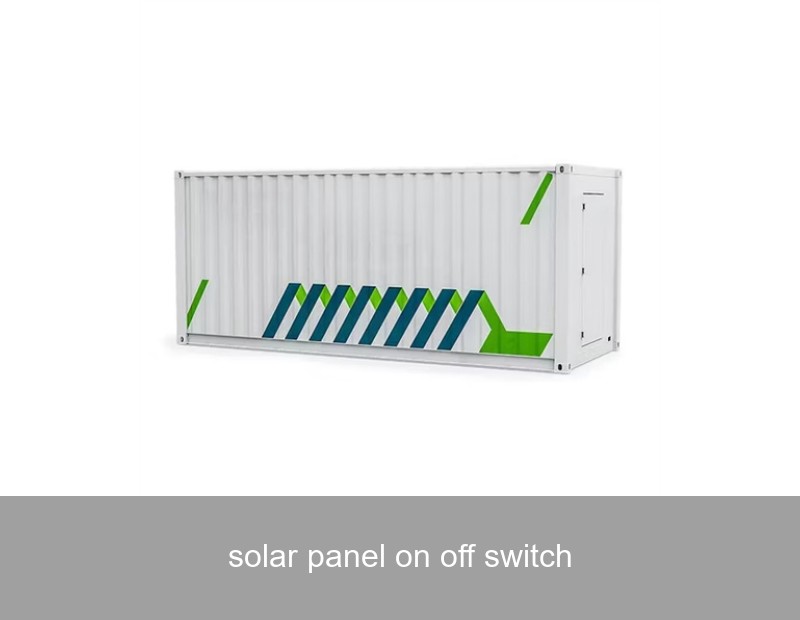
Imagine this: you have a state-of-the-art solar array on your roof, diligently converting sunlight into electricity. But what happens during a grid outage? Surprisingly, most systems shut down entirely—a safety feature called "anti-islanding." Your panels, despite the abundant sun, become inactive. This common frustration highlights a critical missing piece: a true solar panel on off switch. Not a physical lever, but intelligent, software-defined control over when and how your solar energy is generated, stored, and used. This capability is the cornerstone of modern energy resilience and efficiency, transforming a passive system into an active power asset.
Table of Contents
The Silent Panels Problem: Why Solar Shuts Off
Let's demystify the phenomenon. During a power cut, utility workers need to know the grid is dead to safely make repairs. If your solar panels were still feeding electricity back, it could create a dangerous "island" of live wires. Hence, standard inverters are mandated to disconnect. The result? Your home or business is left in the dark, even with a bright, sunny sky. This isn't just an inconvenience; it's a fundamental gap in the promise of solar independence. What you need isn't just generation—it's command.

Image Source: Unsplash - Photographer: Vivint Solar
The Data: Wasted Sunlight and Lost Resilience
The impact is quantifiable. According to the U.S. Energy Information Administration (EIA), the average U.S. customer experienced just over seven hours of power interruptions in 2021. For a 10 kW solar system, a single sunny outage hour could mean over 10 kWh of clean, free energy gone to waste—enough to power a refrigerator for a day. In Europe, with increasing grid volatility, the need for control is even more pronounced. This isn't merely about backup; it's about maximizing the return on your solar investment and ensuring continuous operations.
The Modern Solution: Beyond a Simple Switch
So, how do we create this vital "switch"? The answer lies in a sophisticated integration of three key components:
- Hybrid or "Smart" Inverters: Unlike standard inverters, these can disconnect from the grid while still forming a local, stable microgrid. They are the hardware foundation for the switch.
- Battery Energy Storage Systems (BESS): This is the critical enabler. Batteries act as a buffer, storing excess solar energy. During an outage, the inverter uses the battery as the grid's replacement, allowing solar to keep charging it and powering your loads.
- Energy Management System (EMS): This is the software brain—the true "switchboard." It intelligently decides, based on weather forecasts, electricity rates, and consumption patterns, when to draw from solar, charge the battery, export to the grid, or island for resilience.
This triad transforms a simple on/off function into a dynamic, profit-and resilience-optimizing command center.
Key Functions of an Intelligent Solar Control System
| Function | Description | Benefit |
|---|---|---|
| Islanding / Backup Power | Automatically disconnects from grid and powers critical loads during an outage. | Continuous power, solar doesn't waste. |
| Time-of-Use Optimization | Charges battery when rates are low, uses stored energy when rates are high. | Maximizes bill savings, ROI. |
| Solar Self-Consumption | Directs solar energy to immediate home use first, excess to battery, then export. | Minimizes grid dependence. |
| Grid Services Support | Can provide frequency regulation or peak shaving support to the utility grid. | Potential revenue streams. |
The Highjoule Approach: Integrated Intelligence
At Highjoule, we've been engineering this precise level of control since 2005. We don't view the solar panel on off switch as a singular feature but as the core philosophy behind our HPS (Highjoule Power System) solutions. Our systems are designed from the ground up for seamless integration.
Our HPS-Stack commercial & industrial battery storage system, for instance, comes with our proprietary Neuron EMS. Think of Neuron as the ultimate switch operator. It doesn't just react; it predicts and optimizes. For residential clients, our HPS-Home package offers the same robust intelligence in a compact form factor. The system can be configured via a simple app: want to prioritize bill savings, carbon footprint reduction, or absolute backup readiness? A few taps set your priorities, and Neuron manages the complex interplay of solar, battery, grid, and loads automatically. This is control made simple, empowering you to become the master of your energy ecosystem.

Image Source: Unsplash - Photographer: American Public Power Association
Case Study: A German Bakery's Recipe for Energy Independence
Let's look at a real-world application. A family-run bakery in Bavaria, Germany, with a 50 kWp solar rooftop system, faced two problems: volatile energy costs threatening their thin margins, and the risk of spoilage during grid outages. Their solar system would shut off during failures, endangering refrigerated ingredients.
They partnered with Highjoule to install a 100 kWh HPS-Stack battery system integrated with their existing PV. The Neuron EMS was programmed for two primary modes: 1) Peak Shaving: The system uses stored solar energy to cap grid power draw during high-cost afternoon hours, and 2) Uninterruptible Power Supply (UPS) Mode: For critical refrigeration circuits.
The Results (18-month period):
- Energy Cost Reduction: 68% decrease in demand charges and optimized time-of-use savings led to a 40% reduction in overall electricity costs.
- Resilience Proven: During a planned 4-hour grid maintenance shutdown, the bakery operated at 100% capacity on solar and battery power. Zero product loss, full business continuity.
- Increased Self-Consumption: Solar self-consumption rate jumped from 35% to over 85%, dramatically increasing the ROI of their original PV investment.
For this bakery, the intelligent "switch" provided by Highjoule's system turned their solar panels from a passive income stream into an active, strategic business asset. As the International Renewable Energy Agency (IRENA) notes, coupling storage with renewables is key to unlocking their full value.
The Future of Solar Control: Your Questions
The technology for ultimate solar control is here and proven. It moves us from simply having solar panels to operating a personal, intelligent power plant. The question is no longer "Can I turn my solar on during an outage?" but "How can I orchestrate my solar, storage, and consumption to achieve my specific goals—be it maximum savings, maximum green impact, or maximum resilience?"
At Highjoule, we believe every energy producer—from a homeowner to a large factory—deserves this level of agency. What specific energy goal would you want your solar system to achieve if you had the ultimate control switch?
 Inquiry
 Online Chat