


Your Complete Guide to a 1000-Watt Solar Panel System: Power, Savings, and Independence
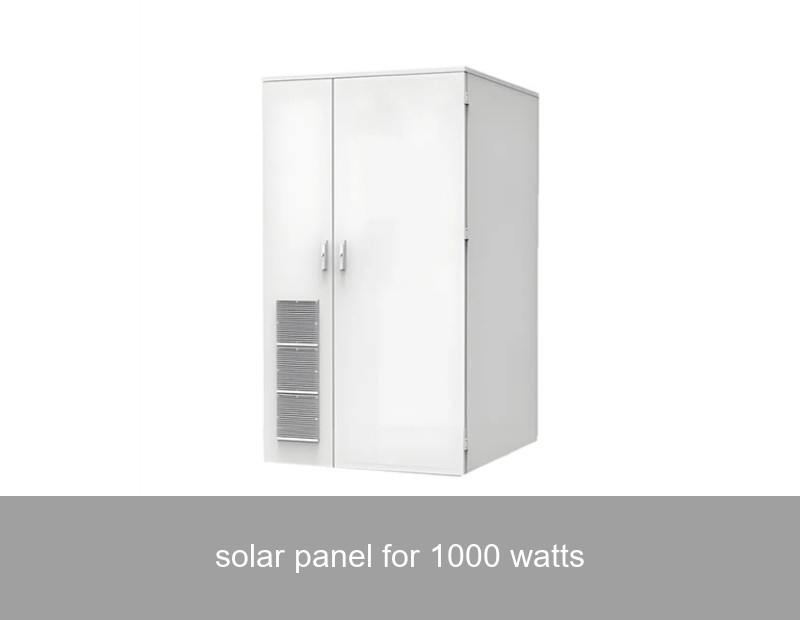
Thinking about harnessing the sun's power for your home, cabin, or workshop? The concept of a "1000-watt solar panel system" is a fantastic and popular entry point into renewable energy. But what does it truly power, and how do you build an efficient, reliable system that lasts? This guide will demystify the 1000-watt setup, moving beyond just the panels to the intelligent storage and management that makes solar energy truly revolutionary. We'll explore real-world performance, a detailed case study, and how modern technology from companies like Highjoule maximizes every watt your panels produce.
Table of Contents
- What is a 1000-Watt Solar Panel System?
- What Can a 1000-Watt System Actually Power?
- Beyond the Panels: The Critical Role of Energy Storage
- Real-World Performance: A German Household Case Study
- Key Components for a High-Performance 1000W System
What is a 1000-Watt Solar Panel System?
At its core, a 1000-watt (or 1 kilowatt) solar system refers to the potential DC (Direct Current) power output of the solar panels under ideal laboratory conditions, known as Standard Test Conditions (STC). This "nameplate" rating is a starting point. In reality, factors like geographic location, roof angle, shading, and temperature all affect daily output. For instance, a 1kW system in sunny Arizona will produce significantly more energy annually than the same system in cloudy Scotland.
Typically, a 1000W system today comprises about 2-3 high-efficiency solar panels, as modern panels often range from 400 to 550 watts each. This compact size makes it ideal for residential rooftops, RVs, boats, or small cabins. But here's the crucial insight: the panels are only one part of the equation. Their true value is unlocked when paired with an advanced battery storage system and smart inverter, transforming intermittent sunlight into dependable, usable power day and night.
What Can a 1000-Watt System Actually Power?
Let's move from theory to practice. A 1000W system doesn't produce 1000 watts continuously. Its actual energy yield is measured in kilowatt-hours (kWh). On a good day, such a system might generate between 3 to 5 kWh, depending on your location and sun exposure.
To put that into perspective, here’s what that energy can run:
| Appliance | Estimated Power (Watts) | Runtime on 4 kWh |
|---|---|---|
| LED Lighting (throughout home) | 50W | 80 hours |
| Refrigerator (Energy Star) | 150W | ~26 hours |
| Laptop | 60W | 66 hours |
| Wi-Fi Router & Modem | 20W | 200 hours |
| 55-inch LED TV | 100W | 40 hours |
As you can see, a well-designed 1kW system can comfortably handle essential loads, especially when paired with a battery. It's perfect for powering critical circuits during an outage, running an off-grid cabin, or significantly offsetting your daytime grid consumption. However, it's generally not sufficient for high-demand appliances like electric water heaters, air conditioners, or electric vehicle chargers on their own.
Image: A typical residential solar installation. Source: Unsplash
Beyond the Panels: The Critical Role of Energy Storage
This is where the solar journey gets exciting. Solar panels generate power when the sun shines, but your energy needs don't stop at sunset. This mismatch is solved by battery energy storage systems (BESS). Adding a battery to your 1000-watt solar panel setup transforms it from a daytime saver to a 24/7 power source.
Think of it this way: the panels are your income (sunlight), and the battery is your savings account. You "deposit" excess solar energy during the day and "withdraw" it at night or during cloudy periods. This is the cornerstone of energy independence and resilience. For over 18 years, Highjoule has been at the forefront of this technology, developing intelligent storage solutions that integrate seamlessly with solar arrays of all sizes. Our H-Series residential battery systems are designed with advanced lithium iron phosphate (LiFePO4) chemistry, known for its safety, longevity (over 6000 cycles), and stable performance, ensuring your 1000 watts of solar power are captured and utilized with maximum efficiency.
Real-World Performance: A German Household Case Study
Let's look at concrete data. Consider the Müller family in Munich, Germany—a region with moderate, not exceptional, solar potential. They installed a 1.05 kW solar array (3 x 350W panels) on their south-facing garage roof, coupled with a 5.8 kWh Highjoule H2 battery and a hybrid inverter.
- System Size: 1.05 kW PV, 5.8 kWh Storage
- Annual Solar Production: Approximately 1,050 kWh (as per PVGIS solar data tool)
- Self-Consumption Rate (without battery): ~30% (most solar exported to grid midday) Self-Consumption Rate (with Highjoule battery): ~85% (most solar used directly or stored)
The key outcome? By adding intelligent storage, the Müller family increased their direct use of self-generated solar power from about 315 kWh to nearly 900 kWh per year. This dramatically reduced their reliance on the grid during high-tariff evening hours. During a widespread 8-hour grid outage in their neighborhood, their system automatically switched to island mode, powering their lights, refrigerator, and internet seamlessly—a real-world test of resilience that passed with flying colors. This case illustrates that the value of a 1000-watt system is magnified exponentially by the intelligence of the storage solution it's paired with.

Image: A modern home battery storage unit. Source: Unsplash
Key Components for a High-Performance 1000W System
Building a reliable system requires more than just panels and a battery. Here’s the essential ecosystem:
- Solar Panels (The Generators): 2-3 high-efficiency monocrystalline panels. Look for robust warranties and reliable brands.
- Hybrid or DC-Coupled Inverter (The Brain & Converter): This critical device converts DC from the panels to AC for your home, manages battery charging/discharging, and enables grid interaction. Highjoule's systems often feature integrated inverter technology for optimized performance.
- Battery Storage (The Bank): A LiFePO4 battery like Highjoule's H-Series, sized appropriately (typically 5-10 kWh for a 1kW array) to cover nighttime usage and provide backup.
- Energy Management System (EMS) (The Conductor): Smart software that learns your usage patterns, decides when to store or draw energy, and can optimize for time-of-use rates. This intelligence is embedded within Highjoule's product ecosystem.
- Safety Gear & Mounting: Includes disconnects, proper racking, and compliant wiring handled by a certified installer.
Making Your Solar Investment Smarter
Choosing a 1000-watt system is a smart decision, but making it a *smart system* is the real game-changer. Modern storage solutions do more than just hold energy. They can:
- Provide whole-home or selective backup power during outages.
- Automatically shift consumption to use solar power when it's cheapest (i.e., when you're producing it).
- Integrate with smart home devices for further automation (e.g., running appliances during peak solar production).
- Offer remote monitoring and control via a smartphone app—so you can see your energy flows and savings in real-time.
Highjoule's solutions are designed with this holistic intelligence. Our focus isn't just on supplying batteries; it's on providing complete, smart, efficient, and sustainable power solutions for homes and businesses. We ensure that every component, from the battery cells to the user interface, works in harmony to maximize the return on your solar investment.
So, as you contemplate your 1000-watt solar journey, ask yourself this: Is your goal simply to generate green energy, or is it to achieve true energy resilience and control? What would it mean for you to have power precisely when and where you need it most, regardless of what's happening on the grid?
 Inquiry
 Online Chat