


Demystifying Solar Off Grid ESS Prices: Your Guide to Smart Energy Independence
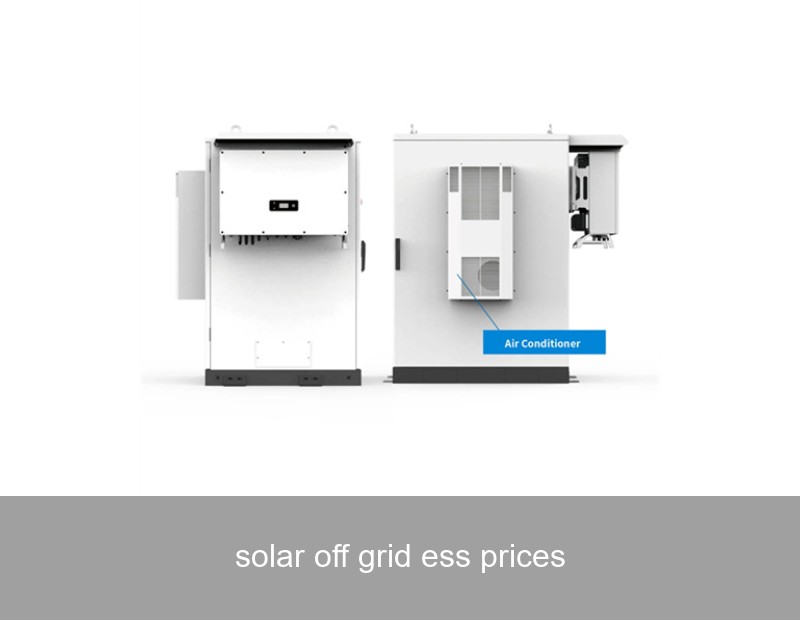
Imagine a home nestled in the sun-drenched hills of California or a remote agricultural facility in the Spanish countryside. The grid is either unreliable, prohibitively expensive to connect to, or simply non-existent. For these locations, a solar off-grid system isn't just an alternative; it's the primary source of power. At the heart of this solution lies the solar off grid ESS (Energy Storage System), the critical component that stores the sun's energy for use day and night. But when you start researching, you'll quickly find that solar off grid ESS prices can vary wildly. Why is that? As a leading provider in this space for nearly two decades, Highjoule is here to guide you through the factors that determine cost, ensuring you invest in a system that delivers true value and unwavering reliability.
Decoding Solar Off-Grid ESS Prices: It's a System, Not a Box
First, let's clarify a common misconception. When people ask about "solar off grid ESS prices," they often think of a single battery unit's price tag. In reality, they are inquiring about the core energy storage subsystem within a complete off-grid power plant. A functional off-grid system requires seamless integration of several key components: solar panels, charge controllers, the battery storage system (the ESS), an inverter/charger, and often a backup generator. The price of the ESS itself is influenced by its role as the central energy bank for this entire ecosystem.

Image Source: Unsplash - A modern off-grid solar and storage installation.
Key Factors That Influence Your Solar Off-Grid ESS Price
Understanding the following elements will transform you from a confused buyer into an informed decision-maker. Let's break down the primary cost drivers.
Battery Technology & Capacity (kWh)
This is the most significant factor. The chemistry, lifespan, and total energy capacity of your batteries dictate a large portion of the cost. Here’s a simplified comparison:
| Battery Type | Approx. Price per kWh (Installed)* | Key Characteristics |
|---|---|---|
| Lead-Acid (Flooded) | $150 - $250 | Mature technology, lower upfront cost, shorter lifespan (4-8 years), requires maintenance. |
| Lithium Iron Phosphate (LFP) | $500 - $800 | Long lifespan (15+ years), high depth of discharge, maintenance-free, safer chemistry. The modern standard. |
*Price ranges are indicative and include battery modules, BMS, and enclosure. Source: Industry estimates & Highjoule project data.
For a typical off-grid home requiring 20 kWh of usable storage, the battery subsystem cost alone could range from $3,000 (lead-acid) to $16,000 (premium LFP). The trend is decisively moving towards LFP due to its superior lifetime value, a technology Highjoule has championed in its H-Joule Sentinel Series for residential and commercial applications.
Inverter/Charger Power (kW)
Your inverter determines how much power you can use at once. Need to run a well pump, a washing machine, and kitchen appliances simultaneously? You'll need a high-power inverter. Inverter/chargers for off-grid use are robust, bidirectional units that convert DC battery power to AC for your home and convert AC (from a generator or grid if available) to DC to charge the batteries. Prices scale with power output and sophistication. A high-quality 8 kW off-grid inverter/charger can cost $2,500 to $4,000, while a 15 kW unit for a large home or small business can exceed $6,000.
System Complexity & Integration
A basic system with a single inverter and battery stack is one thing. But what if you need:
- Scalability: The ability to easily add more batteries in the future.
- Generator Integration: Automatic start/stop control for a backup generator.
- Advanced Monitoring & Control: Remote management via a cloud-based platform.
- Three-Phase Power: For industrial machinery or large commercial sites.
Each layer of complexity adds to the system engineering, component quality, and software intelligence, impacting the overall solar off grid ESS prices. Highjoule’s GridShield Microgrid Controller, for instance, adds a layer of intelligent orchestration, optimizing energy flow between solar, storage, and backup generators, which represents a higher initial investment for significantly improved operational efficiency and reliability.
Installation & "Soft Costs"
This is where geography matters. Installation costs in the US or Europe include skilled labor, permits, electrical balance-of-system components (wiring, breakers, etc.), and sometimes custom enclosures for harsh climates. These "soft costs" can account for 20-40% of the total system price. Partnering with an experienced provider like Highjoule, who works with a certified network of installers, ensures these costs are predictable and the installation is compliant with local codes like the NEC in the US or CE standards in Europe.
A Real-World Case: The Californian Mountain Retreat
Let's make this concrete. A customer near Lake Tahoe, California, faced increasing grid outages due to wildfire prevention shutoffs. They needed a primary off-grid system for a 2,500 sq. ft. all-electric home.
- Goal: Complete energy independence, 24/7 power.
- Solution (Highjoule H-Joule Sentinel Series):
- 25 kW solar array
- 40 kWh LFP battery storage (usable capacity)
- Twin 10 kW inverter/chargers for redundancy and surge capacity
- Integrated 18 kW propane backup generator with auto-start
- Highjoule Energy Management System (EMS) for monitoring/control
- Total System Price: ~$85,000 (before applicable incentives).
- Outcome: The home has operated independently for over two years. The system automatically manages loads, prioritizes solar charging, and only uses the generator during extended cloudy periods. The customer's effective "cost of energy" over the system's 20+ year lifespan is projected to be lower than the cost of extending the utility grid, not to mention the invaluable peace of mind.

Image Source: Unsplash - Professional installation of a lithium battery ESS cabinet.
The Highjoule Approach: Smart Investment for True Energy Independence
Since 2005, Highjoule has moved beyond selling components to delivering guaranteed power availability. When evaluating solar off grid ESS prices, we encourage clients to think in terms of Levelized Cost of Energy (LCOE) and system longevity. Our H-Joule Sentinel ESS, built with premium LFP cells and a modular design, offers a cycle life that is 3-4 times longer than traditional batteries. This means a lower cost per kWh stored over the system's lifetime. Furthermore, our systems are designed for the future. The modular architecture allows you to start with a core system and expand storage capacity as your needs grow, protecting your initial investment.
For commercial and microgrid applications, our GridShield Platform provides the intelligence to manage complex energy flows, integrate multiple generation sources, and ensure critical operations never lose power. This level of sophistication, backed by nearly two decades of global project experience, defines the Highjoule difference.
Looking Beyond the Sticker Price: Total Cost of Ownership & Value
The initial solar off grid ESS prices are just one part of the equation. Consider these questions: What is the cost of a spoiled inventory due to a power outage at your remote facility? What is the value of uninterrupted research in an off-grid lab? For many, the true value of a robust off-grid system is not just in dollars saved, but in risk mitigated and resilience gained. As battery densities improve and the global focus on energy security intensifies, investing in a high-quality system today positions you for the future. The International Energy Agency highlights the critical role of storage in the energy transition, and off-grid systems are at the forefront.
So, as you contemplate your journey to energy independence, we leave you with this: What specific energy security challenge are you aiming to solve with an off-grid system, and how can we help you design a solution where the price truly reflects a lifetime of reliable, clean power?
 Inquiry
 Online Chat