


Solar Irrigation System for Farming: A Sustainable Revolution in Agriculture
Imagine a farm where the water flows as reliably as the sun rises, powered not by costly and polluting diesel generators or an unstable grid, but by clean, abundant sunlight. This is the promise of the solar irrigation system for farming, a technology that is transforming agriculture from California's Central Valley to the plains of Spain. For farmers worldwide, the challenge of securing affordable, dependable energy for irrigation is a constant pressure point, impacting both profitability and environmental stewardship. In this article, we'll explore how solar-powered irrigation is not just a niche alternative but a mainstream solution, and how integrating advanced energy storage from companies like Highjoule can make these systems truly unstoppable.
Table of Contents
- The Water-Energy Nexus: A Farmer's Dilemma
- How a Modern Solar Irrigation System Works
- Beyond the Panels: The Critical Role of Energy Storage
- Real-World Case Study: Vineyards in Andalusia, Spain
- The Highjoule Advantage: Smart Storage for Smarter Farming
- The Future Farm: Intelligent, Integrated, and Independent
The Water-Energy Nexus: A Farmer's Dilemma
Traditional irrigation is energy-intensive. Whether it's pumping groundwater from a well or drawing from a surface source, the cost of diesel fuel or grid electricity can consume a significant portion of a farm's operational budget. In regions like Southern Europe or the American Southwest, where water scarcity is acute, the need for efficient irrigation coincides perfectly with high solar insolation. The phenomenon is clear: when you need water most, the sun is often shining brightest. Yet, the sun doesn't shine at night, and crops may need water during cloudy periods or in the early morning. This mismatch between solar generation and irrigation schedules has been a historical barrier.
Data from the Food and Agriculture Organization (FAO) underscores the scale of the opportunity. They note that solar-powered irrigation can reduce greenhouse gas emissions per irrigated area by over 95% compared to diesel systems. The initial investment, while substantial, is increasingly offset by falling solar panel prices and rising fossil fuel costs, leading to payback periods that now often sit between 4 to 8 years.

Solar panels and agriculture can coexist, powering irrigation directly from the field.
How a Modern Solar Irrigation System Works
A contemporary solar irrigation system for farming is more than just panels and a pump. It's an integrated system designed for reliability and control:
- Solar Photovoltaic (PV) Array: The power plant of the system, converting sunlight into direct current (DC) electricity.
- Solar Pump Inverter/Controller: The brain of the operation. This device converts the DC power to alternating current (AC) if needed, and more importantly, regulates the pump's speed based on available sunlight, preventing stalling or damage.
- Water Pump: Can be submersible (for wells) or surface pumps (for canals, ponds), selected based on water source and required pressure.
- Irrigation System: The distribution network—drip lines, sprinklers, or pivots—that delivers water efficiently to the crops.
The beauty lies in its simplicity during perfect conditions: sun shines, pump runs, water flows. But what about the other times? That's where the next layer of innovation comes in.
Beyond the Panels: The Critical Role of Energy Storage
Relying solely on real-time solar power limits irrigation to daylight hours. For many crops and soil types, night-time or early morning irrigation is preferable to reduce evaporation loss. Furthermore, a passing cloud can cause pump fluctuations. This is where adding an energy storage system transforms a good setup into a resilient and optimized one.
Think of it this way: your solar panels are your income (solar energy), and your battery is your savings account. You earn during the day, store the excess, and spend (irrigate) when you need to, day or night. This capability unlocks:
- 24/7 Irrigation Capability: Water on demand, regardless of weather or time.
- Pump Stabilization: Smoothing out power fluctuations for longer pump life.
- Financial Optimization: In grid-connected scenarios, storing solar energy to avoid using expensive peak-rate grid power for pumping.
Real-World Case Study: Vineyards in Andalusia, Spain
Let's look at a concrete example. A 50-hectare vineyard in Andalusia, Spain, faced rising electricity costs and unreliable grid power during peak summer months, precisely when their grapes needed careful, consistent irrigation. They installed a 120 kWp solar PV array paired with a solar irrigation system.
Initially, they faced the "daylight-only" limitation. In their second season, they integrated a 100 kWh battery energy storage system (BESS). The results were telling:
| Metric | Before Solar + Storage | After Solar + Storage |
|---|---|---|
| Energy Cost for Irrigation | ~€18,000/year | ~€2,500/year (maintenance & grid standby) |
| Irrigation Schedule Flexibility | Limited to off-peak grid hours | Fully programmable, often at night |
| Water Efficiency (estimated) | Baseline | Improved by 15-20% due to precision timing |
| Carbon Footprint | High | Reduced by over 90% |
The battery allowed them to shift 100% of their irrigation load to their own stored solar energy, even running their drip systems for 4-6 hours after sunset. This not only saved money but also improved grape quality by enabling cooler-temperature irrigation. The project's payback period was calculated at under 7 years, a compelling figure for a long-term agricultural business.
The Highjoule Advantage: Smart Storage for Smarter Farming
This is where Highjoule's expertise becomes pivotal. As a global leader in advanced energy storage since 2005, we understand that an agricultural solar irrigation system isn't just another project; it's a critical infrastructure for food security. Our solutions are designed to meet the rugged, reliable demands of farming.
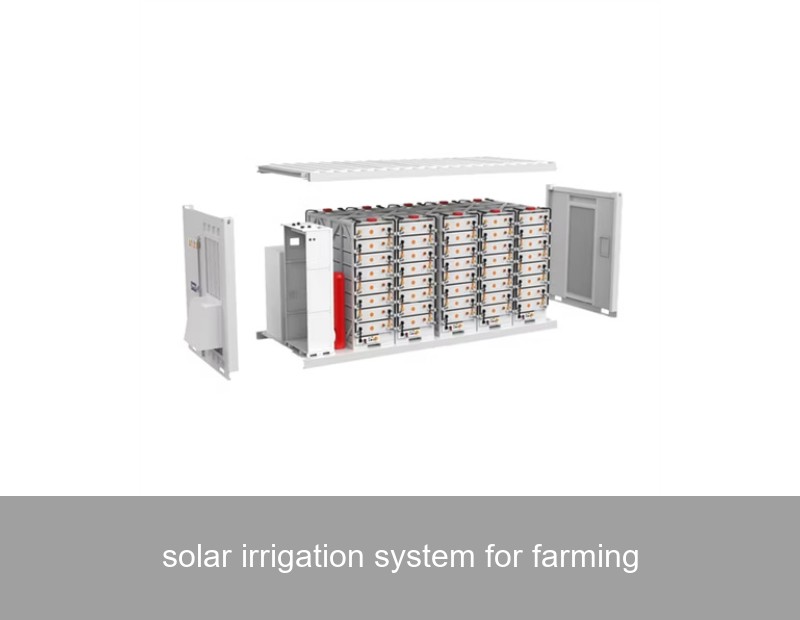
For such applications, Highjoule offers its HI-Stack Commercial & Industrial (C&I) battery systems. These modular lithium-ion phosphate (LFP) battery racks are known for their safety, long cycle life, and high efficiency. What makes them particularly suited for farming is their robust build and smart management system.
Imagine a system where the Highjoule BESS communicates seamlessly with your solar pump controller and weather forecast API. On a predicted sunny day, it might decide to fully irrigate using direct solar and charge the batteries. On a forecasted cloudy day, it would schedule lighter, battery-supported irrigation to conserve stored energy. This level of intelligent control maximizes every drop of water and every watt of energy.

Modern center-pivot irrigation systems are ideal candidates for solar and storage integration.
Highjoule's services extend beyond hardware. We provide feasibility analysis, system design support, and remote monitoring through our energy management platform. This ensures your solar irrigation investment is optimized from day one and performs reliably for decades.
The Future Farm: Intelligent, Integrated, and Independent
The integration of solar generation, smart storage, and even IoT soil moisture sensors is paving the way for the fully autonomous, sustainable farm. The solar irrigation system for farming is the cornerstone of this evolution. It decouples farmers from volatile energy markets and provides a hedge against climate uncertainty.
According to a report by the National Renewable Energy Laboratory (NREL), the technical potential for solar-powered irrigation in the U.S. alone is massive, capable of powering a significant portion of the nation's irrigated acreage. The key to unlocking this potential at scale is the combination of affordability and reliability—a combination made possible by the marriage of solar PV and advanced storage.
So, the question for forward-thinking farmers and agricultural cooperatives is no longer "Can solar power my irrigation?" but rather, "How can I design a solar and storage irrigation system that maximizes my crop yield, minimizes my operational risk, and secures my farm's sustainability for the next generation?"
What is the biggest energy challenge you face in your agricultural operation, and how could 24/7 reliable, clean power change your business model?
 Inquiry
 Online Chat