


Understanding Solar ESS Specifications: Your Guide to Smarter Energy Storage
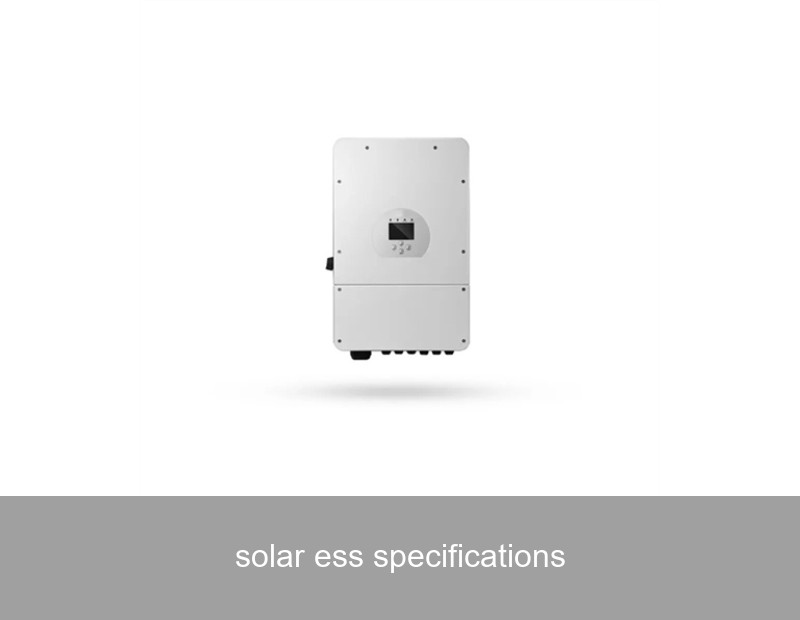
So, you've decided to harness the sun's power more effectively with a solar energy storage system (ESS). That's a brilliant move towards energy independence and sustainability. But as you start researching, you're likely met with a sea of technical jargon—battery capacity, depth of discharge, round-trip efficiency. It can feel overwhelming. Think of solar ESS specifications not as a confusing obstacle, but as your blueprint for success. Getting them right is the difference between a system that just sits there and one that actively slashes your bills, boosts your resilience, and maximizes your green impact. Let's decode these specs together and see how they translate into real-world performance for your home or business.
Table of Contents
The Core Solar ESS Specifications Explained
Let's break down the four fundamental specifications you'll encounter on every product datasheet. These are the non-negotiables for comparing systems.
1. Usable Capacity (kWh)
This is your system's "fuel tank." It tells you how much electricity the battery can actually store and deliver for your use. Crucially, it's different from the total or nominal capacity. Manufacturers often specify a Depth of Discharge (DoD)—the percentage of the battery that can be safely used without damaging it. A 10 kWh battery with a 90% DoD means you have 9 kWh of usable energy. At Highjoule, our H-Series Home ESS clearly states its 10.2 kWh or 16.8 kWh usable capacities upfront, with a 100% DoD, ensuring you get every kilowatt-hour you pay for.
2. Continuous & Peak Power (kW)
Capacity is about duration; power is about strength. Continuous power (e.g., 5 kW) is the steady load the system can handle—running your fridge, lights, and TV. Peak power (e.g., 7 kW for 10 seconds) is the surge needed to start heavy appliances like air conditioners or well pumps. If your peak power spec is too low, your lights might dim when the compressor kicks in.

Image: A modern, wall-mounted home energy storage system. Source: Unsplash
3. Round-Trip Efficiency (%)
This is a critical measure of economic performance. If you feed 10 kWh of solar energy into your battery, a system with 90% round-trip efficiency will give you back 9 kWh. The rest is lost as heat. A higher percentage means more of your self-generated solar power ends up powering your home, not warming your garage. Leading lithium-ion systems typically range from 90% to 95%.
4. Battery Chemistry & Warranty
The chemistry (LiFePO4, NMC) influences safety, lifespan, and performance. More telling than the chemistry alone is the warranty. Look for a guarantee on both years and throughput/cycles. A "10-year or 10,000-cycle warranty" promises the battery will retain a certain capacity (e.g., 70%) over that period. It’s the manufacturer's confidence in their product.
Beyond the Basics: Key Performance Indicators
Once you grasp the core specs, these advanced indicators reveal the true intelligence and durability of a system.
- Scalability: Can you easily add more battery modules later? A modular design protects your investment.
- Operating Temperature Range: Will the system throttle performance or shut down in extreme heat or cold? Robust systems have a wide range and effective thermal management.
- Grid Services & Software Intelligence: Can it participate in utility demand response programs? Does its software learn your patterns and optimize for time-of-use rates or backup readiness? This is where software creates real value.
From Specs to Savings: A Real-World Case Study
Let's translate these specifications into a tangible outcome. Consider a medium-sized commercial bakery in Bavaria, Germany, facing high evening electricity costs and grid instability.
The Challenge: Reduce peak demand charges, ensure uninterrupted operation during brief grid outages, and utilize their existing rooftop solar more effectively.
The Solution & Specs in Action: A Highjoule C-Series Commercial ESS was installed with:
- Usable Capacity: 120 kWh – Enough to shift the baking load through the evening peak.
- Continuous Power: 50 kW – Capable of running all critical mixing and refrigeration equipment simultaneously.
- Advanced Software: Configured for peak shaving and backup priority.
The Data-Driven Result: Within the first year, the bakery achieved a 22% reduction in overall energy costs, primarily by slashing demand charges. The system also provided seamless backup during three short grid interruptions, preventing spoilage of in-process goods. The project's ROI was calculated at just under 5 years, a compelling figure for any business. You can explore more on the importance of storage for grid stability from the U.S. Department of Energy.

Image: Containerized battery storage for commercial/utility applications. Source: Unsplash
Matching Specifications to Your Energy Needs
How do you apply this knowledge? Start by auditing your energy goals.
| Primary Goal | Key Specifications to Prioritize | Highjoule Product Example |
|---|---|---|
| Maximize Self-Consumption of Solar | High Round-Trip Efficiency, Smart Energy Management Software | H-Series with Highjoule EnergyOS™ |
| Whole-Home Backup for Outages | High Usable Capacity, High Continuous & Peak Power | H-Series Pro with integrated backup gateway |
| Commercial Cost Management (Peak Shaving) | High Cycle Life Warranty, Very High Power Rating, Scalability | Modular C-Series or I-Series for Industrial |
For deeper insights into residential energy patterns, resources like the National Renewable Energy Lab (NREL) provide valuable data.
The Highjoule Approach: Engineered for Real Life
Since 2005, Highjoule's philosophy has been that superior specifications must serve a tangible purpose: resilience, savings, and sustainability. Our systems are designed with these principles:
- Specification Integrity: We publish conservative, real-world performance data. Our LiFePO4 batteries offer exceptional cycle life and thermal stability, backed by a straightforward warranty.
- Intelligence by Design: Our EnergyOS™ platform doesn't just report data; it automates optimization. It learns, forecasts solar production, and manages energy flow based on weather, tariffs, and your habits.
- Scalability for the Future: Whether it's our residential H-Series or our containerized Megapack solutions for microgrids, every system is built to grow with your needs. You can start with what you need today and expand confidently tomorrow.
We don't just sell boxes with impressive numbers; we provide integrated power solutions where hardware, software, and service converge to deliver on a promise. Learn how different technologies compare from independent analysts at Greentech Media.
Your Next Step
Now that you can read a solar ESS datasheet with a critical eye, what does your ideal energy day look like? Is it waking up to a battery charged by yesterday's sun, knowing your morning coffee is powered for free? Or is it the confidence that your business operations are immune to the next grid fluctuation? The right specifications make that vision a reliable, daily reality.
What's the one energy worry you wish a battery system could simply make disappear?
 Inquiry
 Online Chat