


Unlocking Grid Stability: The Role of the 7.5 MW Solar Energy Storage Cabinet
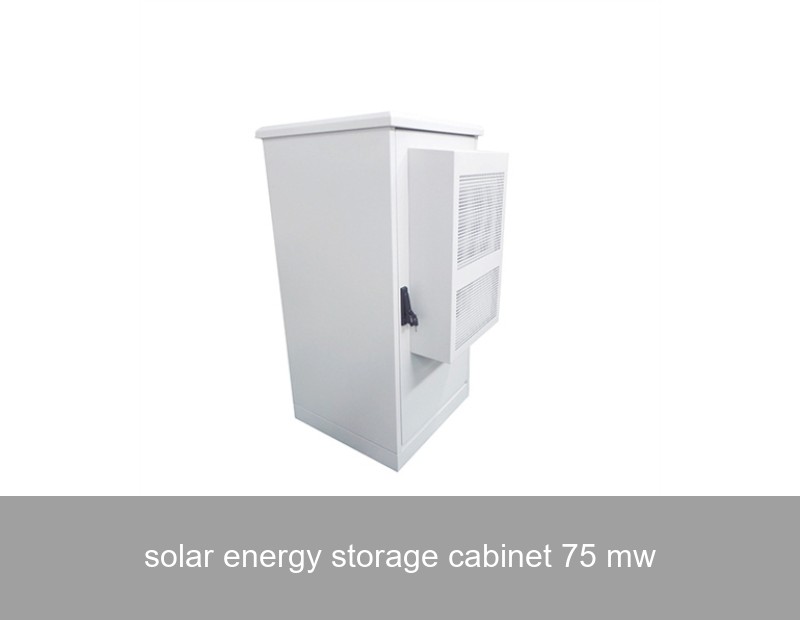
Imagine a cloudy day across your industrial park. Your solar panels dip in production, but your factory lines can't afford to slow down. Or picture a community microgrid that needs to store the midday sun's abundance for the evening peak. This is the critical challenge of modern renewable integration, and the answer is increasingly found in large-scale, containerized solutions. Enter the solar energy storage cabinet, particularly in the utility-scale range of 7.5 MW. This isn't just a big battery; it's a sophisticated power plant component, engineered to transform solar from an intermittent resource into a firm, dispatchable one. At Highjoule, a global leader in advanced energy storage since 2005, we design these intelligent systems to be the backbone of a sustainable and resilient energy future for commercial, industrial, and utility applications.
Table of Contents
- What is a 7.5 MW Solar Energy Storage Cabinet?
- Why 7.5 MW? The Sweet Spot for Grid-Scale Impact
- Core Technology Inside a Highjoule Energy Storage Cabinet
- Real-World Impact: A Case Study from California
- The Highjoule Advantage: Intelligence Meets Durability
- Future Trends and Your Next Step
What is a 7.5 MW Solar Energy Storage Cabinet?
Let's break down the term. A solar energy storage cabinet in this context is a pre-engineered, containerized battery energy storage system (BESS). The "7.5 MW" denotes its power rating—it can deliver 7.5 megawatts of electricity instantaneously, equivalent to powering thousands of homes at once. Typically paired with a capacity (MWh) that allows it to discharge for 2-4 hours, this system acts as a massive reservoir for solar energy.
Think of it this way: the solar farm is the factory producing energy, and the 7.5 MW storage cabinet is the high-throughput warehouse and distribution center. It doesn't just sit there; it actively manages energy flow based on grid signals, weather forecasts, and economic algorithms. For developers and asset owners, this means turning captured sunlight into a reliable, 24/7 commodity.

Image Source: Unsplash (Representative image of containerized energy storage)
Why 7.5 MW? The Sweet Spot for Grid-Scale Impact
You might wonder about the specific size. In the evolving markets of Europe and the United States, the 7.5 MW scale has emerged as a strategic benchmark. Here’s why:
- Grid Services Optimization: Many grid operators have service requirements (like Frequency Regulation or Peak Capacity) where 5-10 MW blocks are ideal for bidding and participation. A 7.5 MW system fits perfectly into these market structures.
- Modular Scalability: It's a substantial building block. Projects can start with a single 7.5 MW unit and scale by adding identical cabinets, simplifying design, permitting, and financing.
- Economic Efficiency: This scale balances the "soft costs" (engineering, grid interconnection studies) with the "hardware costs," achieving a favorable levelized cost of storage (LCOS).
For a commercial solar farm of 30-50 MW, integrating one or more 7.5 MW storage cabinets can drastically increase its value, allowing it to shift energy to high-price periods and provide essential stability services to the local grid.
Core Technology Inside a Highjoule Energy Storage Cabinet
Not all cabinets are created equal. A Highjoule 7.5 MW system is an ecosystem of advanced components working in harmony:
| Component | Function | Highjoule's Approach |
|---|---|---|
| Battery Cells | The core energy storage medium, typically Lithium-Ion. | We source tier-1, UL-certified cells with rigorous lifecycle testing, optimizing for longevity and safety. |
| Battery Management System (BMS) | Monitors cell voltage, temperature, and health. | Our proprietary BMS ensures each cell operates within its ideal window, preventing premature degradation. |
| Power Conversion System (PCS) | Converts DC battery power to AC grid power and vice versa. | We integrate high-efficiency (>98.5%) bi-directional inverters for minimal energy loss during conversion. |
| Thermal Management | Controls the cabinet's internal temperature. | An independent, liquid-cooling climate system maintains optimal temperature year-round, crucial for performance in diverse climates from Scandinavia to Texas. |
| Energy Management System (EMS) | The "brain" that controls charge/discharge cycles. | Highjoule's AI-driven EMS uses weather and market data to autonomously maximize revenue or savings. |
Real-World Impact: A Case Study from California
Let's move from theory to practice. California's CAISO grid is a frontrunner in renewable integration, facing the famous "duck curve" of steep evening ramps. A developer partnered with Highjoule to co-locate a 7.5 MW / 30 MWh energy storage cabinet with a 20 MW solar farm in the Central Valley.
The Challenge: The solar farm was experiencing significant curtailment (wasted energy) during midday oversupply and couldn't participate in the lucrative evening peak market.
The Highjoule Solution: A single, turnkey Highjoule H-Cube 7500 cabinet was deployed. Our EMS was programmed with a dual objective: capture curtailed solar and arbitrage energy prices.
The Data-Driven Result: In the first year of operation:
- 95%+ Solar Utilization: Curtailment was virtually eliminated, storing otherwise lost energy.
- Revenue Streams: The system generated revenue through daily energy arbitrage and by providing grid frequency regulation services.
- Reliability: During a localized grid disturbance, the cabinet's fast-ramping capability (0 to 7.5 MW in milliseconds) provided critical support, preventing potential outages.
This project exemplifies how a precisely sized 7.5 MW asset can transform the economics and grid value of a solar installation.

Image Source: Unsplash (Representative image of energy storage system maintenance)
The Highjoule Advantage: Intelligence Meets Durability
With nearly two decades of experience, Highjoule builds more than just hardware; we deliver a guaranteed performance outcome. Our 7.5 MW solar energy storage cabinet is part of our GridMaster Pro series, designed for utility and large C&I applications.
- Proactive Safety Architecture: Beyond standard certifications, our multi-layer protection includes gas and fire suppression, seismic reinforcement, and 24/7 remote monitoring from our Global Operations Center.
- Adaptive EMS Software: The system learns and adapts. It integrates weather forecasts from sources like the European Centre for Medium-Range Weather Forecasts (ECMWF) to predict solar yield and optimize cycles.
- Global Service & Warranty: We offer comprehensive performance warranties and have local service teams in key European and North American markets, ensuring peace of mind for the 15+ year lifespan of the asset.
For a business or community considering such an investment, the choice of partner is as crucial as the technology. Highjoule provides the full stack—engineering, installation, grid compliance support, and long-term performance management.
Future Trends and Your Next Step
The landscape is moving towards even smarter, more integrated grids. The next evolution for 7.5 MW cabinets is their role in forming virtual power plants (VPPs), where hundreds of distributed assets are aggregated to act as a single, large power plant. Highjoule's systems are already VPP-ready, with the communication protocols and control logic built-in.
So, whether you're an independent power producer looking to hedge merchant risk, a large industrial facility aiming for energy independence, or a municipality building a resilient microgrid, the question is no longer *if* storage is needed, but *how* to implement it most effectively.
What specific challenge is your solar project or energy portfolio facing—is it curtailment, demand charge management, or providing grid services? How could a precisely engineered 7.5 MW energy storage cabinet become the cornerstone of your solution?
 Inquiry
 Online Chat