


How Much Does It Cost to Scale a Microgrid? A Realistic Breakdown
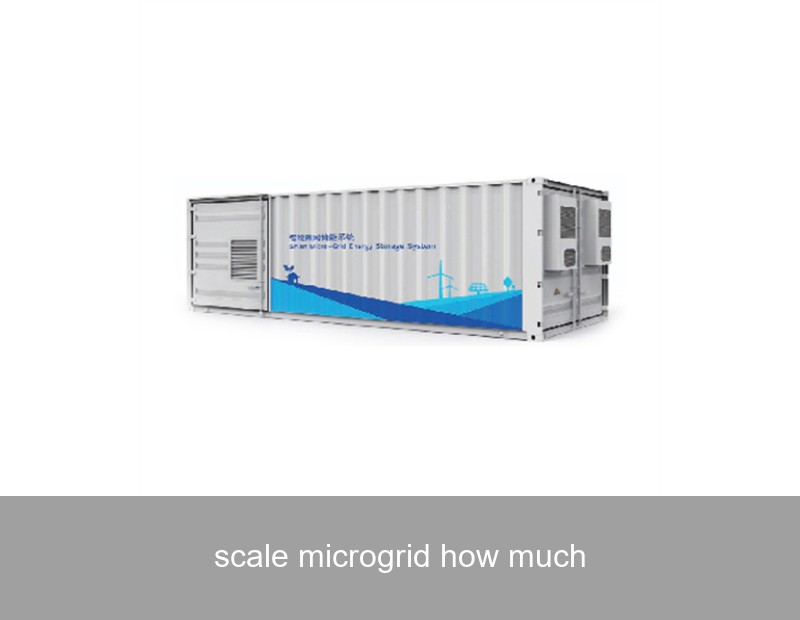
You've decided to explore a microgrid. Perhaps your community faces unreliable power, your business is hit by volatile energy prices, or your industrial facility needs unwavering resilience. The initial concept is clear, but then the big question hits: how much does it cost to scale a microgrid from a pilot idea to a fully operational, robust system? The answer isn't a single number, but a journey. Scaling a microgrid is about strategically matching its size and capabilities to your specific energy independence and financial goals. Let's demystify the costs and components involved in scaling this transformative technology.
Table of Contents
The Phenomenon: Why Scale Matters in Microgrids
Think of a microgrid not just as a backup generator, but as a miniature, intelligent utility. The "scale" directly dictates what it can do. A small-scale system might keep critical lights on. A scaled-up microgrid can power an entire factory, manage complex energy trading, and integrate large renewable assets. The phenomenon we see globally is that the most successful projects are those planned with future scalability in mind from day one. This foresight avoids costly retrofits and ensures your investment grows in value as your needs evolve.
Key Cost Drivers in Scaling a Microgrid
Scaling costs aren't linear. Doubling the power capacity doesn't simply double the price. Here are the core components where costs accrue:
- Generation Assets: Solar PV arrays, wind turbines, or combined heat and power (CHP) units. This is often the most capital-intensive part. Cost scales with capacity (kW, MW) but benefits from economies of scale.
- Energy Storage System (ESS): The heart of modern scalability. Battery storage capacity (kWh) determines how long you can ride through an outage or shift solar energy for nighttime use. As you scale duration, battery costs rise significantly.
- Control & Software: The "brain." A simple controller manages a few assets. Scaling requires advanced microgrid energy management systems (MG-EMS) that can optimize dispatch, forecast, and even participate in grid markets. This software intelligence is crucial for ROI.
- Grid Interconnection & Hardware: Switchgear, transformers, and protective relays. These costs can jump at certain thresholds (e.g., moving from low-voltage to medium-voltage interconnection).
- Installation & Soft Costs: Engineering, permitting, and construction labor. These can vary wildly by region and project complexity.

Image: Scaling a microgrid requires careful planning of physical and digital infrastructure. Source: Unsplash
The Highjoule Advantage: Scalability Designed-In
At Highjoule, we engineer our H-Series battery energy storage systems and Orion MG-EMS platform with modularity at their core. This means you can start with a precise configuration and add battery racks or generation assets later with minimal disruption. Our systems are designed to meet both UL and IEC standards, ensuring safe, compliant scaling for global markets.
From Data to Reality: A Scaling Cost Framework
Let's move from concepts to tangible figures. While every project is unique, industry data provides a framework. According to the U.S. Department of Energy's National Renewable Energy Laboratory (NREL), installed costs for commercial and industrial microgrids can range from $2,000 to $6,000 per kilowatt (kW) of capacity, with complex systems exceeding this. The final number hinges on your scale priorities:
| Scale Focus | Primary Cost Driver | Typical Cost Impact | Goal Achieved |
|---|---|---|---|
| Scaling Power (kW) | Larger generation & power conversion | High initial capital | Power more loads simultaneously |
| Scaling Energy (kWh) | Battery storage capacity & duration | Significant, but decreasing | Longer backup, greater energy shifting |
| Scaling Intelligence | Advanced software & controls | Moderate, high ROI | Optimized economics, grid services |
For example, scaling from a 4-hour to a 6-hour battery duration increases the energy (kWh) component by 50%, but not necessarily the power (kW) component or the balance-of-system costs. This nuance is where detailed modeling is essential.
Case Study: Scaling for Industrial Resilience in Germany
Let's examine a real-world scaling decision. A German automotive parts manufacturer with a 2 MW load initially wanted basic backup for critical processes (estimated at 500 kW). A traditional generator solution was quoted at a lower upfront cost.
However, after a Highjoule feasibility analysis, the client saw the value in scaling to a full 1.5 MW solar-integrated microgrid with a 3 MWh battery storage system. The scaled-up project included:
- Highjoule H3 Battery Systems: Modular lithium-ion units, allowing for phased installation.
- Orion MG-EMS: To autonomously optimize self-consumption of solar, schedule peak shaving, and prepare for grid-balancing programs.
- Scalable grid-forming inverters for seamless islanding.
The Data & Outcome: The total project cost was €4.2 million. But the scaled system delivers:
- €280,000 annual savings from peak shaving and solar self-consumption.
- Full facility resilience for over 5 hours, protecting a €45,000/hour production line.
- Potential future revenue from grid frequency regulation.

Image: Industrial microgrids integrate large-scale renewables and storage. Source: Unsplash
How Highjoule Enables Scalable, Cost-Effective Microgrids
As a global provider since 2005, Highjoule's expertise lies in building scalability into the DNA of our solutions. We don't just sell components; we deliver a scalable energy independence roadmap.
- Modular Product Architecture: Our containerized and rack-mounted BESS solutions can be incrementally expanded in the field. You invest in what you need today, with a clear path for tomorrow.
- Software-Defined Control: The Orion MG-EMS is a platform that gains value as you scale. Its algorithms manage complexity, whether you have three assets or thirty, maximizing financial returns at every stage.
- Lifecycle Partnership: We provide ongoing performance monitoring and advisory services. As energy markets or your facilities change, we help you model the financial impact of scaling further, ensuring your microgrid remains an optimal asset.
For a municipal microgrid in California or a residential community in Spain, the principle is the same: start with a solid, scalable foundation.
What's Your First Step Towards a Scaled Solution?
The journey to answering "how much does it cost to scale a microgrid" begins not with a quote, but with a conversation about your unique objectives. What is the single most critical load you must protect? What are your sustainability targets? How do you see your energy needs changing in five years?
We invite you to share your current energy challenge. What's the one factor—be it resilience, cost predictability, or carbon reduction—that is pushing you to consider a scaled microgrid solution today?
 Inquiry
 Online Chat