


Powering the Future: A Practical Guide to Successful Renewable Energy Sources Projects
So, you’re ready to embrace a cleaner future and invest in renewable energy sources projects. Whether you're a business owner, a community leader, or managing a large industrial site, the vision is clear: reduce your carbon footprint, gain energy independence, and stabilize long-term costs. But between that vision and reality lies a critical, often underestimated, component: effective energy storage. The sun doesn't always shine, and the wind doesn't always blow. This intermittency is the fundamental challenge that can make or break the success of your renewable project. This article will guide you through the essential considerations, backed by data and real-world examples, to ensure your project delivers on its full promise.
Table of Contents
- The Intermittency Challenge: More Than Just a Cloudy Day
- Data Beyond Generation: The Grid's New Demands
- Case Study: A Community's Leap to Resilience
- The Battery Energy Storage System (BESS): Your Project's Keystone
- How Highjoule Integrates for Seamless Project Success
The Intermittency Challenge: More Than Just a Cloudy Day
Let's start with the obvious phenomenon. A solar farm's output plummets at night or during storms. A wind turbine sits idle on calm days. This isn't news. But the real impact goes deeper than just a temporary drop in power. Without a buffer, this variability forces the traditional grid—or your onsite diesel generators—to ramp up and down rapidly to fill the gaps. This "grid balancing" act is inefficient, expensive, and ironically, can sometimes rely on fossil fuels, offsetting the environmental benefits of your renewables. The problem isn't the renewable source itself; it's the lack of a reliable way to time-shift the energy it produces.
Data Beyond Generation: The Grid's New Demands
The numbers paint a compelling picture. According to the International Energy Agency (IEA), renewables are set to contribute 80% of new power capacity to 2030 under current policies. However, the U.S. Energy Information Administration highlights that the capacity factor—the actual output vs. maximum possible output—for solar PV is around 24%, and for wind, about 35%. This means the infrastructure is underutilized without storage. Furthermore, modern commercial and industrial facilities don't just need power; they need high-quality, stable power to protect sensitive equipment, and they need to manage demand charges, which can constitute up to 50% of a commercial electricity bill. A renewable project without storage addresses only the energy charge, leaving a major cost driver untouched.
| Project Metric | Renewables Only | Renewables + Storage |
|---|---|---|
| Energy Self-Consumption | ~30-40% (direct use) | >80% |
| Grid Demand Charge Reduction | Minimal | Up to 90% |
| Backup Power Availability | None during source downtime | Seamless, instantaneous |
| ROI Timeline | Longer (dependent on tariffs) | Shortened (multiple revenue/cost streams) |
Case Study: A Community's Leap to Resilience in Northern California
Consider the real-world example of the Blue Lake Rancheria microgrid in Humboldt County, California. This tribal community, prone to Public Safety Power Shutoffs (PSPS) due to wildfire risks, embarked on a comprehensive renewable energy sources project. Their system integrates 430 kW of solar PV with a 500 kW / 950 kWh battery storage system. The results are telling:
- Resilience: The microgrid can island itself from the main grid and power critical facilities (a clinic, government offices, emergency shelter) for up to three weeks during an outage.
- Economic: They save approximately $200,000 annually on electricity costs.
- Environmental: The project reduces greenhouse gas emissions by about 157,000 kg CO2 per year.
This case underscores a vital insight: the most successful projects treat storage not as an add-on, but as the central nervous system that unlocks resilience, economic, and environmental goals simultaneously. (Source: NREL Case Study).

Image Source: Unsplash - A visual representation of a combined solar and battery storage project.
The Battery Energy Storage System (BESS): Your Project's Keystone
This is where the technology magic happens. A modern BESS is far more than just a battery in a box. It's an intelligent system comprising:
- Battery Cells (Li-ion, LFP): Lithium Iron Phosphate (LFP) chemistry is now the preferred choice for most stationary storage due to its longer lifespan, superior safety, and stability.
- Power Conversion System (PCS): The brain that manages AC/DC conversion, determining how fast and in which direction energy flows.
- Energy Management System (EMS): The master strategist. It uses software and algorithms to decide when to store, when to discharge, and how to optimize for your specific goals—be it peak shaving, frequency regulation, or backup.
Choosing the right BESS partner is crucial. You need a provider with proven technology, deep system integration expertise, and a focus on safety and longevity. This is precisely where a company like Highjoule, with nearly two decades of specialization, becomes an invaluable partner.
How Highjoule Integrates for Seamless Project Success
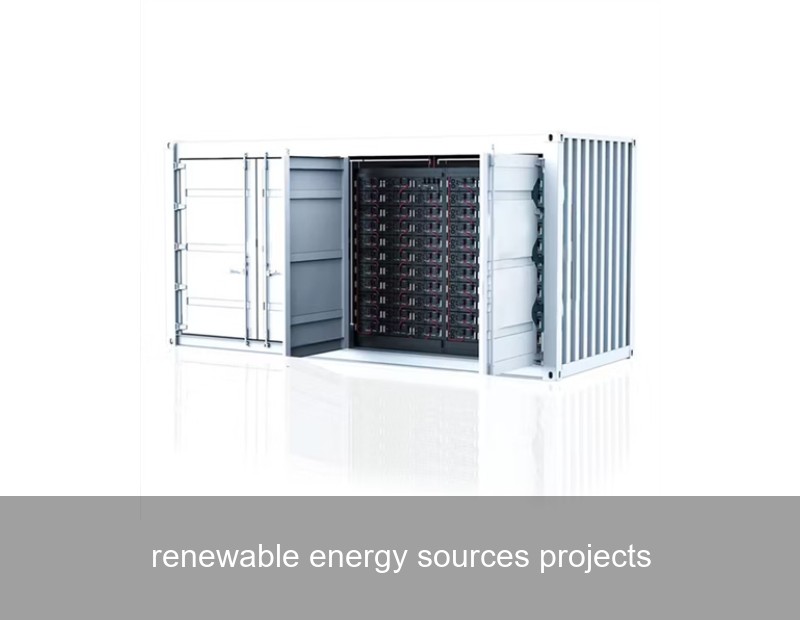
At Highjoule, founded in 2005, we view ourselves not just as equipment suppliers, but as enablers of energy independence. Our role in your renewable energy sources project is to provide the intelligent, reliable backbone that ensures your investment pays off. Our flagship product, the H-Joule Cube, is a containerized, all-in-one BESS solution designed for commercial, industrial, and microgrid applications.
What makes the H-Joule Cube particularly effective for renewable integration?
- Ultra-Safe LFP Technology: Engineered with multi-layer protection for peace of mind.
- Scalable Design: From 250 kWh to multi-MWh configurations, you can start small and expand as your needs grow.
- Advanced EMS with AI Forecasting: Our system doesn't just react; it predicts. By integrating weather forecasts and load patterns, it optimizes charge/discharge cycles to maximize self-consumption of solar/wind power and minimize grid dependence.
- Grid Services Ready: For larger projects, the system can be configured to provide ancillary services to the grid (like frequency response), creating an additional revenue stream to improve project economics.
Our team works alongside your developers and EPC contractors from the design phase, ensuring the storage system is perfectly harmonized with your solar PV or wind assets, creating a single, high-performance ecosystem.

Image Source: Unsplash - Professional management of a modern energy storage control system.
What's the First Question You Should Ask Your Project Developer?
As you move forward with planning your renewable energy initiative, the conversation needs to evolve from "how many solar panels?" to "how do we ensure this energy is available and valuable 24/7?" The integration of storage is no longer a luxury; it's a hallmark of a well-designed, resilient, and economically sound project. It transforms a variable source into a firm, dispatchable asset.
So, we leave you with this open question to pose at your next project meeting: "Beyond the initial generation capacity, how is our project design specifically addressing energy shifting, demand charge management, and providing guaranteed backup power to ensure our operational and financial resilience?" The answer will guide you toward a truly future-proof solution.
 Inquiry
 Online Chat