


Understanding the True Price for Solar Panels and Battery Storage in 2024
If you're considering renewable energy for your home or business, you've likely asked the central question: what is the real price for solar panels and battery storage? It's a smart starting point, but the answer is more nuanced than a simple quote. The upfront cost is just one piece of the puzzle. The true value lies in understanding the long-term investment—a system that reduces your energy bills, increases your independence, and provides resilience for decades. As a global leader in advanced energy storage since 2005, Highjoule is here to demystify the costs and showcase how the right technology partnership transforms a purchase into a strategic asset.
Table of Contents
Breaking Down the Components: Solar Panels vs. Battery Storage
Let's separate the two main technologies. The price for solar panels primarily covers the photovoltaic (PV) modules, inverters, mounting hardware, and installation labor. According to market data, average installed costs for residential solar in the U.S. can range from $2.50 to $3.50 per watt, meaning a typical 6-kW system might fall between $15,000 and $21,000 before incentives.
The price for a battery system is a separate and crucial addition. Battery storage allows you to capture excess solar energy for use at night or during outages. Costs here are often quoted as a price per kilowatt-hour (kWh) of usable capacity. You might see figures from $700 to $1,300 per kWh installed, depending heavily on the battery's chemistry, features, and brand.
Think of it this way: solar panels are your energy generators, while the battery is your energy bank. One maximizes production; the other maximizes utilization and control.

Image: A modern home solar and battery storage installation. The battery unit (on the wall) stores excess solar energy for later use.
Key Factors Influencing Your System's Price Tag
Why such a broad range? Several variables directly impact your final quote:
- System Size & Energy Needs: A larger home or higher energy consumption requires more panels and a larger battery capacity.
- Equipment Quality & Technology: High-efficiency panels and batteries with longer lifespans (like Lithium Iron Phosphate, or LFP) may cost more upfront but offer better long-term value.
- Installation Complexity: Roof type, angle, and accessibility affect labor costs.
- Local Incentives & Regulations: This is huge. In the U.S., the federal Investment Tax Credit (ITC) can reduce your system cost by 30%. Many European countries and individual states offer additional rebates and performance payments.
- Grid Electricity Rates: In areas with high and volatile utility rates (like parts of California or Germany), the payback period for solar and storage is significantly faster.
A Snapshot of Incentives (2024)
| Region | Incentive Program | Potential Impact on Net Cost |
|---|---|---|
| United States | Federal Investment Tax Credit (ITC) | 30% tax credit on system cost (including storage) |
| Germany | EEG (Renewable Energy Sources Act) & KfW loans | VAT exemption on solar installations, low-interest loans |
| United Kingdom | Smart Export Guarantee (SEG) | Payment for excess energy exported to the grid |
| California, USA | SGIP (Self-Generation Incentive Program) | Substantial rebates for battery storage, especially for high-fire-risk areas |
A Real-World Case Study: ROI in Action
Let's move from theory to practice. Consider a medium-sized manufacturing facility in Bavaria, Germany, facing high industrial electricity rates and seeking to stabilize operational costs.
- Challenge: Erratic energy prices and a desire to utilize on-site space for sustainability goals.
- Solution: A 250 kW rooftop solar PV system coupled with a 500 kWh containerized battery energy storage system (BESS).
- Financials: The total project price was significant. However, by leveraging German commercial incentives and KfW funding, the net investment was reduced by over 35%. The system now covers 40% of the facility's daytime load and allows for peak shaving—avoiding expensive grid power during high-demand periods.
- Result: The projected payback period is under 7 years. For the remaining 18+ years of the system's life, the majority of the energy produced is virtually free, locking in long-term cost certainty. This case illustrates that the price for solar panels and battery is better evaluated as a cost of energy over 25 years rather than a one-time expense. You can explore more on commercial energy storage trends from the U.S. Department of Energy.
Looking Beyond the Price: Quality and Intelligence Matter
Choosing the lowest quote can be tempting, but it risks long-term performance. The market is filled with varying qualities of components. A cheap battery might have a shorter cycle life, lower depth of discharge, or lack sophisticated energy management software. This means it might need replacing years earlier than a premium product, negating any initial savings.
The true differentiator in modern systems is intelligence. Can your system forecast weather and consumption patterns? Can it automatically decide when to store, use, or sell energy to maximize economic return? This smart management is where the real savings are unlocked, turning a passive system into an active energy asset.
Highjoule's Smart Solutions: Engineered for Value
This is where Highjoule's nearly two decades of expertise power your investment. We don't just sell components; we deliver integrated, intelligent energy solutions. For residential and commercial clients across Europe and the U.S., our systems are designed to optimize every dollar or euro spent.
Our H-Joule HomePower series features LFP battery technology, renowned for its safety and longevity (over 6,000 cycles). Paired with our AI-driven EnergyOS platform, it learns your habits and local utility rates to autonomously optimize energy flow. Imagine your system charging from solar or the grid when rates are low, and powering your home when rates are high—all without you lifting a finger.
For commercial and industrial applications, our H-Joule GridMax containerized BESS solutions provide scale, resilience, and revenue stacking capabilities. They help businesses manage demand charges, participate in grid services, and ensure critical operations during outages. We work with you to model financial outcomes, ensuring the price for solar panels and battery storage aligns with a clear, attractive return on investment. For independent data on battery performance, resources like NREL's benchmark studies are invaluable.

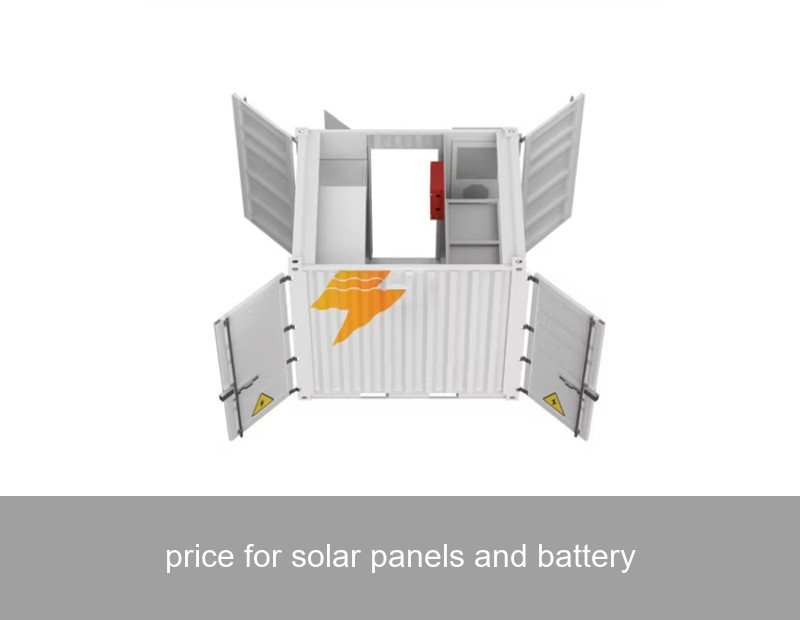
Image: Inside a modern containerized battery energy storage system, showcasing the scale and technology for commercial applications.
Making the Decision: Your Next Steps
So, how should you approach evaluating the price for solar panels and battery storage? Start by looking at your last 12 months of electricity bills to understand your usage patterns. Then, seek a qualified provider who offers a detailed energy assessment and financial modeling, not just a equipment quote.
Ask potential providers: How does your system's software maximize my savings? What is the expected degradation and warranty on the battery? Can you provide a detailed projection of my energy independence and bill savings over 10, 15, and 20 years?
The energy landscape is shifting from a simple utility bill to a managed home or business asset. With the right partner, your energy system becomes a source of savings, security, and sustainability. What specific energy challenge—be it rising bills, frequent outages, or sustainability targets—is motivating you to look into solar and storage today?
 Inquiry
 Online Chat